
PHOTO
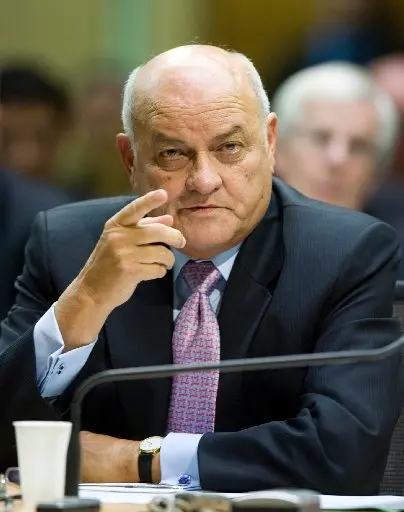
Unlike other Kiwi billionaires, we think we know Owen Glenn. He's famous for his philanthropy and for those political donations that sparked a scandal that, some would say, brought down Winston Peters.
But we don't really know much about Mr Glenn the businessman.
Perhaps that's because he made his money in the unglamorous industry of freight and logistics.
But then, Graeme Hart lives and breathes cardboard and we lap up every snippet of his progress.
And it is odd because, unlike Hart, Mr Glenn is not shy.
Ask him to explain what the logistics industry is and he'll tell you how he invented it. Actually, he'll tell you how someone once credited him with inventing it, which is a clever way of saying the same thing without sounding too brash.
Either way, it doesn't matter; the story he tells to support the claim is remarkable.
Mr Glenn clearly played an important role in the birth of the modern freight and logistics industry.
The year was 1971 and Mr Glenn was working for a London firm dealing with a group of pioneering US computer companies that needed to get their circuit boards to Asia.
''I got the idea of flying a cargo freighter - and in those days there were only about four in the world. So we chartered it and filled it up with equipment from about eight companies and flew it to Singapore ... and we flew it back.
That was how we did it and I thought of that.''
It was a great idea but it didn't make him a billion dollars.
Later that decade he was back in Australia, unemployed and unable to get a mortgage. He went into business for himself.
Now, what a business it is.
OTS Logistics Group - of which he is founder, owner and executive chairman - has 3000 staff, 177 offices in 105 countries and turnover of more than $1 billion.
And, he says, it's booming.
He drops details of four major deals he's just done.
He has partnered with a Belgian company to set up operations in Kazakhstan and done a ground-breaking rail deal to cut out the middle men at the border and send freight from the US straight into Mexico.
Then there's the IT launch that will equip his customers with hand-held devices to book and track orders in real time anywhere in the world.
And the biggest of all - he has just signed a contract with bulldozer giant Caterpillar.
''It's the biggest single account we've ever got. It will add a third to my business,'' he says.
Mr Glenn says his business returns ebitda of 5% on its annual revenue. Ebitda stands for earnings before interest, tax, depreciation and amortisation. But depreciation and amortisation only cost you if you have a lot of assets, which Mr Glenn's companies don't.
That's the beauty of logistics, he says. You shift the freight but you don't have to own the ships.
''Anybody can put it on a truck; logistics is knowing where it has gone. It's the management of freight.''
And then there is interest.
That's easy, Mr Glenn says; he doesn't have any.
''We've always self-financed. We've always developed out of our own profits; we don't leverage up. The difference is that when you come into hard times, you're not beholden to banks or financing assets. You just tighten your belt ... as long as you protect your margins.''
Which is, he says, why the global financial crisis was not a game changer for his company.
Volumes fell and revenue dropped 20%, but without debt and major assets, he was able to shrink the business rapidly.
And now he's expanding again.
''The volume just switched off so we had to let people go.''
The company pulled back on all expansion plans except IT and rationalised jobs.
''We had to displace people. What I did do was accelerate a programme that we had started in China about five years ago. We have about 180 people there and it's going to grow to 240. These people work 24/7 and do all the back-room work ... The average pay is $5000.
"If you employ those same people in the western world you have to pay $50,000 a year. So we save $45,000 a year ... we also opened up in Chennai, in India."
Mr Glenn lives his life like an adventurer, perhaps because of a difficult childhood.
He was born in Calcutta and sent to a Catholic boarding school in the Darjeeling region.
His experiences at the school were so grim they are not for publication, he says.
The nuns ''were frustrated old bitches. You can print that''.
After the partition of India, the family moved to New Zealand, when Mr Glenn was 11. Surprisingly, given his lifelong passion for this country, New Zealand was not a land of opportunity for him. His big breaks would come later in Australia and the UK.
He left school at 15 and, like many Kiwis, worked a while and then headed for London on his big OE.
That was a traditional experience, too.
''I worked as butcher, plumber, [at] a fruit-packing plant ... I drove a lift in Harrods and, in a way, going and looking for jobs and applying and coping was character building.''
When he got back, he took a job with Teal - now Air New Zealand - because he wanted to keep travelling.
Instead, he got stuck in the freight department. Rather than be frustrated by that, he says, he decided to learn the business.
He is based in Monaco but he is not there much. He says he's generally at large on his super-yacht and also spends a lot of time in America, where the OTS head office is.
His philanthropic work regularly takes him to Asia and the Pacific.
Mr Glenn doesn't want to talk about political scandal, but can't resist a political jibe.
He owns a winning racehorse called Monaco Consul - after the diplomatic position he was offered by Winston Peters.
''I only named the horse that to annoy him,'' he says. ''And when he won, I thought, 'Thank you, Lord.''