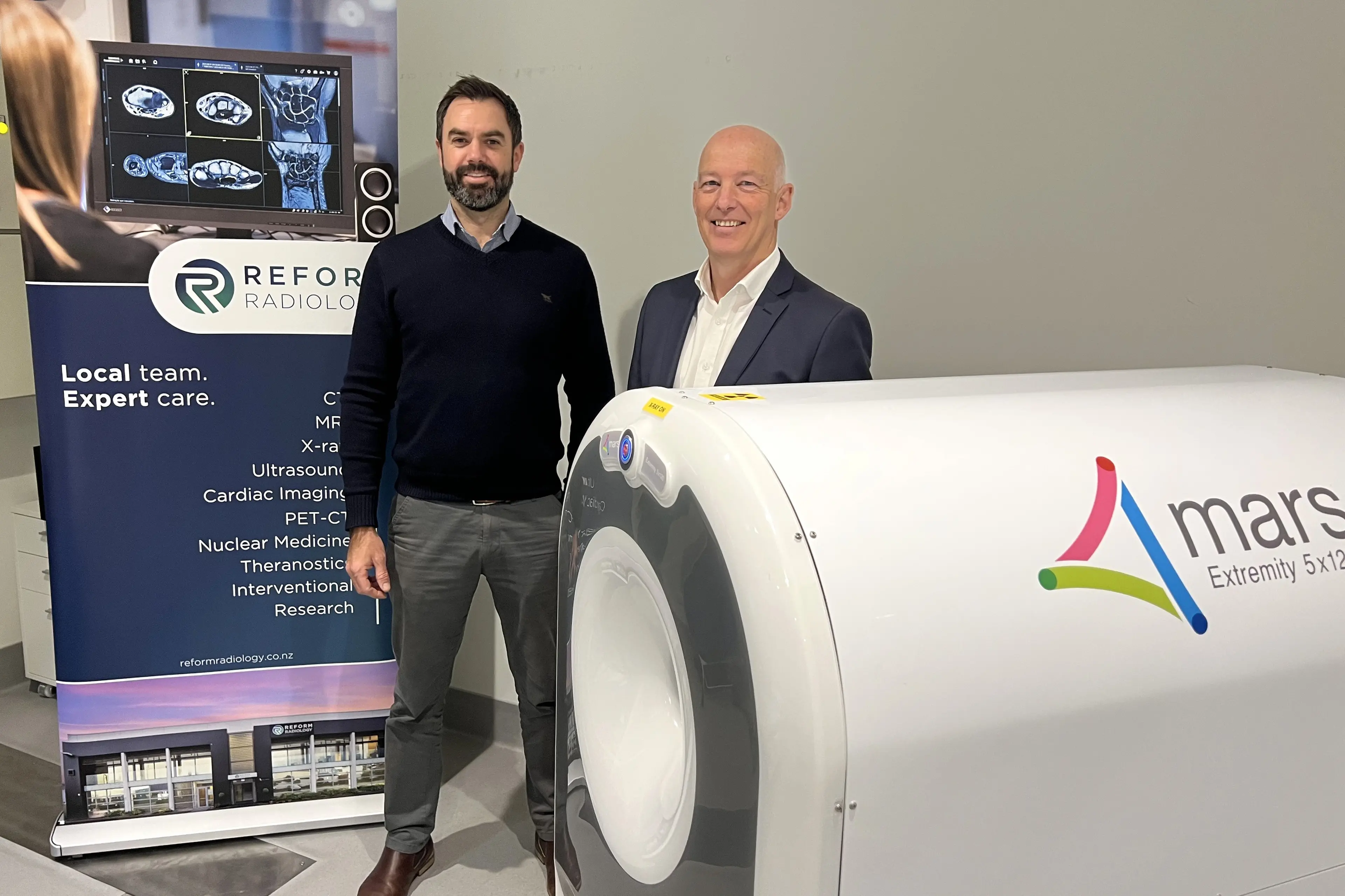
Christchurch medical tech company MARS Bioimaging is off the mark with the first sale of its portable photon-counting computed tomography (CT) scanner to a medical clinic. The sale to Reform Radiology, also based in the city, is a commercial turning point for the company after United States Food and Drug Administration clearance earlier this year. Non-clinical scanners were already being sold to hospitals, universities, bio-engineering companies and laboratories in the US, United Arab Emirates, Canada, China, Hong Kong and New Zealand. But this is the first sale of its scanner to a site directly caring for patients with plans to roll this out globally to medical centres and other clinics. Spectral molecular imaging scanners produce high resolution, three-dimensional colour X-rays, initially for diagnosing patients with hand to shoulder complaints. [Missing Credit]The MARS Bioimaging extremity imaging system, a portable photon-counting CT scanner, initially for hand to shoulder complaints. Photo: Supplied Images define bone, cartilage, soft tissue, blood vessels and metal implants to help medical professionals diagnose patients, plan for surgeries, assess fracture healing and evaluate orthopaedic implants. Chief executive officer Dr Ojas Mahapatra said the sale was an important milestone for commercialising the technology. "After significant efforts to develop, validate and secure regulatory approval for this technology, seeing it move into routine clinical practice is the milestone every medical device company strives to achieve. It means clinicians are beginning to use our technology to improve patient care. He said it was fitting the first clinical installation was made in Christchurch, where the technology had been developed over many years. The sale to Reform Radiology would serve as a reference point for sales expanding internationally, he said. Reform Radiology general manager Paul Mouthaan said the practice had a long history of introducing advanced imaging technologies to improve patient care. "Reform Radiology has always sought to bring new leading-edge imaging capabilities and services to patients across the South Island. We're delighted to once again introduce an important new imaging technology that simply hasn't been available before in a community imaging setting.’’ Reform Radiology had supported the technology’s development in trials and saw its value for clinicians and patients, he said. Radiologist Thomas Moritz said the system provided a new level of information for complex musculoskeletal imaging of the intricate bony and soft tissue anatomy of the hand and wrist. "It gives us high-quality detail that supports our assessment of complex injuries in this region, and we look forward to building our clinical experience with the system.” The US is the priority for the company as the world's largest CT imaging market with contact already being made with hospitals, imaging providers and research institutions. A capital raise target was oversubscribed with $15 million topped up in a second round last January for the next stage of the sales programme. tim.cronshaw@odt.co.nz