

PHOTO
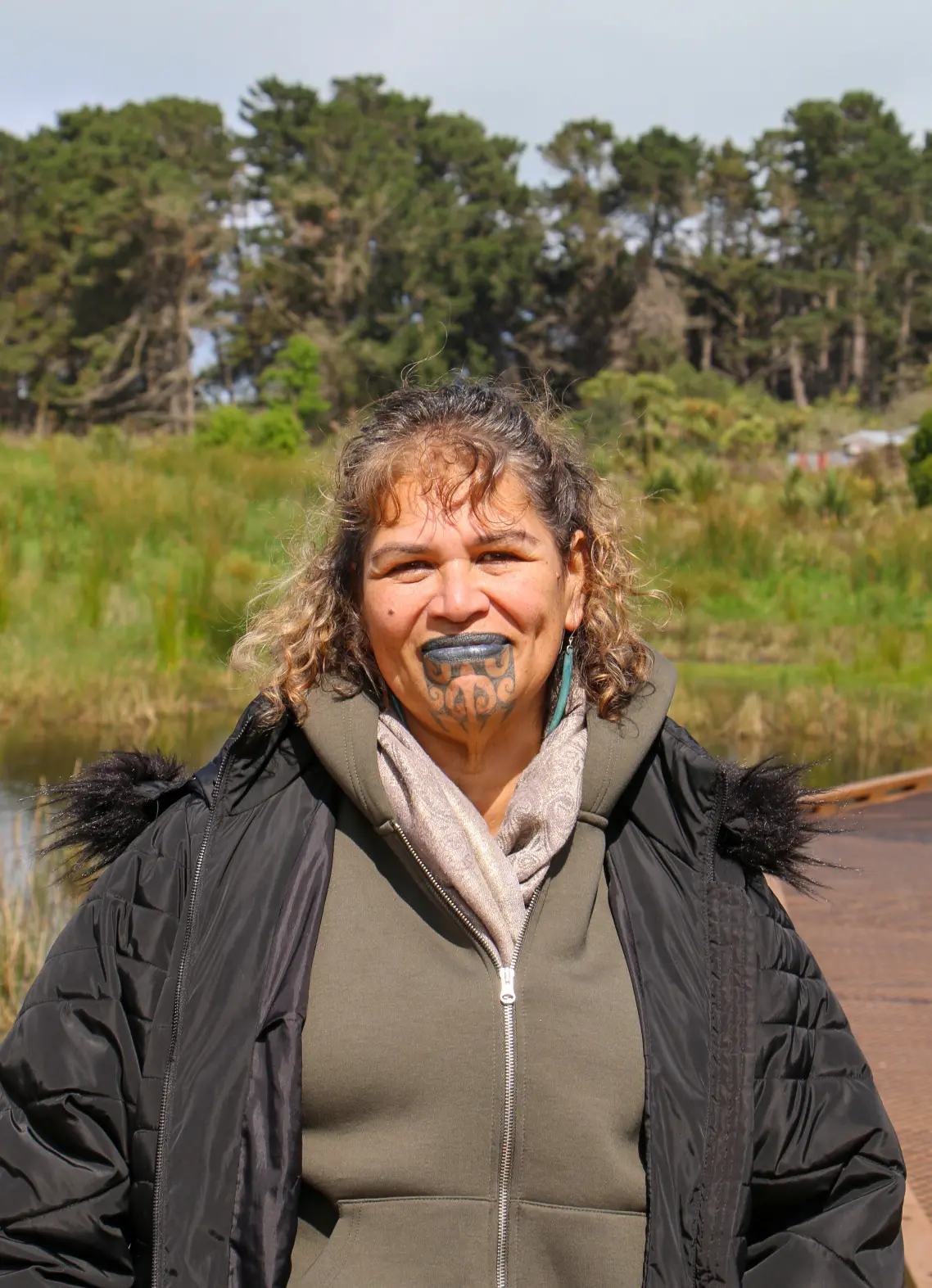
From kapa haka to governance and advocacy, Puamiria Parata-Goodall has spent her life championing te ao Māori. Now, as Te Taumutu Rūnanga’s mana whenua representative at the Selwyn District Council table, she is helping shape the district’s future. Daniel Alvey reports
As a child, Puamiria Parata-Goodall felt pressure to leave part of her identity behind. Today, the kapa haka tutor and Taumutu leader is helping ensure Māori voices are heard in local decision-making.
Parata-Goodall was born in Rotorua and moved to Christchurch at age seven, when the family decided to return home to their Ngāi Tahu roots.
Christchurch in the 1970s was very much a European city compared with her Māori upbringing in Rotorua.
“That was quite a culture shock coming to Christchurch and realising all our cousins were blue-eyed and blonde, and we were the dark kids with really long, hard Māori names.”
While at Rowley Primary School, Parata-Goodall had to effectively take on a new identity.
“As a seven-year-old, you’re sitting in the classroom, and the roll was being read, and it gets to your name and the teacher goes, ‘Do you have a nickname?’”
So Puamiria became Anne and also went by Sarah.
“So I’d taken on this whole new identity because I had to adjust to this new alien space.”
At high school, Parata-Goodall began to reclaim her identity.
“My mother became the matron and later principal of Te Waipounamu Māori Girls’ College and lived at the school.”
It was here Parata-Goodall had a pivotal moment at age 15, which would lead her down the career path she ultimately chose after talking to the school guidance counsellor about future careers.
“I wanted to do kapa haka. I want to be a tutor; I want to be a performer; I want to make a living out of kapa haka because I’d seen my dad do it,” the 56-year-old recalls telling the counsellor.
Instead, Parata-Goodall was told to be a teacher or a nurse.
“What that did for me was fire me up. It made me think, this is the thing I want to do.”
At 16, her dream became reality when she was selected as part of the rangatahi group that performed as part of the Te Māori group in Chicago.
“I found my love for heritage, arts and culture because I could see where it could take you.”
“It was a really pivotal point because I am all about arts, culture and heritage; that’s me.
“It was about me recognising I could be Māori and that it was okay to be Māori with all of my heart.”
From there, Parata-Goodall’s career focused on teaching kapa haka and song for Ngāi Tahu and various kapa haka groups and schools.
In the 1990s, Parata-Goodall was involved in teaching Ngāi Tahu waiata and anthems for key events such as the 1998 signing of the Ngāi Tahu settlement in Parliament.
“For three months we travelled all over our motu, and we taught these songs so by the time we turned up in Wellington, 300 Ngāi Tahu members turned up at Parliament, and we could sing.
“I’m hopeless at remembering genealogy, but if I can sing it I can remember it.”
When she was growing up in Rotorua, Parata-Goodall always thought that was where her origins were but her Ngāi Tahu ancestors were first welcomed by Rāpaki in Banks Peninsula and had family connections with Taumutu.
“My great-grandmother and her siblings are buried down here. I also have my father’s bones and my mother’s bones buried down here.”
Parata-Goodall has lived in Rolleston for the past five years with her husband Anake Goodall, a former chief executive of Ngāi Tahu.
Parata-Goodall has one adult son, Awhioraki, and two grandchildren.
In recent years, Parata-Goodall has turned her love of arts, culture and heritage towards governance roles.
She is pro-chancellor of Lincoln University, a board member of Canterbury Museum, serves on the Arts Council and Te Māori Manaaki Taonga Trust, chairs the Ngāi Tahu Fund, and is a member of the Ngāi Tahu Archives.
“That is my job. I’m a governor 90% of the time.”
Parata-Goodall has now been chair of Taumutu Rūnanga for a year and is also a director of the company which assists with the commercial side of the rūnanga.
“We are a company with a professional board which makes the big decisions on behalf of us, but we also operate as an incorporated society, so the company is still accountable to the people.”
Last month she was also appointed as Taumutu’s mana whenua representative on the Selwyn District Council. A position which gives her voting rights on council committees but only speaking rights at full council meetings.
Parata-Goodall is the second representative, following lawyer Megan McKay.
But some residents criticised the position for being unelected.
In response to the criticism, Parata-Goodall said the Taumutu community chose her in a way not dissimilar to how communities elect a ward councillor.
Parata-Goodall said she had to apply for the role and go through an interview process.
“The things that me and my community want are the same things all communities want and need.”
“We want good health, we want food in the cupboard, we want a roof over our heads, we want a strong economy.”
She said having the position brings a different perspective to council.
“It adds something that is not necessarily at that table, so it’s adding a new set of skills, but it is also bringing a different voice.
“As iwi, we are planning 50-100 years out. Iwi become a constant at local government tables because we have that memory.”
It is not the first time she has worked for the council, having served as a cultural advisor for about two years during the build of Te Ara Atea and also helped develop a bicultural strategy for council.
One of the big focuses of Taumutu is restoring the health of Te Waihora/Lake Ellesmere, developing wetlands on the marae site, and working with nearby landowners to help improve the water quality flowing into the lake.
“Ultimately, in my dream world, the lake will be a lake and allowed to be a lake, and it will be healthy, and we will be able to use the resources from it and around it.”
The rūnanga is already seeing more wildlife returning to the lake and surrounding area.
Like many of the lakeside communities, it is also looking at how it adapts to climate change.
“We’re not closing our eyes and hoping it will go away; we can’t do that any more.
“For the rūnanga, it will mean moving the marae and considering how it protects sites of cultural significance.
“It’s going to be underwater. So what do you do?”