
PHOTO
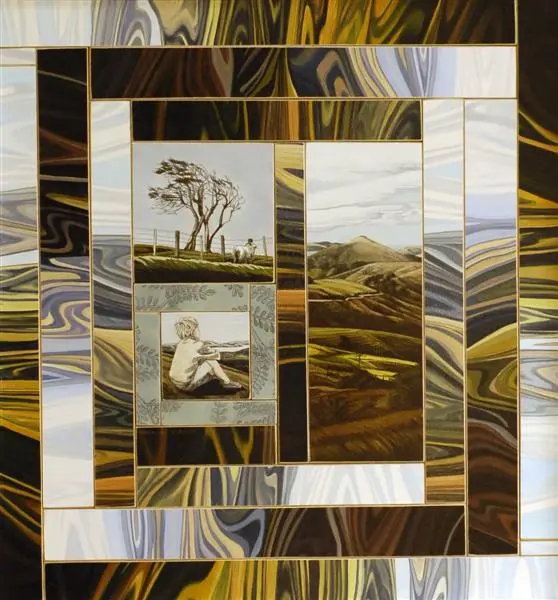
James Dignan checks out three art exhibitions currently showing in Dunedin.
"Identity", Maria Kemp. The Artist's Room
It is a very busy time for Dunedin's art galleries, with more than 10 exhibitions opening around the city this week to coincide with the Otago Festival of the Arts.
Notable among these is an exhibition at Salisbury House celebrating one of the city's more historic - and until recently most neglected - buildings, the old Chief Post Office.
A large group of artists has collaborated to produce an exhibition commemorating this building.
Each has worked separately, and the result is a series of impressions - some of the building itself, others inspired by its postal or social history.
The works are diverse but cohesive, and all are impressive.
Prominent among the pieces is a series of photographic studies of the building by Alan Dove.
These fine, well-composed works strongly capture the structure's fallen grandeur and sad decay.
Rochelle Liggins has used similar images for her fine mixed media photographic drawings.
John Z.
Robinson has used the shape of the building itself for his elegant jewellery, and Erin Dellow and Julie Whitefield have taken a different tack again, using the forms of postage stamps as a basis for their prints.
Lynn Taylor, as always, has produced some beautiful works redolent of the building's history.
Her sepia-toned intaglio prints echo with the ghosts of the building's past.
Claire Beynon too has produced some excellent pieces with her impressive miniature sheets of artwork stamps.
"Southern paintings". Bellamy's Gallery
The name Caselberg needs no introduction to the Dunedin art scene, and the legacy of John and Anna looms large in a couple of current exhibitions.
One of these is at Bellamy's Gallery, where paintings by Anna Caselberg and her daughter Sara Addy are presented alongside several new pieces by Pauline Bellamy.
Anna Caselberg's work is a series of fine Otago Peninsula landscapes.
The oils are simultaneously slab-like and delicate in their use of colour, great blocks of expressionist form standing firm against a pale sky.
The artist's watercolours show another side of the land, finely capturing the play of light on the hills.
Sara Addy's series also aims to produce an impression of the land rather than a pure representation, and these acrylic works reflect the essence of the hills around the Wairau Valley in Marlborough very effectively.
Pauline Bellamy's latest large pieces are among her finest work.
These almost monochrome images capture the liquid mountains of Fiordland, with the desaturated blue-greens disappearing into the rain.
The pieces are evocative and captivating; their drizzly mists effectively complement the dry slopes of Caselberg and Addy's works.
"The Chief Post Office, 1937". Salisbury House
Maria Kemp also creates liquid landscape, but hers are molten metal hills, shimmering in Otago sunlight.
In her latest exhibition at The Artist's Room, Kemp has produced a fine series which both continues her studies of Otago landforms and also returns to her earlier passion of full-length portraiture.
Works such as the delightful Eve combine these two themes by placing its subject, a contemplative young woman, against the folded hills of the South.
Several influences show through.
Foremost, of course, is Kemp's faith, which frequently informs her art and which is here most clearly apparent in the punningly titled After fall winter came, with its updating of the story of the Garden of Eden.
A second influence in several pieces seems to be traditional oriental landscape art.
This is especially notable in a group of three thin vertical slices of hilly landscape.
An intriguing element in several pieces is the literal cutting up of the ground of the painting and the reassembly of the pieces as panels reminiscent of wooden parquetry.
The pieces are inverted or presented on their side like the images in shards of mirror, endlessly reflecting and reinterpreting the scenes they depict.