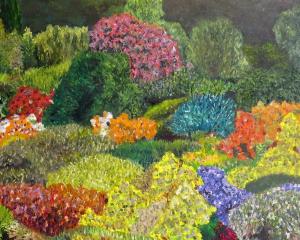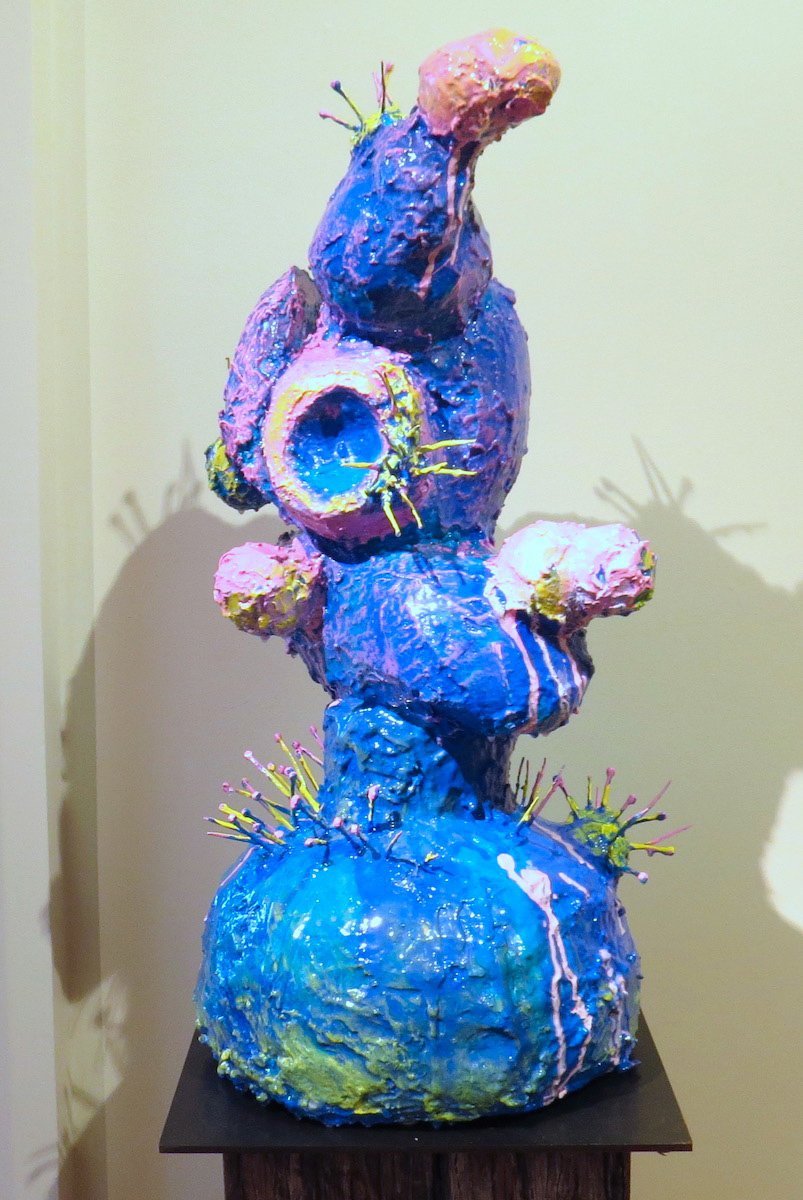
Lisa Higgins presents a riot of colour and quirkily odd shapes at Gallery Fe29. Her glistening, amorphous sculptures dot both gallery and sculpture garden, with small works within the gallery and several larger forms — some as high as 2m — occupying space outside.
The pieces are created from concrete reinforced with metal rods that occasionally break free from the surface. This frame is worked over repeatedly in marine resin and brightly coloured acrylic paint, often accompanied by silicon cord and further metal adornment. The gleefully vivid works take inspiration from natural forms, especially fungi, as was the case in the artist's previous exhibition, "Coming Out of the Shadows". The onset of the Covid pandemic has added a second inspiration to the works, both in the spherical, lobed form of the virus itself and also in a desire for the works to be joyful and uplifting in the face of potential disaster.
There is indeed a happiness in the finished works. Whether it be in the small benchtop forms such as Brouhaha and Bazaar, or in the massive pieces which lurk within the bushes of the sculpture garden, there is a warmth and joy in these sculptures which belies their occasionally unnerving forms.
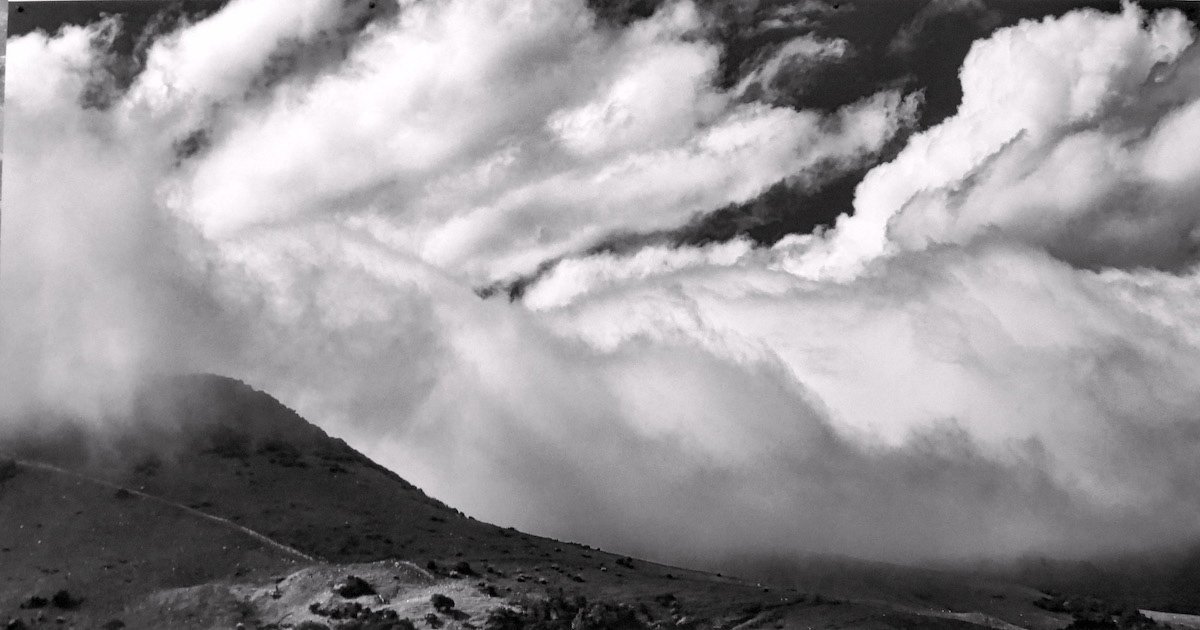
Adrian Hall's exhibition at Pea Sea Art is an intriguing assemblage of photography and installation art.
Over Hall's illustrious career, he has frequently returned to themes of conservation and of the folly of war. In the current exhibition, the two installations both deal with the latter theme. In one, a model of a World War 2 anti-aircraft battery, also used as a bomb shelter, is recreated with giant lego-like bricks. The message, that war is a childish pursuit, is clear. The second installation is a large world atlas cut by random straight lines. This is a deliberate nod to the arbitrary slicing up of the Arab world after World War 1 without thought of local allegiances or cultures — a dissection from which we still feel the repercussions.
Hall's photographs deal with the changes to the Earth being wrought by our warming climate. A series of impressive and poignant smaller works, several of them making great use of chiaroscuro, are secondary to several massive and beautifully worked pieces. In several of the images, our sense of normality is challenged by the deliberate upside-down hanging of the photographs. We are being made to look at our world in an unfamiliar way, and to examine it more closely so as to see how it is changing.
(Gallery On Blueskin)
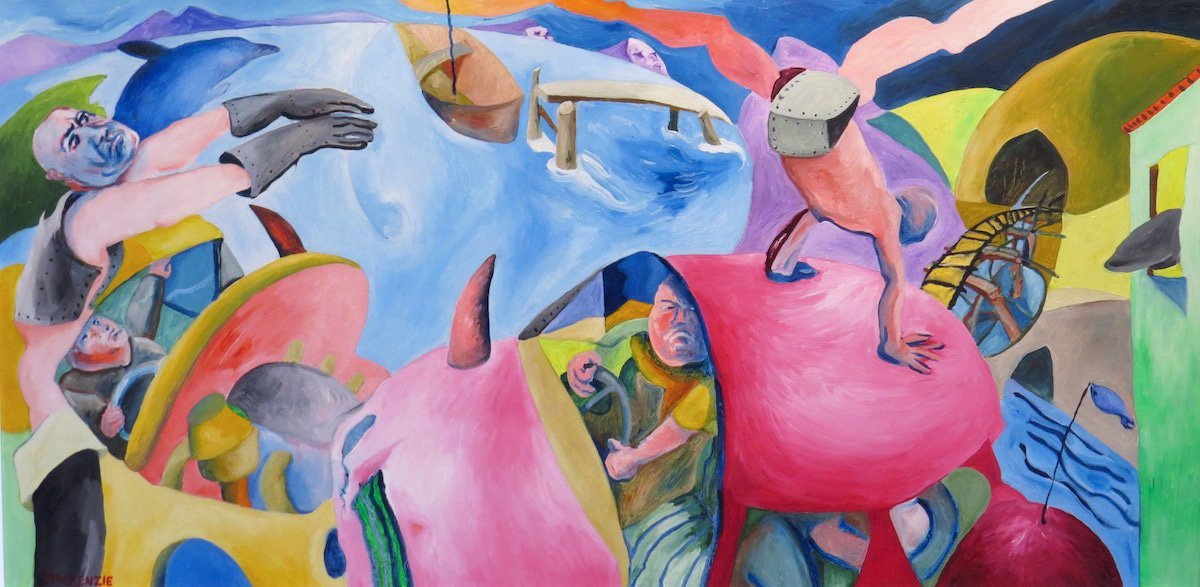
Don Mackenzie creates a mythical Blueskin Bay in his exhibition "The Big Waka", at Gallery On Blueskin.
The artist's oil paintings combine elements of the landscape and people of the area, occasionally adding echoes of the whakapapa of pre-European settlement as passed down through oral tradition and legend. The resulting images are colourful journeys through a land which is both realistic and fabulous, a "para-Otago" which shares elements with the magical realist worlds of artists Frank Gordon and the late Lindsay Crooks.
In Mackenzie's work, realistic features of the images are balanced with surreal and caricatured elements. Boatmen become grotesques, railway tracks bend and fall away, and cars crash like angry rhinos. The composition of the scenes is tight, as is needed with the busy canvases, and each work contains a wealth of strange and occasionally humorous detail. Several of the pieces (such as Minoan Bull-Leaping) have as much the feel of miniaturised murals as canvas works, and would be very impressive if executed on a wall-sized scale.
The most poignant of the pieces are the images where a sense of the clash between colonial sensibilities and tikanga Maori is evoked, most notably in the powerful yet mysterious Webber Paints Canoe Beach and the politically pointed Stolen From.