
PHOTO
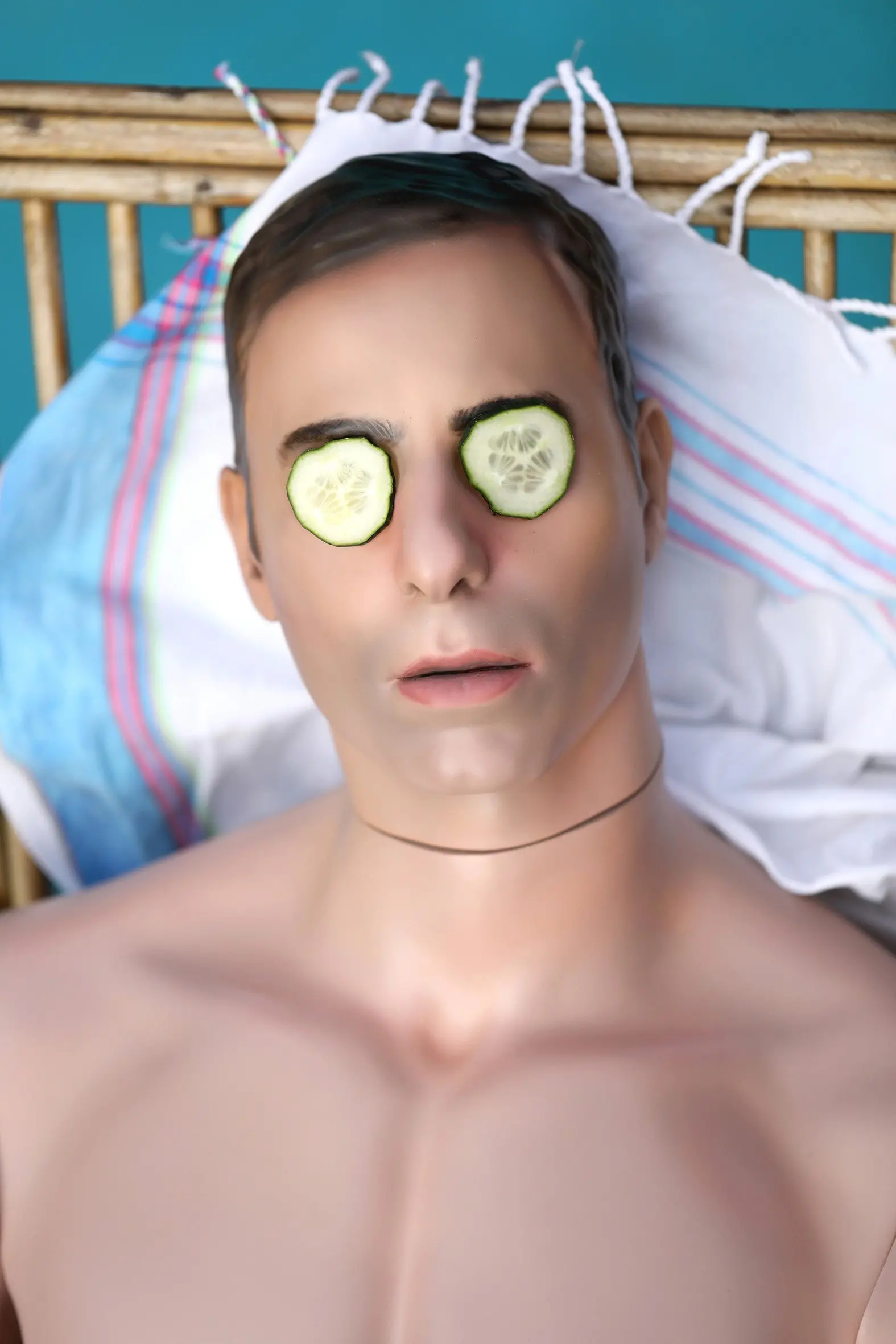
"Meet the Zavros’s", Michael Zavros
(Dunedin Public Art Gallery)
A major survey show, "Meet the Zavros’s", introduces New Zealand audiences to the Australian artist Michael Zavros, spanning his career with works from 1999 to 2025.
Finely rendered oil paintings established the artist’s renown as a photorealist painter of luxury things, such as the designer clothing, shoes, perfume bottles and sunglasses in Executive Suite (1999-2001) and Ars Longa Vita Brevis (2010), for example, and the autobiographical, like the self-portrait V12/Narcissus(2009) that depicts the artist reflected in the bonnet of his Mercedes.
In later works, Zavros’ children are brought into this autobiographical and made-up world — the artist’s performative self-reflective practice and/or provocative artifice.
As part of the gallery’s international visiting artist programme, Zavros made trompe l’oeil — or optical illusion — paintings of the disembodied heads of two of his children, foregrounded by a small copy of the Winged Victory of Samothrace (c. late 1800s) from the gallery’s collection.
Zavros’ practice has been described as walking an uneasy line between meaning and decor.
The subject of a work is often furnished with interpretive associations for the viewer, through a title or an intertextual cue; but it also seems to be the thing, the subject, or the painting itself that is celebrated by the artist.
Questions of interpretation and criticality seem to be purposefully perplexing.

(Otago Art Society galleries, Dunedin Railway Station)
This year, the Otago Art Society marks its 150th anniversary and its programme of celebration events and exhibitions has begun with the "Summer Exhibition Open and Plein Air Categories".
The exhibition includes works across a range of media and styles from more than 100 of the society’s artists.
The artists were invited to submit up to two works each so there is something for everyone in a maximalist show like this, with a keen sense of community and inclusiveness apparent in the diversity and number of works.
The exhibition also included a plein air category with the conditions of entry specifying the definition of the practice: in that the work must be completed outdoors and from direct observation.
En plein air helps the artist capture the sense of changing light and effects of the weather, fostering a sense of immediacy that translates in different ways, a sensibility definitely apparent in the works submitted to this category.
At the opening weekend, the awards were announced to the public. Lynn Grace’s Summer Lane took first prize, Scott Drummond’s South Coast Trees was second and third prize went to Jenny Longstaff’s Rural View. The plein air award was awarded to a pastel by Anneloes Douglas, Misty Orokonui.

(Tūhura Otago Museum)
The Beautiful Science Gallery at Tūhura Otago Museum hosts an interactive multimedia exhibition of illustrations by Ruby Jones.
Jones’ work communicates and embodies themes of compassion and kindness spanning everyday moments of self-care to statements and symbols of solidarity, some of which are now globally known.
In response to the Christchurch mosque attacks of 2019, Jones illustrated a moment of care — one woman embracing another wearing a hijab — accompanied by the phrase "This is your home and you should have been safe here".
The image, shared on social media, resonated with so many and to such an extent it became emblematic and unifying, shifting out of the artist’s hands to be adopted by the communities that shared it.
Taking up the call for solidarity again, None of us are free until we’re all free, is a more recent work made in response to the conflict in Palestine.
The walls of the gallery feature moving images of Jones’ body of work to date.
There is a short film featuring the illustrator’s visit to a local primary school, with tables and spaces for visitors to make their own work. Cabinets include drawings from the artist’s own childhood and the covers of magazines and ephemera that feature Jones’ work.