
PHOTO
Ebon Moss-Bachrach brews a green tea and passes the still boiling, handleless cup to me. While I debate trying to pretend this isn’t agonising, he quickly assesses the situation and brings me a book to rest it on. I check what it is — Carson McCullers — and ask what else he’s reading. "I’ve been reading In Cold Blood," he says, flipping through the small stack on his shelf, "Carson McCullers, Truman Capote — oh, and Healing Back Pain, of course."
Then he lights up, handing me a slim, somewhat battered mass-market paperback. "And I have this trashy Dog Day Afternoon book. This was made after the movie — a very pulpy fictionalisation. It’s got a lot of really sexy passages."
"It’s great," he says with earnest conviction.
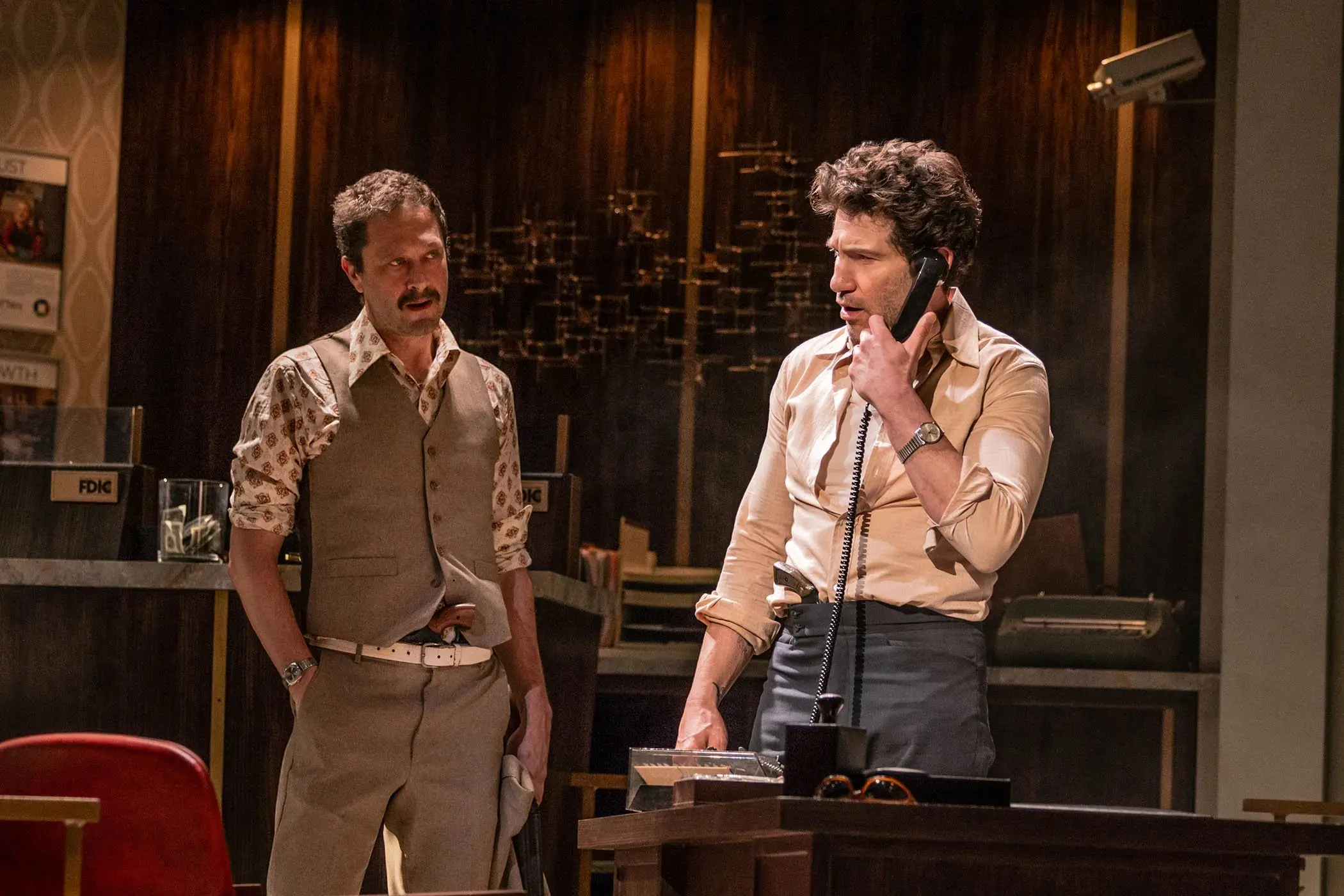
We are backstage at the August Wilson theatre in Manhattan, where the 49-year-old Moss-Bachrach is performing in a production of Dog Day Afternoon, an adaptation of the 1975 film starring Al Pacino and John Cazale, based on the true story of a 1972 bank robbery in Brooklyn staged to pay for gender-reassignment surgery. I had watched Moss-Bachrach, who plays Sal to Jon Bernthal’s Sonny, die on stage just a few days before.
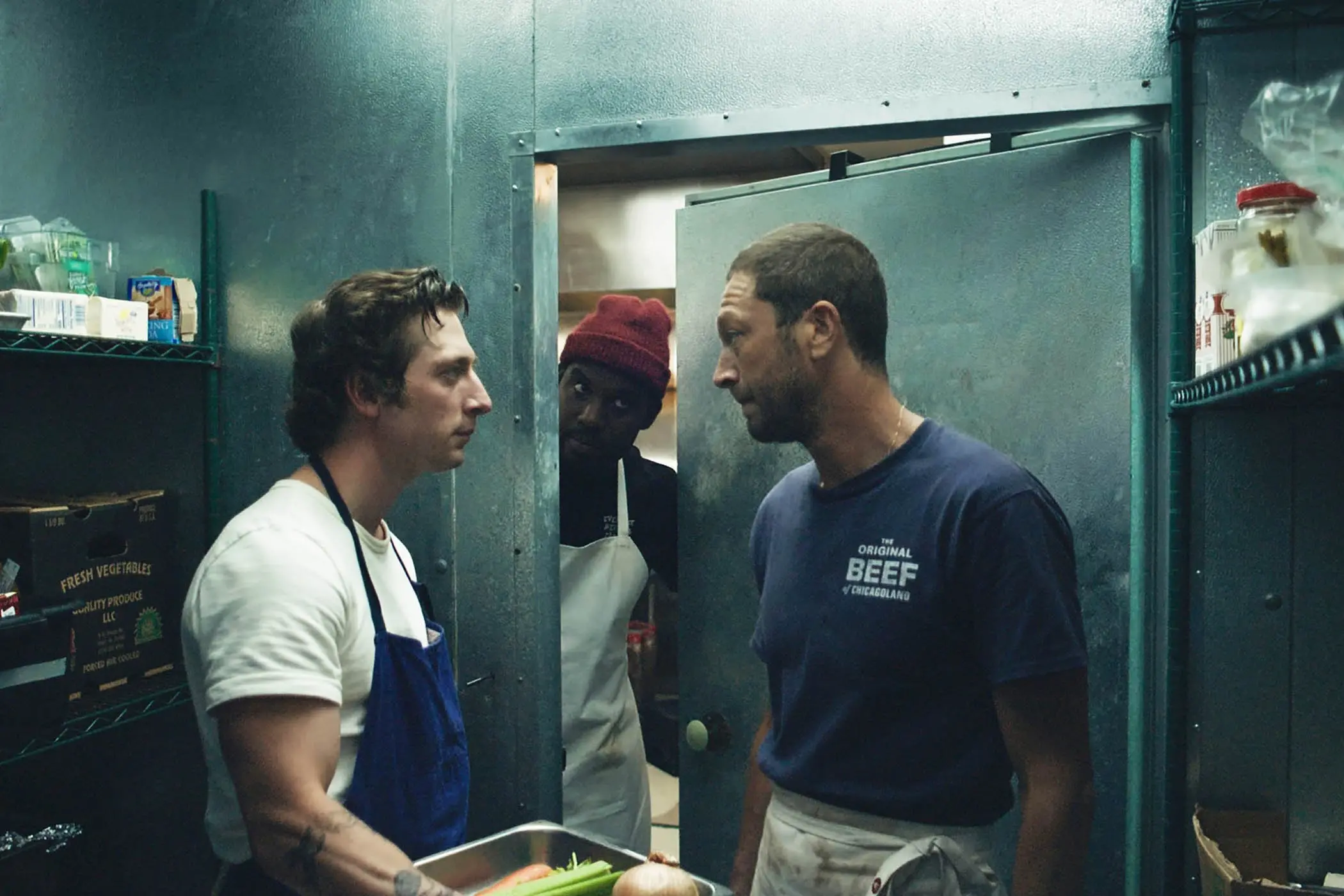
The play is Moss-Bachrach’s Broadway debut; it follows the breakthrough years of his career. He was a successful working actor for more than two decades before he was cast as the frustrating and lovable "Cousin" Richie in The Bear, one of the defining performances in perhaps the defining TV show of the decade. The series follows the chef Carmy Berzatto (Jeremy Allen White) as he returns to Chicago to take over the shambolic kitchen of the sandwich shop passed on to him by his brother Mikey, who has died by suicide. Help (and sometimes hindrance) is supplied by the manic energy of Mikey’s best friend, Richie. Powered by workplace tension, emotional trauma, family secrets and comic chaos, the show immediately won a huge fanbase — and 21 Emmys. Though White is the show’s star (and the "internet boyfriend", as wags termed his widely heralded sexual appeal), Richie is its true heart.
Over the past few days, when Moss-Bachrach has been signing autographs after the Broadway show, his fans have been telling him how much they love Gary, last month’s standalone, hour-long prequel episode that precedes The Bear’s fifth and final season, out later this month. Moss-Bachrach co-wrote the episode with his onstage partner in crime Bernthal, who also plays Mikey in flashbacks throughout The Bear.
The one-off episode was an unexpected departure for Moss-Bachrach, after he and Bernthal approached Chris Storrer [The Bear’s creator] to pitch a couple of flashback scenes.
"But before we could even say that, Chris asked us to write a whole episode. We were gobsmacked — honoured — and so tickled by this offer and immediately started coming up with ideas."
Writing Gary gave the pair the chance to explore the crucial relationship that is the emotional DNA of the whole show. "[The episode is] a little like a western, where two guys go to deliver something to a different town," Moss-Bachrach says. "But, really, I was interested in exploring what it was that Richie had lost when he lost Mikey. Why is this man grieving so intensely for the entirety of season one? I like minutiae. I like to ask: who are these two guys together and what is their shorthand? What are they listening to on the radio? What snacks are they getting? I like that dirt-under-the-fingernail kind of stuff of life."
Beginning as a buddy road trip, the plot descends into darkness: a torturous denouement between the two friends is one of the best few minutes of television in years. Moss-Bachrach has spoken of how his acting approach is about boiling a moment down to the simplicity of just existing with the other person in front of you. The culmination of Gary is remarkable for just that intimacy; you feel as if you are intruding on a moment of life.
Moss-Bachrach has said he feels a strong kinship with his character Richie because they share a dogged — at times, misguided — loyalty to the past and struggle to accept change. The new episode was shot after season four, and before filming the last season of The Bear. Moss-Bachrach says he did not have much time for drawn-out goodbyes on set — the show agreed to wrap his shooting early so that he could depart for Dog Day Afternoon rehearsals. But it seems important to him, with the release of Gary, to have afforded Richie the additional space to breathe.
How did making it play into how he feels about The Bear concluding and leaving Richie behind, I wonder?
"To have all these crew members and actors — people I love so much, my friends — come together to realise this thing that I wrote with my buddy, just a couple of dummies, it was really, really very moving. I care deeply about everyone who worked on The Bear, and I care deeply about that friendship [between] Mikey and Richie. I like to see grown men express love."
Gary was not the first writing collaboration between Bernthal and Moss-Bachrach. They met 10 years ago, working on the Marvel Cinematic Universe’s TV series The Punisher, in which Bernthal stars, and on which the two gave some joint script feedback.
"We both thought that those scripts were problematic, and it took a lot of negotiation, persuasion and politics to get them to a better place. Often times with genre stuff, especially with things that are from comics, they can exist in a very two-dimensional manner," he says.
"You can just be the tough guy. But Jon was committed to portraying a man; a soldier who came back, whose government did not support him, who was having mental health issues. We were trying to deepen that as much as we could. I don’t know if we were successful, but we tried really hard."
Having played Ben Grimm, AKA the Thing, in The Fantastic Four: First Steps last year, Moss-Bachrach will reprise the role for the new Avengers: Doomsday film this December — but it seems clear that, of his time in the Marvel universe, his enduring friendship with Bernthal is the most meaningful outcome. Bernthal later says of his years working with Moss-Bachrach: "You never have a doubt that Ebon is about making the scene great, fighting for the character and the story — it’s never selfish or indulgent."
Talking about their onstage collaboration, I ask Moss-Bachrach about the charged moment in Dog Day Afternoon when Sonny is outside the bank, riling up the watching crowds with anti-establishment chants; in the film — famously — the rallying cry is "Attica! Attica!" in reference to the 1971 prison riots that were brutally cracked down on by police. In the new iteration, I tell Moss-Bachrach, I heard some audience members demur uncertainly when led to chant: "F*** the NYPD!".
"Well," he says, "the first one says: ‘F*** the mayor!’ — and now everyone’s a little like: ‘Eh, we like that guy [Zohran Mamdani], actually.’ You know what I mean? If it was [former mayor Rudy] Giuliani, that’s a lot easier."
The production is tonally quite distinct from the film; more comedic and, by its nature, less intensely visual. (As Moss-Bachrach points out, much of the movie’s power lay in its amazing close-up shots of Pacino and Cazale’s faces pouring with sweat.) Reviews have been mixed, if almost unanimous in their praise for the central performances.
Audiences, on the other hand, seem consistently enthusiastic. It was, I tell him truthfully, easily the most energised and happy audience I’ve sat in at any play I’ve seen in New York — on or off Broadway.
He’ll take that; and he has, anyway, he insists, been at this long enough that bad reviews won’t rattle him. Moss-Bachrach began to act seriously in college, having been focused on music as a child in Amherst, the western Massachusetts college town where he grew up; his father ran a music school in nearby Springfield, while his mother worked for the Big Brother Big Sister mentoring programme for young people.
"I played piano and drums but mostly I spent a lot of time in the woods spacing out," he says.
In college at Columbia, he took an acting class and studied the Stanislavski method, though he describes his approach as more fluid, "based in daydreaming and imagining".
Sometimes, of course, reality and fiction mingle. He gets up to retrieve a note that someone left for him after a performance. In large, slightly alarming lettering, it says that its writer was a cousin of the real-life Sal, and the play reminded them of those dark days, ending with a phone number to be in touch.
It’s surreal, this muddling of truth and make-believe — the New York of 1972 and New York of 2026. Did he call?
"I tried, but the number didn’t work. I don’t know if it’s real. But to me," he says, looking down at the note, "the penmanship feels like Sal."
The affection for potentially dislikable and reductive characters is Moss-Bachrach’s gift as an actor. I get the sense he feels actual love for the odd little guys he plays — Richie and Sal. Because of this, his performances bring something restless and disruptive to the process. The first role I saw him in, almost 10 years ago, was Desi in Lena Dunham’s Girls. His character — memorably described as looking "like someone in the Pacific north-west knit a man" — is the enraging, outrageous love interest of Allison Williams’s Marnie in the show’s later seasons.
Desi was written as a fairly disposable and two-dimensional figure; all the worst hipster excesses and indulgences wrapped in a knowingly, irritatingly handsome package. But Moss-Bachrach imbued him with something surprising and seductive. Yes, he was ridiculous. Yes, he was annoying, but he was also a vividly alive and specific person instead of a gag reel. Dunham and showrunner Jenni Konner ended up keeping the character much further into the series than they had anticipated.
In coming months, Moss-Bachrach will shoot a film called Foxfinder with the Irish director Aoife McArdle, in which he and Tessa Thompson play a couple in what he describes as an "authoritarian fascist fairytale". Owen Cooper, the teenage, Emmy-winning star of Adolescence, plays the fascist pursuing them. Isn’t he just 16? I ask.
"That’s who you have to be scared of," he says. "The fascists with the hormones going crazy."
Before then, though, Moss-Bachrach needs a break, and to catch up with his family. One thing that endeared him to me before meeting was his apparent devotion to his wife, the photographer and visual artist Yelena Yemchuk, and their two teenage daughters, Sasha and Maribelle. In interviews, he has approvingly cited Gene Wilder, with whom he acted in his film debut, the 1999 TV movie Murder in a Small Town. Wilder believed that method acting was redundant, and you should always leave your performance on set in order to go home be present with those you love.
What is his relationship to work like?
"I don’t want to work all the time," he says. "I’m lazy. I’m good at not working, and it’s diminishing returns. If you don’t have a life outside of the work, you don’t have much to draw from. This place [the theatre] is very draining. I’m doing this all the time and very little outside of it." — The Observer