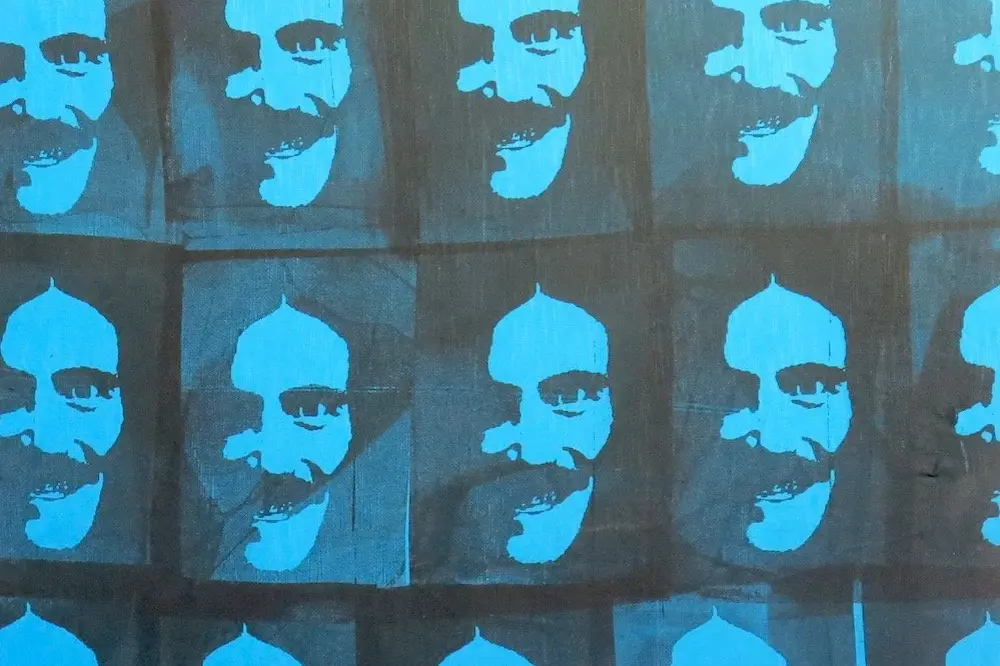
“big Other”, Wesley John Fourie (RDS Gallery) RDS Gallery is filled with Wesley John Fourie. The artist has reproduced multiple self-portraits via screen print, the resulting stark images staring from the walls, as though the viewer is the exhibit and Fourie is watching. The works initially seem to be exactly identical, yet every iteration is different from its neighbours due to the vagaries of the screen-printing process and deliberate irregularity of the frames. Further faces stare from T-shirts in the gallery’s window. There are multiple concepts involved in these works. They are a commentary on the commodification of art and the artist, and the schizophrenic nature of the industry. Artists’ work to present their ideas and visions to the world, but under this veneer is the ever-present commerciality of the process. The artists themselves become commodities — baring their souls for the ever elusive dollar — an idea which has been explored by artists from Andy Warhol to Ronnie van Hout. Beyond this narrative is the idea of today’s surveillance society, with the exhibition’s title being a deliberate riff on “Big Brother” and all its inferences from Orwell to reality television. A further concept still is the ambiguous nature of stark portraiture. Are the faces grinning or grimacing? Is the watcher happy or threatening? The answer seems to vary with every image. james dignanPriscilla Rose Howe’s “Ellie and the Orb Spider”. Photo: James Dignan. “Stranger”, Priscilla Rose Howe (Brett McDowell Gallery) An emigre from the wilds of Christchurch, Priscilla Rose Howe’s surreal, sinister coloured pencil works are now adding to Dunedin’s art scene. It would be easy to characterise Howe’s art as outsider art, but there is a deep vein of expressionism in her sometimes seamy scenes. Like the early 20th-century caricatures of Grosz, Beckmann, or Schiele filtered through the manic cartoonery of Chris Knox, there is a dark glee to the artists uncomfortable scenes. The works have something of the dark South Island gothic to them, filled with an eerie erotic charge that makes the viewer feel slightly dirty, but the anything-goes fatalism and decadence of the Weimar era pervades many of the images, despite the occasional references which anchor the art in the present day. That these dark carnivals are presented in that normally gentle medium of coloured pencil makes them more surprising still. Somehow, the expectation of gentle shades and soft lines increases the attractive repulsiveness. The figures become archetypes, somehow encompassing more than the energy of the works themselves. It is likely no coincidence that the two works which look most like pencil drawings are the only two works in the show which are not in that medium — the two monochrome pastel pieces, Splatch and Portia. james dignanZehavit Darlington’s “Conversations with Hereweka (4)”. Photo: James Dignan. “Mirrors”, Zehavit Darlington (Koru Gallery) Zehavit Darlington’s ceramic exhibition at Koru has the seemingly random title of “Mirrors”. The title, however, does make sense once the works are contemplated. The pieces form two distinct groups: attractive pots and cups, each glazed to a sheer reflective surface, and a series of small caricature figures, each of which is a tongue-in-cheek mirror on society. The latter group are inspired by the heavily pointed children’s stories of Dr Seuss, especially The Zaks from The Sneetches and Other Stories. In this family favourite, two Zaks refuse to give way to each other, metaphorically butting their heads eternally for the sake of their pride. Similarly, Darlington’s miniatures present a cynical yet fun view of society, attempting to deflate the balloons of pompousness which exist everywhere. Alongside these works are the utilitarian yet attractive vessels, series of cups and bowls which are arranged into connected groups each with its own specific glaze colours. The largest and most impressive of these series is the “Conversations with Hereweka” range, its rich, earthy greens, browns and blues inspired by the contours and landforms of Otago Peninsula. One of the more intriguing pieces in this series, simply titled Conversations with Hereweka (17), is a square container which has been deliberately crushed before firing, leaving attractive “crumple zones” along its sides.