
PHOTO
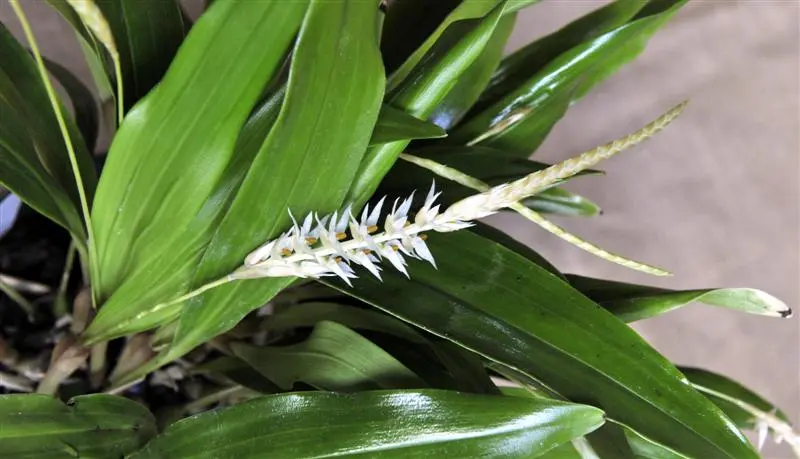
Of all the orchids that we grow here at the Dunedin Botanic Garden, I find the fragrance of Dendrochilum glumaceum to be one of the most beautiful.
It is produced from small graceful sprays of white starry flowers with a yellow centre in late winter or early spring.
It is not a particularly showy orchid and can be easily overlooked, but it's the scent that draws your attention. It is also not an overpowering, sickly-sweet scent like some other orchids, such as Stanhopea.
Native to the Philippines, it grows in trees or on rocks so is classed as an epiphyte or lithophyte. In cultivation it can be grown epiphytically, in a wire basket or in a pot.
The plant develops small clustered pseudobulbs at its base, with each producing a solitary grass-like evergreen leaf.
Thin flower spikes arise from the centre of the new growth, producing two rows of small delicate flowers arranged closely together, opening from the base and moving towards the tip. Up to 80 flowers can be produced on a single flower stem.
- Commonly known as chain orchid because of the tightly clustered flowers along the flower stem.
- They need the protection of a heated, humid glasshouse with night temperatures between 10degC and 16degC and day temperatures between 21degC and 27degC.
- Can be repotted in a medium-grade bark chip in spring.
- Needs a rest period over summer when little water and fertiliser are required.
- Dendrochilum glumaceum is growing as an epiphyte on a log above the fish pond in the central house of the winter garden glasshouse at Dunedin Botanic Garden.
- Stephen Bishop is collection curator of the winter garden glasshouse at Dunedin Botanic Garden.