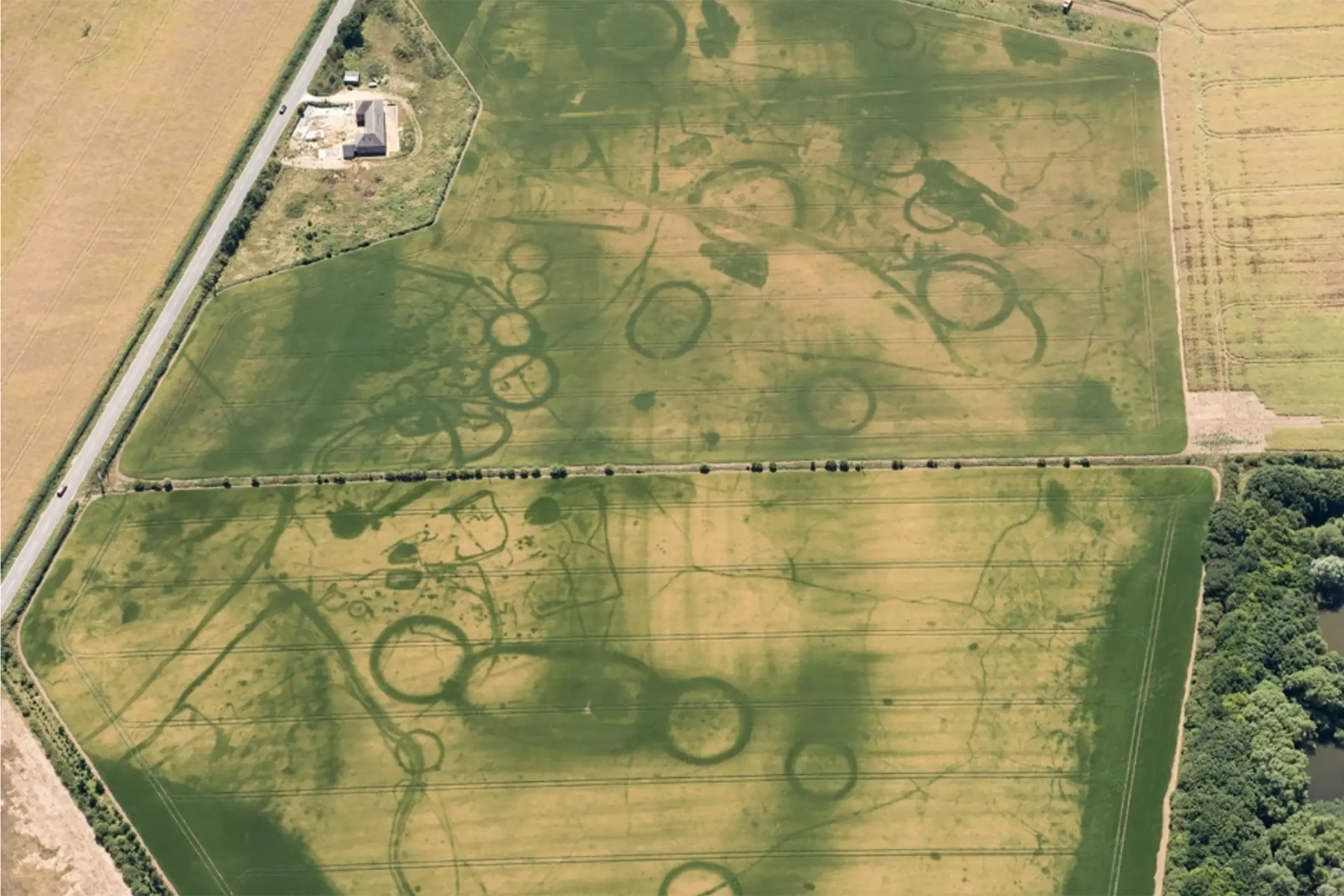
The airwaves and newspapers are full of reports on the exceptional heatwaves all over Europe, and the destructive wild fires that are destroying forests and homes. However, every cloud has a silver lining, and archaeologists are now on the lookout for lost sites that emerge as what are known as crop marks. As fields dry out, a hidden ditch will take on a different colour because it is less dry. By contrast, if a stone wall is close to the surface, it too will appear because the soil above it dries out more quickly. One early archaeologist famously wrote a century ago that to be a successful archaeologist, you had to be able to fly like a bird over the landscape. One of the most dramatic examples of these crop marks following a dry summer comes from Eynsham in Oxfordshire when a set of curious circles appeared. My first ever excavation on the Salisbury Plain involved a site known as a Bronze Age round barrow. This is a raised tumulus surrounded by a ditch that covered the grave of an elite person. Well, at Eynsham ploughing over the ages has levelled the tumuli, but the surrounding ditches remain under the surface. So the circles are what survives of a cemetery of exalted individuals that goes back 7000 years. Looking at the image in more detail, there are rectangular marks and long lines. Only excavation will reveal precisely what they represent, the most likely explanation being ritual areas or habitations, while the long lines are probably ancient trackways. There are few new discoveries more spectacular than finding the plan of a Roman villa. Since they had stone wall foundations, they come across very clearly as crop marks. Most comprise rooms round a large central courtyard, those with mosaic floors being particularly visible. Sometimes too, abandoned medieval villages appear from the lost past. Upper Smite in Warwickshire was depopulated in 1150 when an abbey was constructed. A long dry spell reveals the streets, houses and the deserted fields. Gainsthorpe in Lincolnshire is remarkably documented from the air with its lanes, ponds and houses. Many of these were deserted when the Black Death struck, or when wealthy landlords ejected villagers to make way for more profitable sheep farming. One remarkable finding from the deserted village of Wharram Percy has come from archaeological research: the dead in their graves were exhumed and decapitated or otherwise mutilated for fear of the ghostly presence of the living dead.