
PHOTO

Taieri Fallen Soldiers’ Memorial/Mosgiel War Memorial
Built: 1923.
Address: Anzac Park, Gordon Rd, Mosgiel.
Architect: David Gourlay Mowat.
Contractors: H.S. Bingham & Co.
Over 500 community war memorials honour the more than 18,000 New Zealand soldiers who died in World War 1. They are expressions of remembrance for the loss of family, friends, citizens, and brothers in arms. This month, they are focal points as the country marks the centenary of the end of the war.
Memorials built before the armistice include one at Kaitaia unveiled as early as 1916, but most date from the years after the war. In Otago, the busiest years for construction were 1921 to 1923. Sometimes referred to as fallen soldiers' memorials or cenotaphs, they took a variety of forms, including obelisks, statues, arches, and gates.
In April 1920, the Taieri RSA sought progress towards a memorial for the Taieri Plain. In response, the Mosgiel Borough Council organised a public meeting, held in May. RSA president Ivan Spedding suggested "something in the shape of a rough-cast monument" with marble tablets. Little was settled, but there was enough momentum to get the project under way. A further meeting in July elected a committee chaired by Mosgiel mayor William Allan. Other members represented the RSA, the church, patriotic organisations, and the borough and county councils.
Fundraising efforts began with a concert in the Coronation Hall. In March 1921, the committee called for submissions for the design, and the site was debated at a public meeting in May. The leading suggestions were Gordon Rd itself, and Mosgiel (now Anzac) Park. The park won out in a close vote.
Mosgiel Park was the gift of the Taieri Amateur Turf Club, which, on closing, had left funds for the purchase of a reserve. Opened in April 1919, it featured paths and lawn, ornamental entrance gates, and a band rotunda. In July 1919, peace oaks were planted on either side of the entrance, one by the mayoress Mrs Allan, and another by Dr Spedding on behalf of the RSA.
A proposal to dismantle the centrally placed rotunda to make way for the memorial offended park donors, who threatened legal action. The monument was instead built inside the gates, close to Gordon Rd. The rotunda and gates survived another 50 or more years before they were removed.
Referred to in reports of the time as the Taieri Fallen Soldiers' Memorial, the monument named soldiers from Mosgiel and the wider plain but excluded West Taieri as a separate memorial had been built at Outram in 1921. The committee placed an advertisement inviting parents and families to provide names, and in July 1923 published a list and invited corrections or additions.
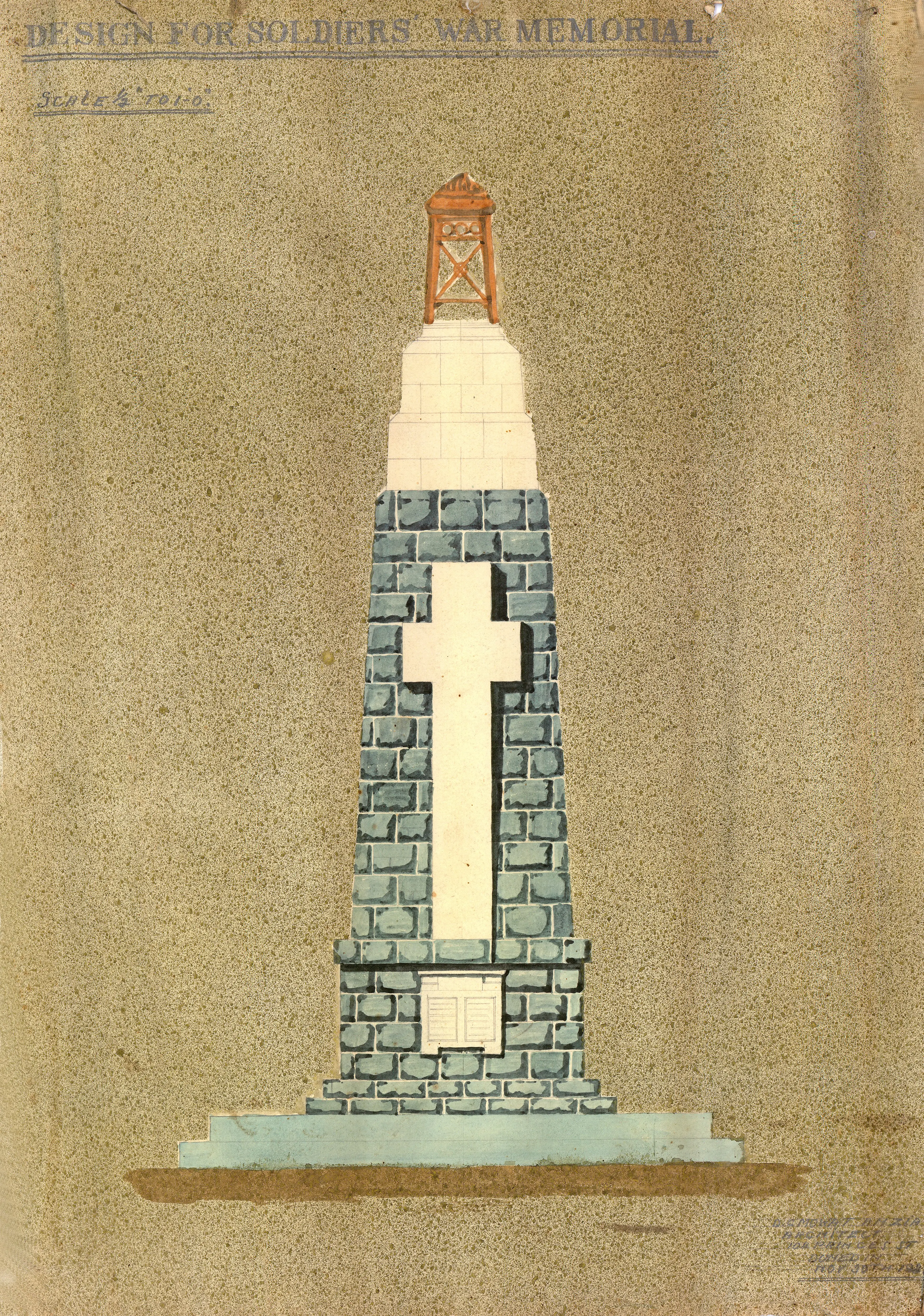
The successful submitting architect was David Mowat (1880-1952). Born in Dunedin, he had worked as an assistant to Edmund Anscombe before studying at the Architectural Association School in London. He established his own practice in Dunedin in 1914. His works included the Donald Reid Wing for the Otago Early Settlers' Association, Constance Hall for Columba College, Maori Hill Presbyterian Church, and various commercial and residential buildings. He also designed the war memorials at Port Chalmers (since demolished) and High Street School.
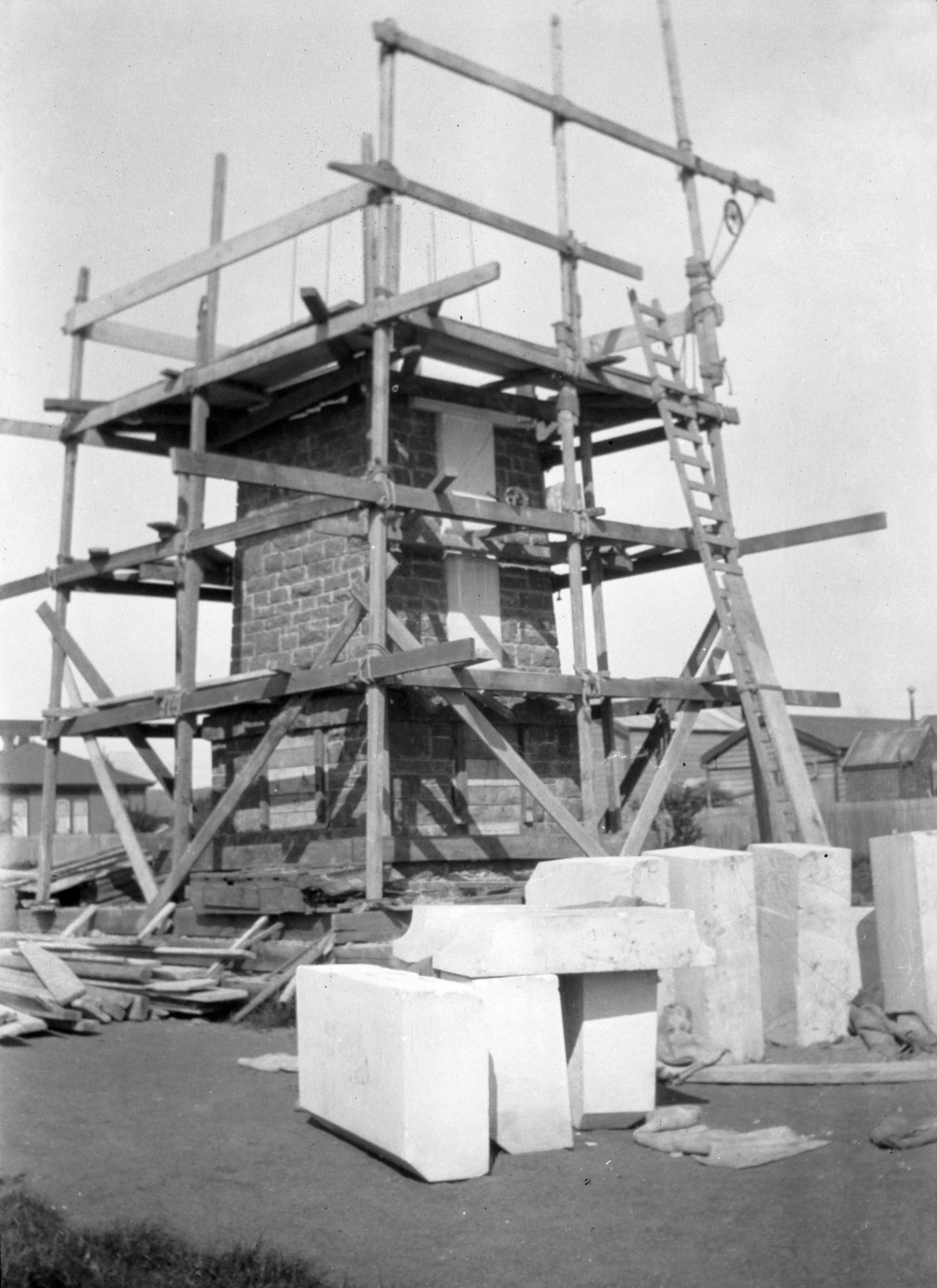
Dunedin monumental masons H.S. Bingham & Co built the Mosgiel memorial. Established by George Munro about 1870, and taken over by Henry Bingham in 1911, the company continued in business until 2008. Its name can be found throughout Dunedin cemeteries, and other war memorials it built included those at Northeast Valley and Kaikorai, and the cenotaph at Queens Gardens. The cost of the Mosgiel memorial was a little over 600, about the same as a modest two or three bedroom house.
The concrete base was complete by the time Major-general Edward Chaytor laid the foundation stone on August 26, 1923. Sung items were God Save the King, and the hymns O God Our Help in Ages Past, Land of Our Fathers, and O God of Bethel. The Rev David Calder offered a dedicatory prayer and David Hannah, of the RSA, read the roll of honour. Maj-gen Chaytor, presented with a greenstone-handled silver trowel, remarked that, "The amount of good that these memorials would do in the future would depend on how the young were brought up to regard them. Those who lived at present knew what the war had meant in every way." He emphasised the ongoing struggles of soldiers returning to peacetime lives.
The monument, 9.1m high, is an obelisk rising from a square base with three concrete steps. The main shaft is steel-reinforced concrete, with a central cavity. Most of the facings are bluestone, but the top portion is Oamaru stone over solid concrete. A cross in white Italian marble, representing sacrifice, faces Gordon Rd. The monument is surmounted by a bronze stand and bowl or urn, representing the sacrifice of non-Christian peoples and nations. Panels at the base name 60 fallen World War 1 soldiers. A biblical quotation comes from John's gospel: "Greater love hath no man than this, that a man lay down his life for his friends."
Mosgiel mayor J.C. Browne died two weeks before he was due to dedicate the memorial, and his widow, Margaret, performed the unveiling on Armistice Day, November 11, 1923. The Mosgiel Brass Band and Taieri Pipe Band played. Charles Statham, independent MP for Dunedin Central and Speaker of the House, gave a speech emphasising the scale of the loss of life, and expressing hope for a time without wars. He also offered condolences to those who had lost loved ones.
The War Trophies Committee had initially allotted Mosgiel four machine-guns, but the RSA argued it should have a big gun, and in 1921 the town was allocated a 77mm Howitzer field gun captured by the New Zealand Division on November 5, 1918. It stood in front of the memorial for many years and was probably scrapped around 1956, when it was seen lying in a corner of the tennis court grounds with a collapsed wheel.
After World War 2, tablets with a further 31 names were added to the shaft, and "Great War" was given an "s" to become "Great Wars". The monument was extensively renovated in 2007 at a cost of $10,000, its stonework repointed and replacement marble name tablets installed. These are not replicas of the originals, which had lead lettering.
The Mosgiel Branch of the New Zealand Society of Genealogists has two compiled booklets of soldier biographies. My own grandfather's first cousin, William Ernest McLeod, was killed in action at the Somme on April 5, 1918. He worked in Mosgiel as a bricklayer for my great-grandfather, George McLeod, who was a borough councillor and member of the memorial committee. William was an only child, and years after his death, his parents placed a memorial notice that read: "Too dearly loved to be forgotten."
The memorial helps us to remember.
For more from David Murray go to builtindunedin.com.