
PHOTO

The number of people working for the Dunedin City Council could top 1000 by the end of the year.
As the council prepares to consult on its draft 2020-21 annual plan, it says it needs to increase rates by 6.5% and bring in an extra $10.2million to balance its budget.
The plan includes a $4.8million increase in spending on staff, bringing total forecast spending on staff to $69.8million next year.
As at June 30 last year, there were 974 staff, made up of 747.01 fulltime-equivalent (FTE) positions. The 2020-21 annual plan calls for another 27.1 FTEs, which would likely push actual staff numbers over 1000.
Yesterday, both Dunedin Mayor Aaron Hawkins and council chief executive Dr Sue Bidrose said the staffing levels were justified.
Mr Hawkins would not be drawn on the significance of employing staff numbering in the four-figure range.
"It’s a number," he said.
"We’ve got a lot of work to do and we need staff to do that work.
"The role of the elected arm is to set the strategic direction for the council and to assign budgets to the chief executive to enable that to happen.
"If there are people who want us to do less of some things, then their opportunity for them to do that is through the annual plan process.
"The work doesn’t happen by itself. It’s usually good to have staff that drives the council work programme."
Dr Bidrose said about 25% of the budgeted increase in personnel costs related to salary or wage increases for existing staff, including a 2% pay bump across the board.
The council was getting a lot done while still having residential rates that were the "lowest of any New Zealand city".
"We keep a close eye on staff numbers and are constantly looking for efficiencies. But we want things done in the city, and improvements made, which means we need to have staff to do the work.
"We provide the full range of council services and our average residential rates are in the lowest 20% of all councils, which suggests that we are serving our community in a cost-effective and efficient manner — this is what ratepayers have a right to expect," Dr Bidrose said.
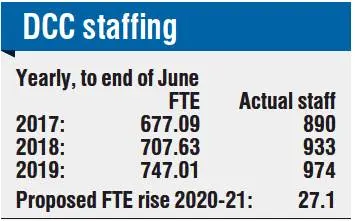
Of the 27.1 FTEs the council planned to add in 2020-21, two were for people paid more than $100,000 a year.
Council staff numbers have steadily increased since 2017, when there were 890 (677.09 FTEs) employees.
The draft annual plan for 2020-21 would increase the budgeted FTEs to 822.4.
Proposed new FTE positions include staff in infrastructure services, consent processing, operations, community support, health and safety, infrastructure support, urban development and district plan support, three waters and transport support, human relations and communications, and mayoral strategic support.
"Some new positions, such as building consent processing, have a supporting revenue stream.
"Other positions are largely required to ensure maintenance of services in a growth environment — particularly in the core infrastructure areas," a report on the draft annual plan says.
Dr Bidrose said staff would be added to support the running of community events.
"In addition, a community and engagement specialist will take a lead role in the development and delivery of engagement and communication plans and activities for the South Dunedin Future and DCC’s long-term coastal plans."
Late last month, Cr Lee Vandervis took issue with the council’s message that an overall rates increase of 6.5% was required "in order to maintain levels of service" and suggested the council’s annual plan consultation should indicate the added spending was "to enable these very significant staff increases".
The bulk of the increase in the proposed rates take, 4.3%, is to maintain existing levels of service and the rest (2.2%) is to offset a drop in revenue from the Green Island landfill.
The council plans to spend a total of $321.1million in the 2020-21 year.
The Otago Daily Times reported last week the Otago Regional Council planned to add 38.1 FTE positions next year to reach 241.3 FTEs.
Economics consulting firm Infometrics recently said public administration was among the key sectors contributing to job growth in Dunedin in 2019.
In cities with similar populations to Dunedin’s roughly 130,000, the Hamilton City Council (population 164,500) employed 1204 staff (1023.19 FTEs) at the end of June last year, and the Tauranga City Council (population 131,500) had 757 staff members (663 FTEs).
New FTE positions
Infrastructure services ....................7
Consent processing......................6.2
Operations....................................2.3
Community support ......................1.5
Health and safety..........................3.3
Infrastructure support...................2.6
Contract management and support in three waters and transport............5.2
Organisational support, human relations and communications.........2
Mayoral strategic advice ..............1.5
Offset by drop of 4.5 FTEs with end of fixed-term contracts and changes to other contracts