
PHOTO
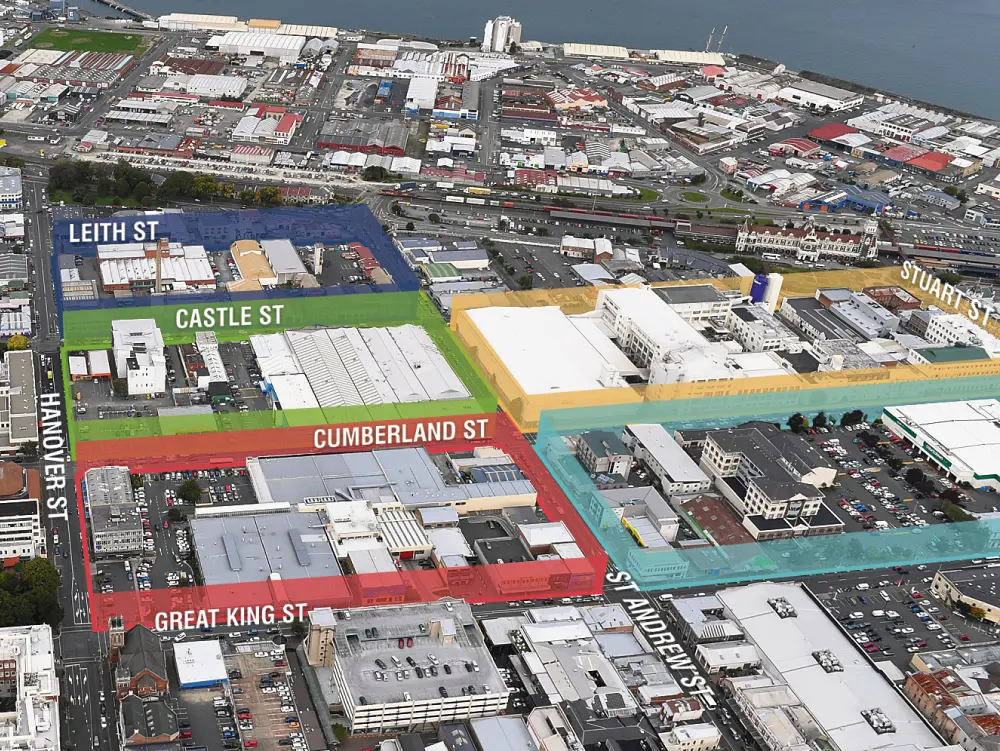

Speculation is rife about where Dunedin's new hospital will be built.
The Otago Daily Times called business and property owners on the five main blocks of flat land between the Octagon and the existing hospital yesterday.
Most spoken to thought it would make sense for the new hospital to be built on the soon-to-be vacated Cadbury factory and warehouse, and in conjunction with the adjacent Wilson parking building across the road, while possibly including more of that central city block bounded by Cumberland, Hanover, Castle and St Andrews Sts.
The area between the Octagon and the existing hospital has been identified by the chairman of the committee co-ordinating the rebuild, Pete Hodgson.
Mr Hodgson has previously said the new hospital could ''be built over streets''.
None of those spoken to had been approached by anyone about the new hospital going on their sites.
All blocks in the area are inhabited by multiple businesses on what is some of the city's most expensive real estate.
Wherever the hospital is built, it is possible land will have to be taken under the Public Works Act, potentially leaving owners and the Government to thrash out compensation while building went on.
Murray Frame is part-owner of Frames Footwear, in a block bordered by Castle, Hanover, Leith and St Andrews Sts. This block is largely already owned by the Southern District Health Board and is also home to the Dunedin Central Fire Station.
Mr Frame said he had not been approached about the seizure of his shoe-shop for a new hospital, and reckoned the location of the new site was a no-brainer.
''It's gotta be Cadbury's. Tony wouldn't like that [if it was in their block],'' he added, referring to Advance Equipment Supplies director Tony Guy's plans to expand his offices, located in the same block as Frames.
Mr Guy's sense of civic duty overcame any concern the new hospital might foil his expansion plans.
''I'd never stand in the way, even if it took the whole block.
''We need to keep the hospital close [to town] for the medical school.''
Two blocks east, New World owner Foodstuffs (South Island) Ltd said it had no comment to make on the issue. A store manager earlier said she had heard nothing of the supermarket site being used for the new hospital.
If Chamber of Commerce chief executive Dougal McGowan knew the site of the rebuild, he was playing his cards close to his chest yesterday.
He did not have a preference, and said he was just glad it would be located in the city's heart.
Construction management specialist Ian McKie, director of Naylor Love Dunedin, said the easiest way to procure land would have been to agree to buy large areas from a small number of owners in advance while keeping the whole procurement process absolutely as low-key as possible.
''The smart thing to do would be to buy land in advance and tie up the owners with confidentiality agreements.''
Mr McKie said negotiating the sale of a couple of big chunks of land well ahead of the design and build process getting under way would be much easier than using the Public Works Act to seize a greater number of smaller sections, which would be more complicated and potentially more costly.
On that basis, a good candidate for the new hospital was the site of the old Cadbury factory and the Wilson Parking building.
In terms of the technical building challenges, a new hospital in the middle of the city would not be easy, Mr McKie said.
''The scale will make it challenging.''
But he did not think it should be much more disruptive to life in the city than the construction of the new Dental School and Animal Research facility under way nearby. A Dunedin-based geotechnical engineer, who did not want to be identified, said the land between the Octagon and the Hospital was ''not massively challenging'' to build on.
''The surface soils are a bit variable, with some gravel and fill, but 4m-5m down you hit some fairly solid ground.''
The area chosen was well-understood by local consultants and contractors, and was easier to build on than the reclaimed land closer to the harbour, he said.
One potential issue with using the Cadbury factory itself is that it features four category-2 historic listed buildings, with an Art Deco facade extending along Cumberland St.
Heritage New Zealand area manager Otago Southland Jonathan Howard said the Southern Partnership Group overseeing the rebuild would need to follow the district plan and would not have free reign to tear down historic buildings.
But, he said, it should be straightforward to adapt the heritage facade into any new hospital.
''We'd be hoping to work with them to incorporate as much heritage as possible.''
What is the Public Works Act?
The Public Works Act is a trump card the Crown and local authorities can use to acquire land for public work.
It is commonly employed to obtain properties for roads, power stations and other infrastructure projects such as Dunedin’s new hospital.
University of Otago law professor Andrew Geddis said the Crown would negotiate with the property owner before offering an amount based on market value calculated by a third party.
While owners had recourse to appeal to the Environment Court and an owner might be awarded more money, in the end the Crown would get the land, he said.
Mr Geddis said public good infrastructure projects like the new hospital were exactly what the Public Works Act was designed for.
‘‘It subjugates the private interest for the public good. The Act is there to stop bolshie land owners slowing things down.’’