
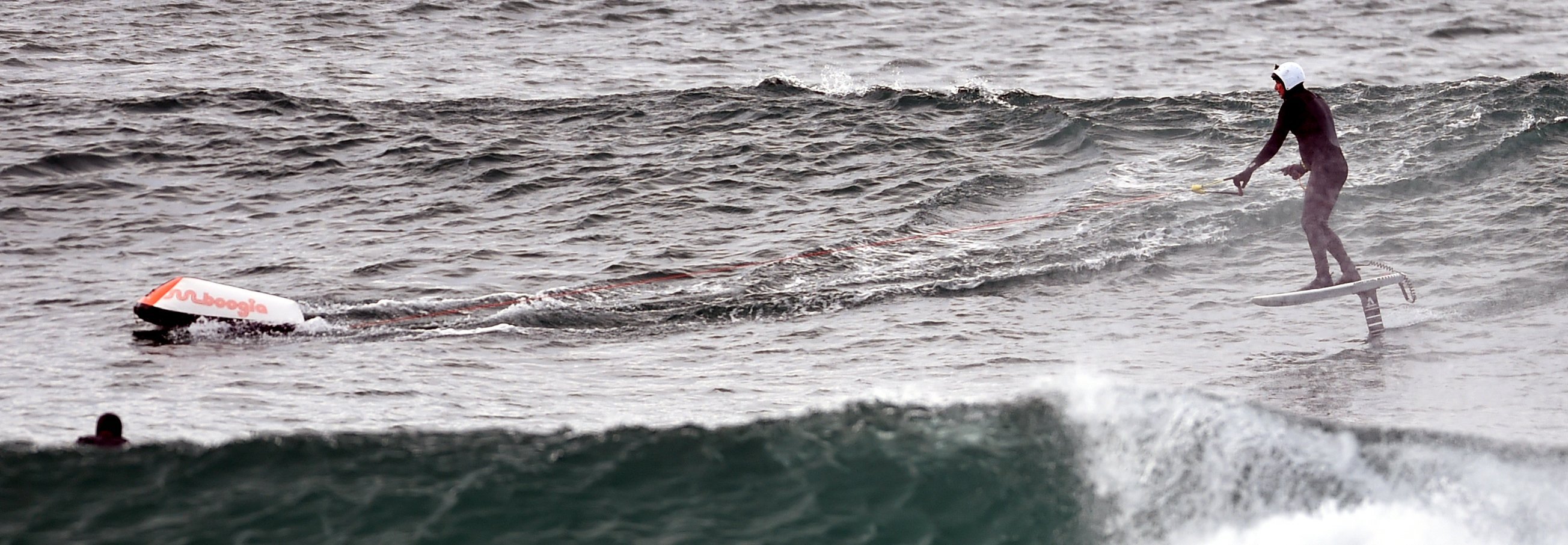
The Catlins man said it was an easy enough skill to pick up.
‘‘It just gets me lots of waves.
‘‘It just tows me on to the wave and then I let go of the rope and then I’m on the wave and it automatically follows me through GPS.’’
The technology has taken off, Mr Smart said, and his own hydrofoil system was designed by New Zealand company Armstrong Foils.
‘‘It’s good to support local, you know, support New Zealand companies - Armstrong foils are a wee bit more pricey, but they’re renowned as the best foils in the world.
‘‘All the boats in SailGP now have Armstrong wingtip foils, so that’s a big, massive move forward for them.’’
Mr Smart, who runs his own surf school, said hydrofoiling was a bit more solitary than ordinary surfing.
‘‘It’s extremely important to use it away from surfers though. It’s not a tool that’s to be put among people.
‘‘It doesn’t have collision avoidance, so if someone gets between me and the boogie, it will run them over.
‘‘What I do is I’ll ride the wave for 20 seconds or 30 seconds, and then as soon as I see the surfers getting close to me, I just scoot off the back and pump out the back and get another wave away from them.’’
But for Mr Smart, there was a lot of enjoyment out of the relatively new technology.
‘‘There hasn’t been a lot of change in the technology of surfboards for a long time, so foiling seems to be the way that it’s headed.
‘‘There’s always been surfers and they’re purists, but foiling is a new angle on surfing.’’


