
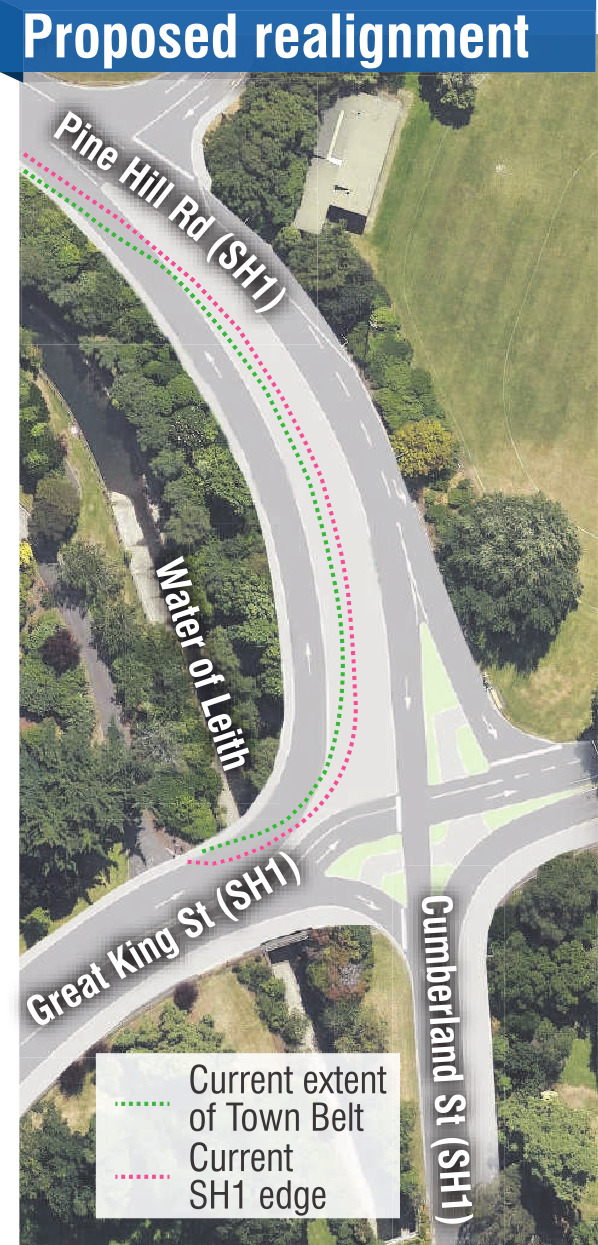
NZ Transport Agency Waka Kotahi (NZTA) proposes to shift the State Highway1 northbound Pine Hill Rd uphill lane, out of Great King St, by about 10m into the Dunedin Town Belt.
Public feedback to the agency largely backed the plan and many respondents to the consultation described the intersection as high risk and in need of urgent attention.
"Improved sightlines were seen as essential to reducing the frequency and severity of crashes, particularly for vehicles crossing or descending the hill," NZTA said in its feedback summary.
Some people who made submissions considered the proposed changes practical and cost-effective.
"Others called for bold, long-term infrastructure solutions such as flyovers or underpasses," NZTA said.
Great King St provides access to North East Valley, but it also crosses the main entry into Dunedin from the north.
Transport officials had previously observed the main issues there had included trucks having brake failure or brake fade as they came down Pine Hill Rd, inadequate visibility from Great King St and poor provision for cyclists and pedestrians.
The agency said a wide range of suggestions were offered to improve the proposal.
Ideas included installation of flashing or smart stop signs to increase driver awareness, improved road markings and removing roadside vegetation.
There were 167 responses to a survey question about visibility for drivers at the intersection of Pine Hill Rd and Great King St.
Slightly south along SH1, the agency proposes to stop the straight-through movement in Duke St across Cumberland St.
Traffic from Duke St would instead be required to turn into the one-way Cumberland St.
The agency said there was general support for this.
Many respondents viewed the proposed change as a way to reduce confusion and improve safety at the intersection, NZTA said.
The most frequently raised concerns about proposed changes were potential parking losses in high-demand areas, particularly near Duke St, Queens Gardens and at key bus stops.
"Respondents emphasised the importance of maintaining access for students, hospital visitors, and local businesses, and were concerned about the cumulative impact of parking losses."
The need for safer infrastructure for cyclists and pedestrians, especially at complex intersections, was another key theme.
The agency intends to finalise its plan by the end of the year and apply for funding early next year.


