
PHOTO
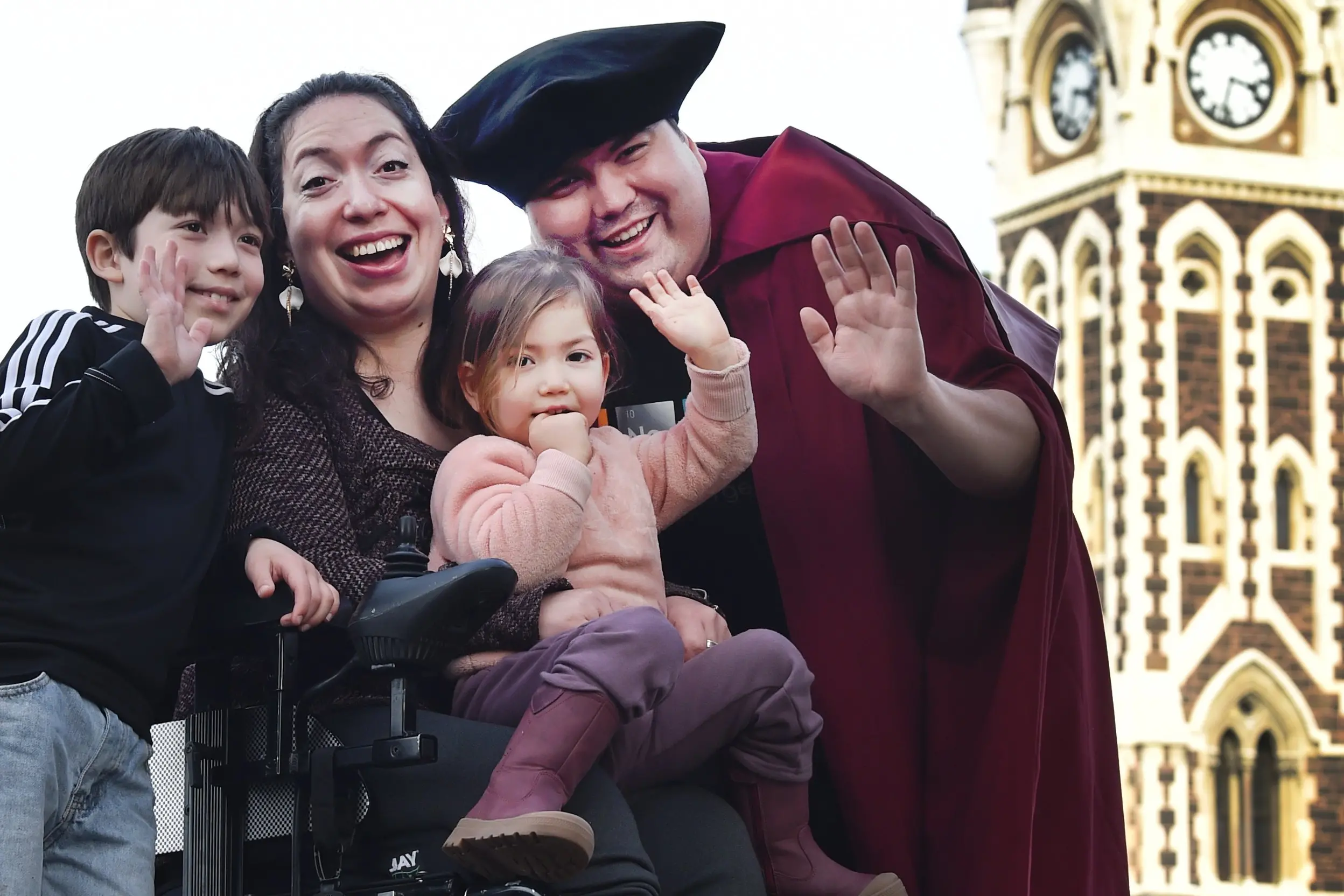
Shifting family from Chile to Dunedin during Covid-19; rushing overseas for life-saving surgery for his baby daughter; and supporting his wife following a miscarriage and a cancer diagnosis — nothing has been straightforward about Benjamin Duran-Vinet’s study for a PhD.
Surprisingly, now that the 28-year-old has overcome the major adversities and is about to graduate from the University of Otago this afternoon, he believes he has been “extremely lucky and extremely blessed”.
He said he had only coped because of the support of his wife Karla, and by remembering an old Spanish proverb — “al mal tiempo, buena cara”, which means “to bad weather, a good face”.
About a year after the couple settled into university life in Dunedin with their son Maximo, they welcomed daughter Amelia into the world.
But soon after her birth, doctors diagnosed her with scaphocephaly — a condition where the cranial sutures fuse prematurely and restrict normal brain and skull growth.
“That can potentially generate neural damage, usually permanent, because the skull doesn’t expand but the brain keeps growing,” he said.
“So we had to go to Texas, in the USA, to a special hospital.
“They have a really novel surgery which is minimally invasive, and it’s really amazing.”
While they still have to wait until she is 5 to see if there has been any neural damage, Dr Duran-Vinet said Amelia appeared to be just like any other 2-year-old.
“She’s just running around, making a mess, and she is always asking, ‘why, Dad, why?’ and wanting to know more about everything.”
No sooner had they jumped that hurdle, another popped up when Karla was diagnosed with ovarian cancer.
It was discovered after their third baby miscarried.
Dr Duran-Vinet said his wife had had surgery to remove the cancer and the prognosis was looking good.
“We have had a check-up and everything looks clean. But she still has to be on the screening list for five years.”
Life had been quite challenging over the past three years, but the family had only coped by supporting each other through it, he said.
“I think Karla is very, very strong, and we try to support each other.
“Whenever we have an issue like this, of course it hits you, but then we’re like, ‘okay, we’re going to go through this’.
“This is just another challenge. We just need to keep moving forward, and we’re going to find a way to solve it.
“We have never had too much time in our lives to feel sad about anything. It’s more about making proactive actions to fix whatever is in front of you.
“In Chile, we say, ‘make a good face to the bad weather’.”
Despite everything that had happened over the past three years, he said he felt lucky.
“It could have been much worse.
“Every challenge that we went through, we were always feeling extremely lucky and extremely blessed and extremely well supported by the community, because it could have gone way worse.”
Somehow, between all of this adversity, he has managed to complete his PhD in genetics, which focuses on environmental biosurveillance and biosecurity applications.
Now his PhD research is attracting growing international attention — particularly the eDNA-based test that he has been working on, which has detected two significant invasive marine species in New Zealand already.
“In easy terms, it means that we’re able to detect biosecurity threats very early on, before it’s an actual issue, and we can put the appropriate responses in place so we can avoid economic and environmental damage to productive ecosystems like agriculture, aquaculture, poultry and cattle, from invasive species.”
The platform technology is now being further developed to help monitor and manage endangered Hector’s and Māui dolphins, he said.
Dr Duran-Vinet is among hundreds of graduates who will receive their degrees during two ceremonies (1pm and 4pm) at the Dunedin Town Hall, on Saturday.
john.lewis@odt.co.nz