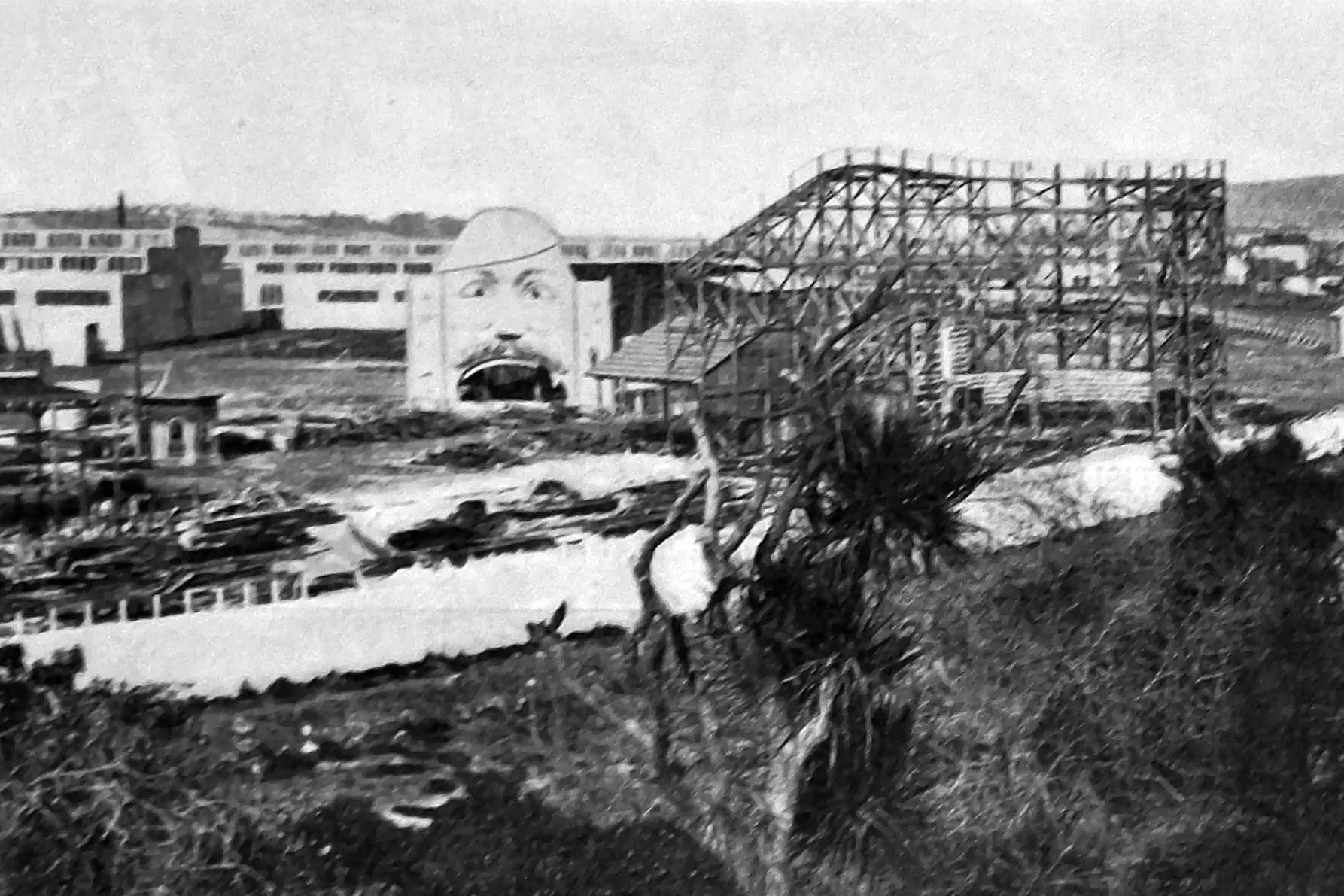
When the Amusements Park at the New Zealand and South Seas Exhibition was first opened there were few who thought that it would become the success it ultimately proved. The seven devices (the scenic railway, the river caves, the fun factory, the whip, the dodgem, the caterpillar and the merry mix-up) were always kept busy, with the result that the takings amounted to over £10,000 per month — a total of 156,270 for the 5½ months during which they were running. When the Exhibition was closed the devices were purchased by a syndicate, which decided that the most suitable city for the reconstruction of the park was Auckland, which, in addition to a large population, has a climate particularly suitable for such a form of entertainment. A site within a few minutes’ walk of Queen street, and with an area of 2¾ acres, was procured, enabling the length of the scenic railway to be increased to 3000 feet — twice as long as the ride at Logan Park. The Auckland Amusement Park (Ltd) has been formed to finance the undertaking, and the directors expect to be able to open the park during the first week in December. Unemployment is misery It is a lamentable and pathetic thing that unemployment should exist in our midst — indeed, that it should exist anywhere. It is lamentable, for it implies that society has failed to give security to its deserving members. It is pathetic because it entails actual suffering, physical and mental, on those it has visited. Further, unemployment is a disease that attacks the very heart, the moral being, of society. Most men in normal times maintain a respectable average of moral conduct, balancing temptation by resistance, at least so far as to avoid the law. In a time of unemployment, however, the balance fails. The sight of one’s family hungry, ill-clad, or in ill health without the necessary attention and comfort, the desperate feeling that even the best intention in the world to work honourably for a living is thwarted by the absence of work, upsets the balance. Ordinary restrictions of morality are thrown off, and during periods of unemployment offences and crimes increase. It would be unnatural if they did not. No man who really loves his country or has any feeling of brotherliness for his neighbour, no matter what his occupation may be, can sit down comfortably to his breakfast, knowing that in a neighbouring street the breadwinner is out of work and that grim misery is in the house. Unemployment, long continued, is a disgrace to a civilised Christian community. It is a question that demands the thought of all men of goodwill. — editorial Time of trial On June 28, 1914, the Archduke Ferdinand, of Austria, was assassinated, and exactly one month later Austria declared war on Serbia. That was the first definite step that was to involve the whole of Europe in a devastating conflict. On August 1 Germany declared war on Russia, the Germans entered France, and the Russians entered Germany. Two days later Germany declared war on France, and with the violation of Belgian neutrality, when Germany expressed her contempt for the Scrap of Paper, Great Britain entered the conflict. That was on August 4, 1914, a day that will never be forgotten. MPs’ bar keeps the booze Only 29 members of the New Zealand Parliament voted for a “dry” Bellamy’s. The Prohibitionists must be able to claim the support of more than 29 members in the two Houses. But their supporters are not prepared to prohibit themselves, though they may prohibit others. — by ‘Civis’ Coarse gravel bad for walking Complaints regarding the size of the screenings placed on the footpaths at St Leonards were made by Cr J.W.H. Clarke at last night’s meeting of the West Harbour Borough Council. He said that the screenings were so large and rough that the residents preferred to walk on the roadway. The Mayor (Mr H.E. Moller) said that the stones carted from the quarry were too large, but the council had to be satisfied with what was available. — ODT, 4.8.1926