
PHOTO
The family of a New Zealand woman believed to have been near the location of a devastating flash flood and landslide in Nepal are desperately hoping she made it to higher ground.
- New Zealanders requiring urgent consular assistance can call the emergency line on +64 99 20 20 20.
A huge wall of mud and rock collapsed into a river on the Himalayan border of Nepal and China's Tibet on Wednesday, triggering catastrophic flooding on the Nepali side that killed scores of people.
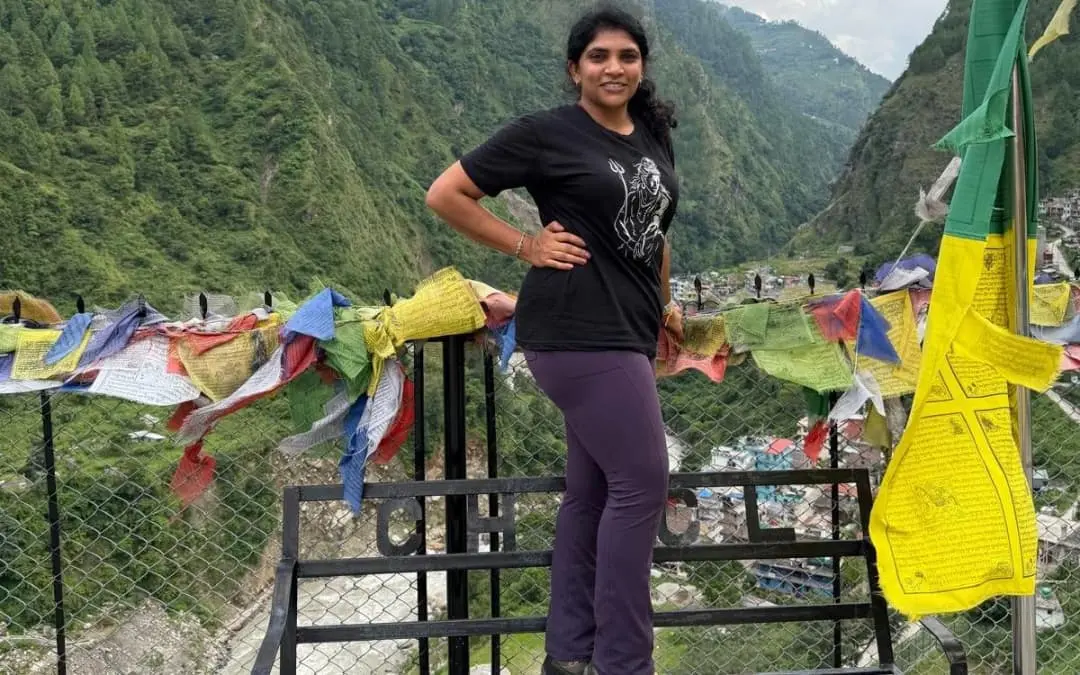
Suhasini Reddy is one of at least five Kiwis unaccounted for.
Her brother Rajeev Reddy told RNZ on Thursday she and the group of hikers she had been due to meet with Chinese authorities to get permission to cross the border close to the time the raging flood hit.
Her appointment was at 11am (local time); the tragedy unfolded shortly after 8.30am.
Rajeev Reddy said his sister was a mother of two and was a New Zealand citizen who lived in Australia.
Late on Thursday afternoon, three of the other missing New Zealanders were named.
They are Auckland man Dejan Kuzmic, and Hamilton couple Mihir and Kinnari Patel.
Kuzmic was travelling on the Kailash Mansarovar Yatra, a pilgrimage to Mount Kailash, when the disaster struck.
Nepal's Tourist Police confirmed his name to RNZ.
The Patels own the Best Value Urlich Ave Dairy in Hamilton.

Their eldest son, Drishya Patel, told RNZ the couple were visiting Nepal to celebrate his mother's upcoming 50th birthday. The couple had been gone for about a week, he said.
"They're just on a trip to go visit some of the mountains in Nepal… It's like a pilgrimage of sorts."
Drishya Patel spoke to his father the day before the flash flood. He said the couple's trip was going "really good".
"They were having a good time."
Nearly 1500 people including more than 700 foreigners were missing, authorities said on Thursday evening (NZ time).Almost 500 foreigners were among 826 people missing in Nepal, police and tourism officials said.
Among the missing tourists from more than two dozen countries, 177 were from India, 63 were from the United States, 34 from Australia, 33 from Britain and 25 from Canada.
The tally of missing in Tibet's Gyirong county was 558, Chinese state broadcaster CCTV said on Thursday, including 260 foreign nationals. China said the death toll stayed at three.
A total of 270 bodies had been found, Nepal's police said in a post on X late on Thursday night.
Verified videos showed crushing masses of water and debris sweeping away dozens of people at the border, with authorities in both China and Nepal fearing far higher casualties and massive destruction.
New Zealand’s Prime Minister Christopher Luxon described the images coming out of Nepal and China as "heartbreaking", saying the government was in touch with Nepal authorities about Kiwis who may be affected.
"My deep condolences to those affected and to impacted communities," he wrote in a post on X.
Foreign Minister Winston Peters said his ministry and international agencies were undertaking "full scale investigations" but they did not yet know how many Kiwis were missing, or the total number of New Zealanders in Nepal.
"We're doing our best to find out as we speak. It's very early days, it's only ... so many hours ago that this has happened, and so we're doing the best we can to find out so we can report to New Zealand people."
The affected countries' governments had not asked New Zealand for resources, Peters said.
Former Honorary Consul of Nepal to Auckland, Dinesh Khadka, told RNZ on Thursday that Nepal Police had given him the names of five New Zealanders unaccounted for.
The Ministry of Foreign Affairs and Trade (MFAT) has yet to confirm the number.
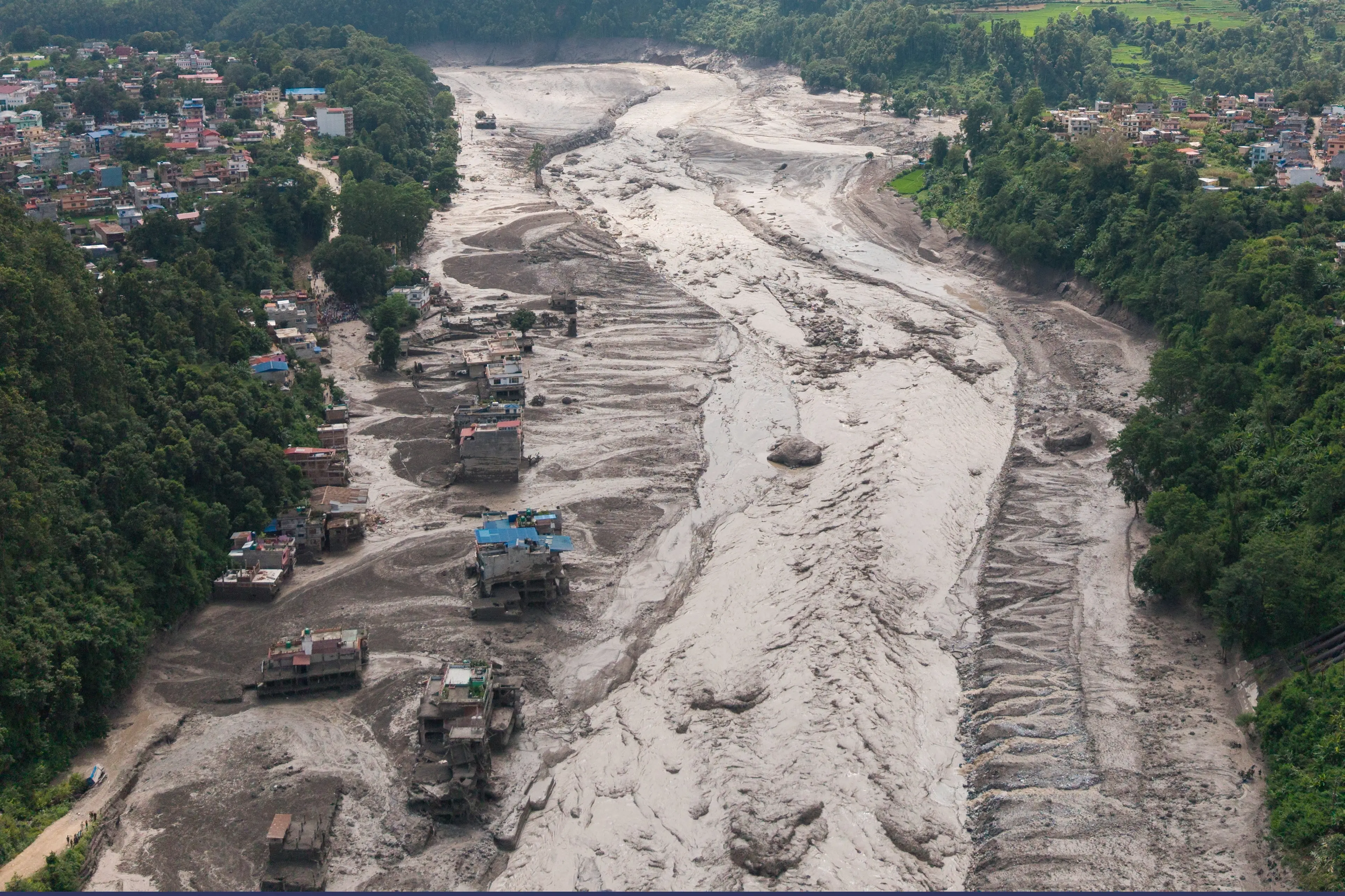
Houses, roads and power projects were washed away in Nepal, while officials in Tibet said they feared "major casualties" after a mudslide hit a border land crossing in the county of Gyirong.
"It was a huge gush of mud coming straight towards us. As it got closer, it kept rising higher and higher. When I saw it enter our home, I tried to grab my wife's hand and take her to the terrace. But she was swept away by the mud," said Keshav Prasad Baral, a 68-year-old survivor, who was being treated at a small hospital.
"Four or five hours later, a helicopter came to rescue me. My wife is still somewhere beneath the mud. She's gone."
Another survivor described being saved by clinging to a mango tree as he watched the house where he had been working disappear.
Initial reports from Nepali officials suggested an earthquake in the area could have caused the lower part of a glacier to collapse and trigger the floods.
As darkness fell, authorities continued the grim task of recovering and trying to identify bodies.
POPULAR PILGRIMAGE AREA
Many of the victims were on a pilgrimage to Kailash Mansarovar, a high-altitude site in Tibet that is revered by Hindus, Buddhists and others.
Mount Kailash, believed by Hindus to be the abode of Lord Shiva, lies on the banks of Lake Mansarovar, also seen by various religions as sacred.
Sunil Sharma, a Nepal tourism board spokesperson, told the Toronto Star that 133 of the tourists were from India on a pilgrimage.
A US State Department spokesperson said: "The State Department is aware of Americans impacted by the floods in Nepal and is closely tracking the situation."
Canada was also closely following the situation, said Canadian Prime Minister Mark Carney on X, calling the floods "absolutely devastating."
United Nations Secretary-General Antonio Guterres said UN teams and partners were mobilising supplies and personnel in Nepal to support communities affected by the disaster.
Australian Prime Minister Anthony Albanese confirmed that 34 Australians were missing. “Nepal, you know, is a developing country. It doesn’t have the resources that an event like that would have in Australia, so information is difficult.”
China's state broadcaster said three people were killed and 265 missing in Gyirong. It said the toll was still being verified and rescue efforts were ongoing.
South Korea said eight of its nationals working on a hydropower plant were missing, while Malaysia and Japan also reported missing nationals.
FIXED CAMERA FOOTAGE SHOWS PEOPLE FLEEING
Security footage captured on the Chinese side of the Nepal-Tibet border showed many people fleeing before a torrent of rock, mud and water destroyed buildings and vehicles and took many lives.
The German Research Centre for Geosciences said there was a 4.4-magnitude quake approximately seven minutes before the time shown on the security footage time-stamp.
Locals from the affected areas of Nuwakot and Dhading were seen gathering outside a Nepali army training centre - the base for helicopter rescue operations - seeking information about missing family members.
Police were recording the names of the missing just outside the barracks gate, using mobile phone flashlights as their only source of light as the area remained without electricity due to damaged hydropower infrastructure.
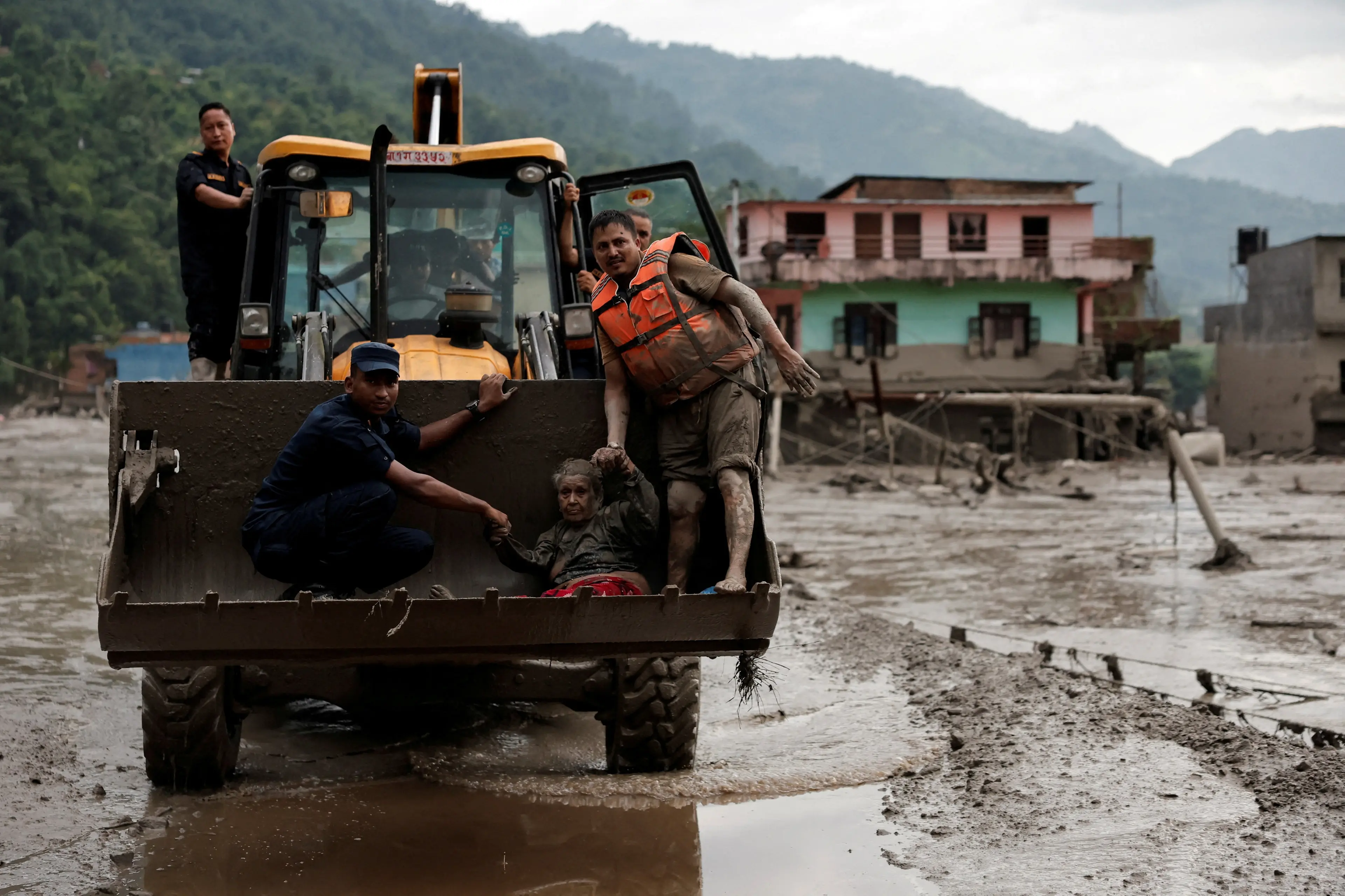
In the affected areas, houses, trees and vehicles were submerged or buried in mudslides. Helicopters hovered overhead all day in the area bringing in survivors.
An initial study of Planet Labs satellite imagery indicated that a landslide of ice and rock triggered a debris-laden flood in the Lhende River, about 20km northeast of the Nepal-China Rasuwagadhi border crossing, Nepal's National Disaster Risk Reduction and Management Authority said on X.
Rescue helicopters could not land in Nepal's affected areas of Syapru Besi and Timure in the mountainous district of Rasuwa, with a population of about 50,000, officials said, with the river flowing above its normal course.
Television images showed collapsed homes, floating cars and a metal bridge being washed away, while witnesses told Reuters the waters engulfed entire villages.
"There is devastation everywhere we look," Tula Bahadur BK, a health worker in Rasuwa, told Reuters. "The settlements next to the river have been completely swept away. Five of my own relatives are missing."
GYIRONG PORT AFFECTED
China's official Xinhua news agency said the mudslide hit the Gyirong port, cutting roads, communications and power links in the Shigatse region near the border.
A rescuer interviewed by Chinese state broadcaster CCTV said they had been trying to establish contact with the Gyirong border port but "so far there haven't been any results". All roads leading to the border crossing had been "completely destroyed" after a preliminary inspection with a drone, the rescuer added.
With the deluge of muddy water sweeping down from an estimated nearly 2000 metres (6,560 feet) above sea level, flood alerts were issued in the populous northern Indian states of Uttar Pradesh and Bihar, which border Nepal and where several rivers flow down the mountains into the plains.
Authorities in Bihar said they had evacuated about 5000 people from six districts and planned to evacuate a total of 10,000 to 12,000 people.
- RNZ and Reuters