
PHOTO
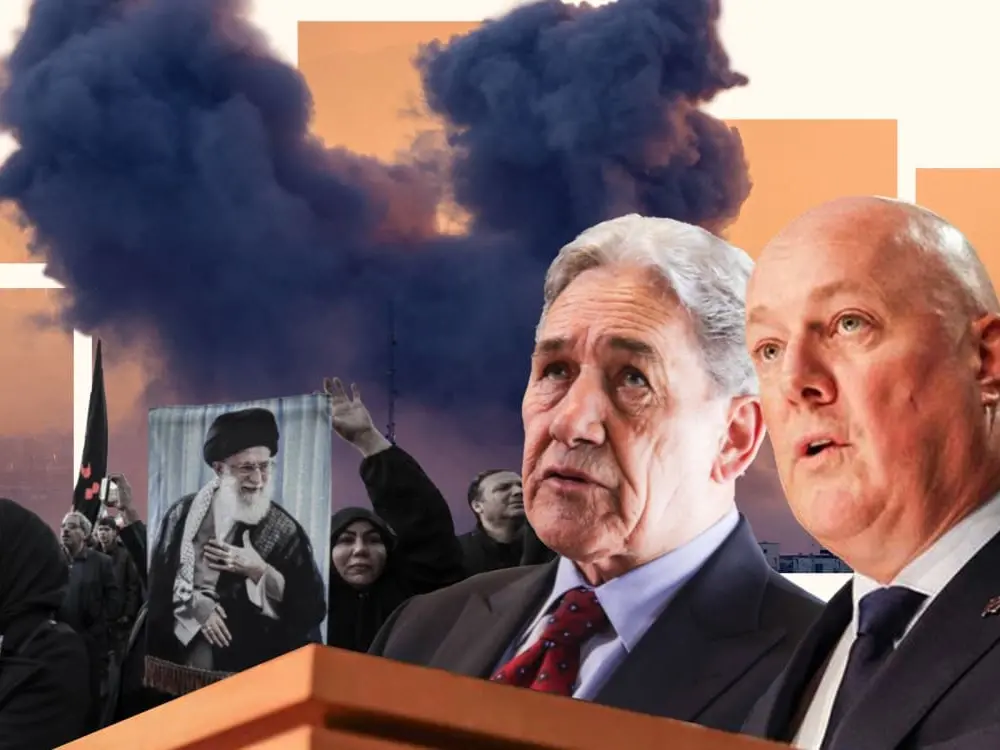
The Prime Minister says he told Winston Peters he expected better political judgement from him during a meeting in the Beehive on Wednesday night.
Christopher Luxon said his coalition partner and foreign minister "acknowledged he had made a mistake" during that meeting after Peters' office released discussions between the pair to the NZ Herald following an Official Information Act request.
The political spat between the two leaders broke out over the release of emails that show Luxon within days of the US-Israel war in Iran starting, wanting to move the Government's position to showing "explicit public support" for the US.
But Luxon's office said the emails released only show Peters' office's characterisation of the Prime Minister's views.
"These emails mischaracterise the PM's position. As you'd expect, it is the PM's job to always challenge the advice he receives and, in this case, he sought to test New Zealand's position against that of Canada and Australia," a spokesperson for Luxon said in a statement to RNZ.
"The public statements made by the Government reflect the PM's position. If they didn't, they would not have been made.
"We were surprised to see Winston Peters' office release internal discussions like these to the media, as our office was not consulted on this.
"The decision to release these discussions to the media clearly put politics ahead of the national interest.
"The PM would expect Mr Peters to show better judgement after more than 40 years in politics."
The Prime Minister met with the Foreign Minister on Wednesday night "to make that point and Mr Peters acknowledged he made a mistake", the spokesperson said.
On Thursday morning RNZ contacted Peters for an interview, but a spokesperson said he had nothing further to add.
In an earlier statement to the NZ Herald - provided before Wednesday Beehive meeting - Peters' spokesperson said the foreign minister had been travelling in Latin America when he was alerted to the Prime Minister's "wish" to express explicit support for the US-led military strikes.
"The minister considered this suggestion to be an imprudent course of action, which would run counter to New Zealand's national interests," the spokesperson said.
"Experience matters in foreign policy."
In late February the United States and Israel launched their attack on Iran, and just a few days later, on March 2, Luxon was on RNZ's Morning Report for his weekly interview.
He was asked whether New Zealand supported the strikes, but Luxon would only go as far as to say the strikes were acknowledged.
In a public written statement, the same word was used by both Luxon and Peters, prompting questions about why New Zealand hadn't joined other like-minded countries, such as Canada and Australia, in using the word "support".
In the documents first released to the NZ Herald there are emails from staff in Peters' office detailing it's the foreign minister's view that New Zealand does not "move towards explicit support, like Australia/Canada have expressed".
"He sees value, from a foreign policy perspective, in walking the careful line we established yesterday via the written statement and in his stand up - which neither condemns nor gives explicit support to the US action", the email stated.
"I think we're going to need to try and come up with a drafting solution - which gives the PM clearer lines to use" but ultimately doesn't substantively change the government position, the staffer wrote.
The email exchange and suggestion New Zealand shift its position came the day after the RNZ interview and a post-Cabinet press conference where Luxon, in both instances, struggled to clearly articulate the government's position on the US-led war in Iran.
The Prime Minister declined an interview with RNZ on Thursday morning.
New Zealand First deputy leader Shane Jones would not comment on the matter, saying it was between the leaders - but he brushed away suggestions of cracks in the coalition.
"The coalition personalities are strong, but the overarching purpose of the coalition is solid, and I think Kiwis are learning and watching the ebb and flow of MMP politics," he said.
Jones said professional politicians sometimes agree to disagree - pointing to the just-signed India free trade agreement which his party opposed.
"The Prime Minister and our two leaders, Mr Seymour and Right Honorable Winston Peters, have achieved a great deal.
"The issue on the India free trade deal was an item that we were entitled to agree to disagree on, and that's how democracy works. I wouldn't catastrophise frothy language," he said.
In a statement to RNZ, Labour leader Chris Hipkins said the emails helped explain Luxon's difficulty in explaining the government's position on the war.
"He's blamed this war for our current fuel woes, when all along he backed it," Hipkins said.
"At first he said 'all actions are justified' which he claimed was a mistake, when clearly it was his view all along."
Hipkins questioned how the coalition parties could run the country given their inability to work with one another.
This story was first published on rnz.co.nz |  |