
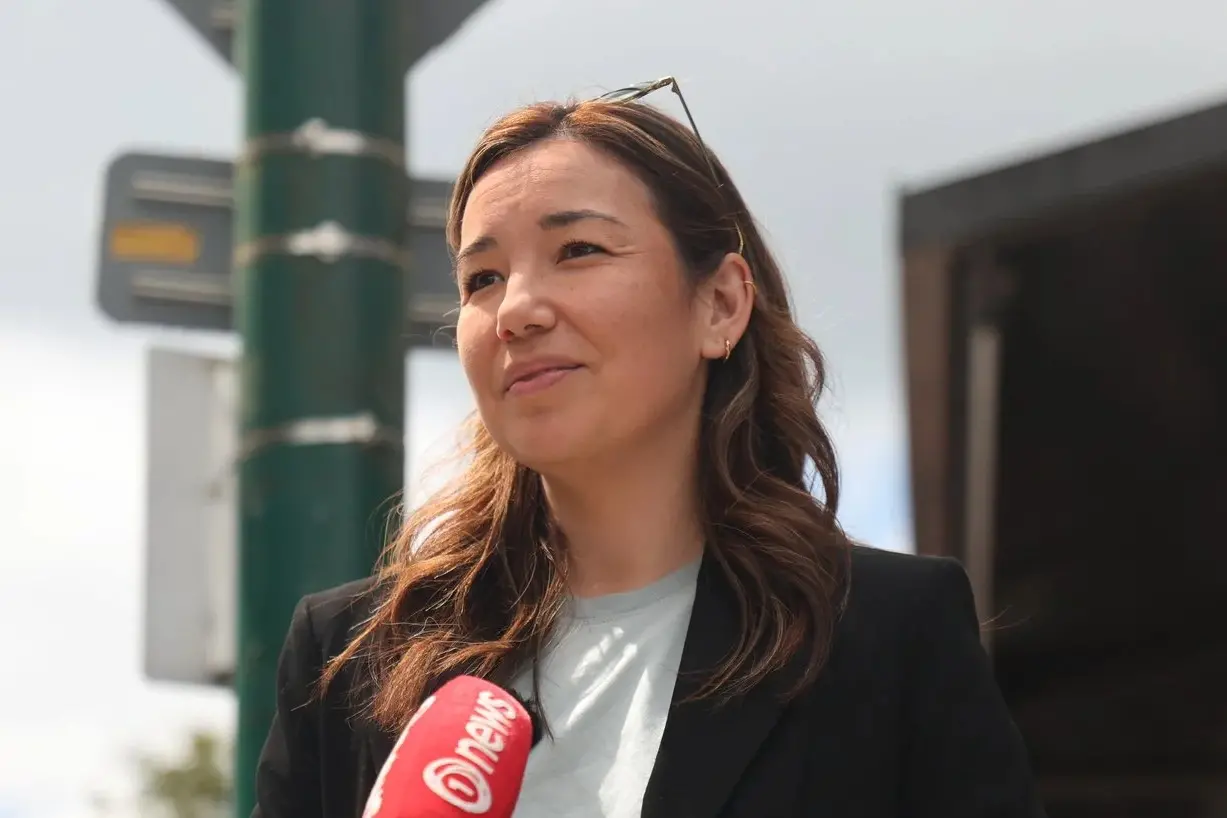
PHOTO
Opportunity leader Qiulae Wong says she would walk away from government rather than support through to first reading a policy that her party doesn't believe in.
Even if the deal was simply to appease another coalition partner, and required no support beyond first reading, Wong told RNZ she would choose being in opposition over compromising on values.
The newest political leader on the block was front and centre in the third debate of the so-called minor party leaders on Wednesday night - the New Zealand Herald Powerbrokers' Debate moderated by Ryan Bridge.
Wong has been questioned heavily in these debates on her party's bottom lines and no-go areas as Opportunity continues to poll over the 5% threshold and hold the position of kingmaker if the results were replicated on November 7.
On Morning Report on Wednesday Wong said she would not have propped up the current coalition of National, New Zealand First, and Act or signed up to its agreements.
"I want to be clear: we are not here to prop up the current coalition government. If that coalition agreement was put in front of us, we would have walked away," she told Morning Report.
"We're not supporting things like a Treaty Principles Bill in this next term of government. But if there are other things that we can work with parties on, whether that's tackling competition or investing in innovation, then we will work with them on that."
Asked by RNZ following the Powerbrokers' Debate what the threshold was for walking away and being in opposition over government, Wong said "the way that we approach those things is we genuinely have to believe that it's a good idea".
She said New Zealand First's proposal to buy back the BNZ bank was an example of a policy the party wouldn't support, not even through to first reading, adding "but I don't think anyone really believes that's going to happen".
Other policies the party wouldn't give even initial support to include Act's freezing the minimum wage, National's drug testing beneficiaries and both Act and New Zealand First's pledge to abolish the Waitangi Tribunal.
Wong told RNZ Opportunity had been "really generous putting out our bottom lines" when other parties did not, and that had made it really clear what the party's vision for the future of the country was.
'I learnt the hard way' - Peters on being smacked as a child
The other eye-opener of the debate in Auckland was New Zealand First leader Winston Peters saying he was smacked as a child and that he "thoroughly deserved them".
Peters was one of 11 children in his family growing up in Whananaki and following the debate he expanded on what trouble he had got into, which had caused him to be punished.
He said he was one of the more naughty of his siblings - "I can't deny that but then heavens I was shown the error of my way, so to speak."
Asked to recall an example of this behaviour, Peters told RNZ he and his brother had got into trouble for racing horses on the beach.
"The previous night we had a fantastic time having the horse race but this night it was so quiet my father heard it, so in the middle of the race he comes rushing out of the trees, and all of a sudden we're walking home having rather sore legs, and then we had to walk to school for the next month.
"That was the punishment, yeah, I learnt the hard way," he said.
Peters and Wong took part in the debate alongside Greens' co-leader Marama Davidson and Act leader David Seymour.
Te Pāti Māori was also due to be there but pulled out after news of the death of co-leader Debbie Ngarewa-Packer's mother, who had been ill throughout the campaign.
Davidson was asked for her response to Peters speaking positively about being hit as a child - it was the Green Party's Sue Bradford that got the anti-smacking law passed in 2007 after introducing it as a member's bill.
She told RNZ she fully understood as a parent how stressful it could be raising young children.
"It's really ordinary for people to feel wigged out many times as a parent of young children, but I think that where we have to be putting our emphasis is in all of us supporting each other to just end violence of all forms towards any child."
'The political market is changing'
Seymour spoke during the Powerbrokers' Debate of being proud of the work he had done cross-party to get the assisted dying legislation passed through Parliament.
Asked following the debate what advice he had for Christopher Luxon and Chris Hipkins about how to reach bipartisanship on the tough issues, Seymour told RNZ "there's no limit to what you can achieve if you don't care who takes the credit".
"I, still, as recently as a couple of weeks ago, credited Chloe Swarbrick for her role in helping get the End of Life Choice Act passed. Now, as you know, Chloe and I don't always see eye to eye, but on that issue, I'm happy to do so.
"Secondly, you've got to be prepared to not make the perfect the enemy of the good. The bill that we finally passed is not the one that I introduced. So, if you're prepared to make the odd compromise where necessary, if you're prepared to share the credit, there's no limit to what you can achieve," he said.
Seymour was of the belief the "political market is changing" and voters wanted to see better collaboration between political parties on things like transport and infrastructure.
"It takes 10 years to build a decent road - that's three electoral cycles.
"Obviously, if we don't start working out better institutions for planning infrastructure, we'll never get anything built, which is basically what's happened for the last five years," he said.
