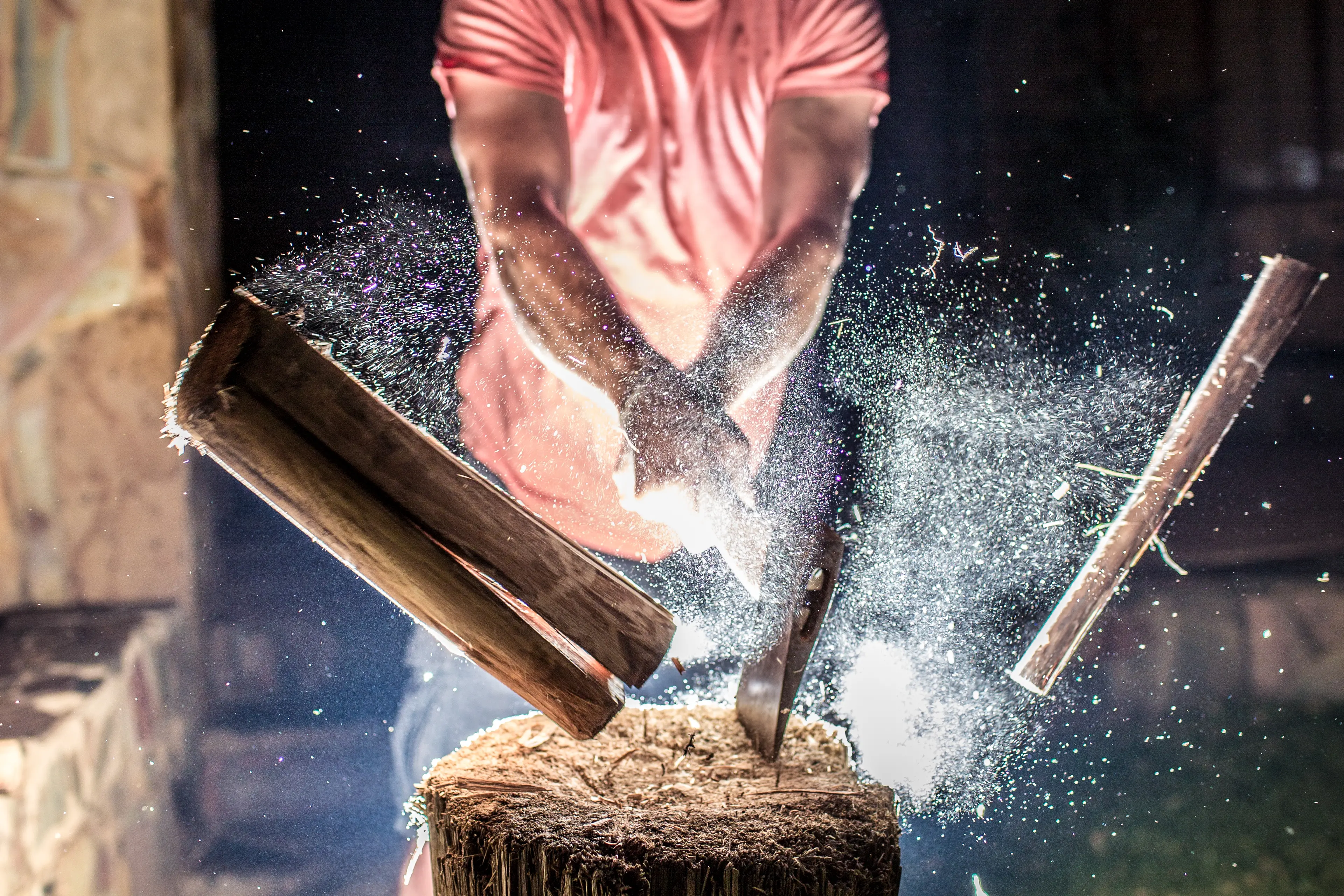
JIM emailed from Canada. He’d fulfilled an ambition by having a log burner installed — only he called it a wood stove. Now he was spending the northern summer chopping and stacking wood against the northern winter and he was emailing to say that he had always liked splitting wood and that he found it therapeutic and that he thought of it as a form of a meditation. I emailed a one-word answer. Yes, I said. Fire is an ancient essential. We’re the naked ape in a cool world. And our eyes are no good in the dark. The oldest image of our species is around the campfire at the mouth of the cave, faces bent to the heat and light, backs turned to the cold and dark and the night shrieks of a dangerous beyond. Hearth and home are the same thing. Last year I wrote about having three poplars felled. The arborist said the wood wasn’t worth burning. But it was there and it was mine and it was free and I went at it. As I type this, the log burner upstairs is reducing some of that work to a feathery ash. For sure it burns fast but it burns hot and that heat is 30 years or more of sunshine beating down right here on this little patch of earth and being captured by the leaves of a tree and stored, held. There’s an atavistic art to splitting wood. For a chopping block I use a round of timber sat solid in the ground so that – and this is physics – the force of the chopping is not weakened by wobble. As I place the round to be chopped on the block, I assess it. How fat is it? Is it a knotty thing? Is the grain straight? Are there the stumps of branches on its flanks? Are there preliminary cracks? With practice, assessment becomes instantaneous. As I reach for the splitter I know where I’ll aim the first blow and I have a sense of how hard. The splitter is a splendid tool, like a medieval war-hammer. A metre of handle ending in two or three kilos of steel shaped into a blunt wedge. The idea is that if it manages to penetrate, it’s all over. The wood is wrenched open by raw violence. Raising anything above your head and bringing it down with force feels good, feels like something a man should do, feels like action. And when the wood splits as foreseen, it feels better still. If the halves fly you’ve swung too hard. They should drop neatly either side of the block, like shot birds. Some rounds resist. They are cussed creatures, whorled and knotted. The grain twists and dives around the stubs of branches. The splitter can’t find a flaw, can’t breach the flesh. It thuds down and is repelled, time and again. I turn the timber, turn it round, turn it over, seeking the weakness, the fault line. It is tempting to discard the thing, split easier wood, but there is a challenge there and I am in sweaty, manly mode and bent on victory. I choose one final point of attack, swing the splitter higher and further back over my head than I have swung it before. It feels daring. It feels primal. If the head came off now it would be a missile to kill a cow. I bring the thing down with a Viking roar and a force that lifts me off my little feet, and I feel the head bite and the wood graunch. It isn’t split yet but I’m in through the gates and the end is now inevitable. To turn a mound of rounds to a stack of firewood, leaning against the side of the house to dry through the summer, is a good day’s work. The back aches at the end of it, the arms hang with exhaustion. It’s what people go to the gym to fail to find. For the gym is the treadmill going nowhere, is the hamster in its wheel, is unproductive vanity. But the wood stack is product, is an investment of time and sweat. It’s food in the larder, money in the bank, a bulwark against the winter that is always coming. And is the evening, the summer evening, with earned food and earned wine and an earned ache in the flesh, it is impossible to resist the urge to step out and admire the stack of wood that wasn’t there that morning, to pat its heft, assess its girth and to say ``I bloody did that.’’ Therapeutic? Yes. Meditative? Yes. Good? You tell me. Joe Bennett is a Lyttelton writer.