
PHOTO
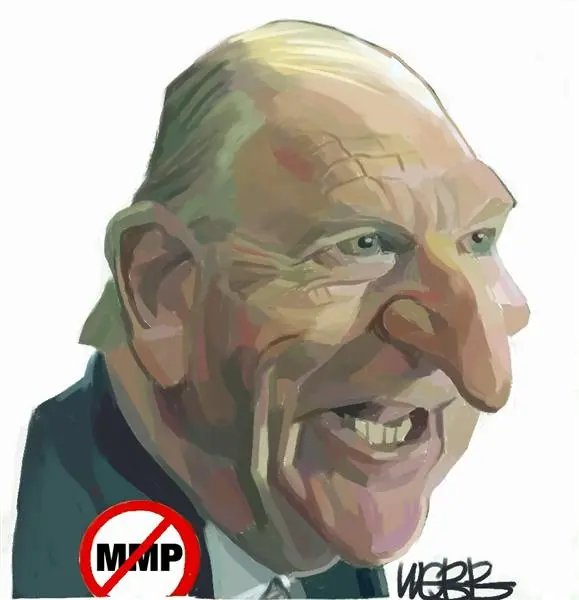
Nearly half of all New Zealanders would like to see the end of MMP, a survey suggests.
A new Herald-digipoll shows 49% of respondents would vote to get rid of the controversial electoral system when it goes to referendum in 2011.
Only 35.8% of those polled would vote to keep it, and 15.2% of respondents did not know.
The referendum - to be held at the 2011 general election - will ask voters if they want to keep MMP or change it.
If their choice is anything like the results of today's poll, a second referendum will be held at the 2014 election pitting MMP against the most popular alternative.
If that referendum is won by a new system, it will be put in place for the 2017 election.
Today's poll puts the mood for change at a much greater level than many have suspected, with politicians like Prime Minister John Key believing New Zealanders were increasingly comfortable with MMP.
The result was welcomed by long-time anti-MMP campaigner Peter Shirtcliffe.
It was no surprise so many people would vote for change, but the discontent found in the survey showed they should get a chance to do so as soon as possible, he said.
He was surprised by what he believed was a lack of public outcry about the two-stage referendum process set, which meant change was eight years away.
"It is an outrage.
We should be rearing up on our hind legs about the delay in getting rid of this."
Mr Shirtcliffe said the dissatisfaction with MMP was firmly embedded.
He was regularly stopped in the street and and asked "what are you doing to get rid of MMP" even though he actively campaigned on it back in 1993.
But Green co-leader and MMP supporter Metiria Turei said the poll result showed the need for the referendum's education campaign, as the public was not yet engaged in discussion about it.
Many people who responded negatively towards MMP might only have a problem with aspects of the system, which was still widely misunderstood, she said.
"There has been no opportunity for the public to be educated about it, and until that happens a poll like this is not going to be a true indicator of people's views," she said.
The Government has said an independent panel will be appointed to conduct a public education campaign in the lead-up to the 2011 referendum, with a budget of $6 million.
The referendum itself will cost $11.5 million.
The first MMP election was held in 1996.
Five Parliaments have now been elected under MMP elections.
A cross-party select committee reviewed MMP in 2001.
In last year's election campaign, National promised a referendum on MMP.
A Royal Commission into the electoral system was set up under the fourth Labour government, and reported in 1986.
It recommended a referendum on the adoption of MMP (mixed member proportional).
Then-National leader Jim Bolger promised to hold a referendum if National was elected, which it was in 1990.
In a referendum in 1992, 84.7% voted for change and 15.3% to retain first past the post.
Of the four alternatives offered, MMP polled highest with 70.5%; then STV (single transferable vote) with 17.4%; PV (preferential voting) 6.6%; and SM (supplementary member) 5.6%.
A referendum was held between MMP and first past the post at the same time as the 1993 general election and won 53.85% of the vote compared with 46.14% for first past the post.