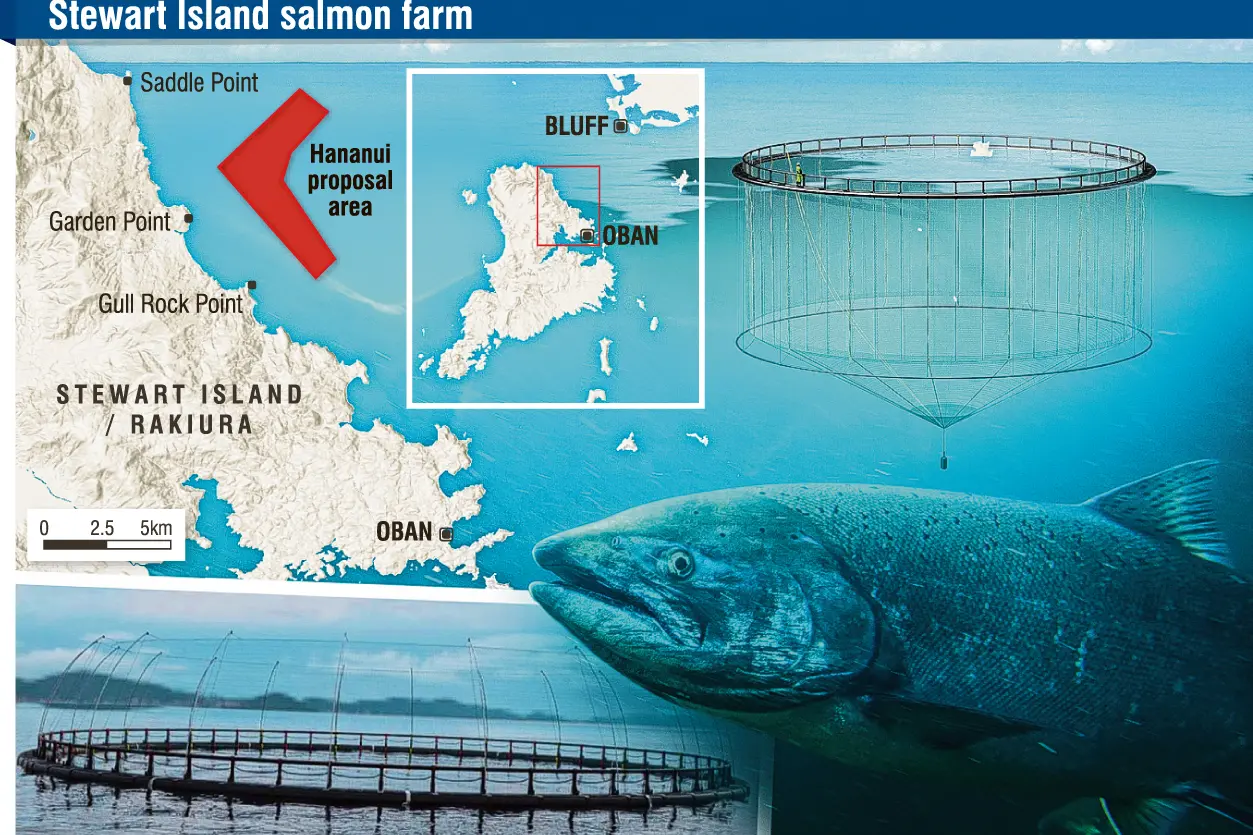
A massive salmon farm in Foveaux Strait, which has the potential to double salmon exports, and bring in $5 billion, has gained approval. Ngāi Tahu Seafood Resources Ltd had applied through the fast-track process to construct a coastal water finfish farm off the northern coast of Stewart Island, known as the Hananui Aquaculture Project. It was third time lucky for the applicant after it was declined twice previously. The construction and operation will have four marine farms positioned within an 1285ha area 2-6km from the shore. The marine farms will consist of polar circle pens, each farm comprising up to 20 pens, in two 10-pen blocks, along with associated mooring lines, anchors and anchor blocks, feed and accommodation barges and navigational aids. The principal activity of the farms is the stocking of pens with fish, introduced as smolt, and feeding of those fish, to a harvest weight of about 4.5kg-5kg. It will be built in two stages, the first stage comprising one block of 10 pens at each of the four farm sites and a total discharge of up to 15,000 tonnes of feed per annum. The second stage will have a further block of 10 pens at each of the four farm sites with a total aggregate discharge of up to 25,000 tonnes of feed per annum. The development of the second stage will depend on the results from the first stage and effects remaining within specified thresholds. An application for a salmon farm was lodged in December 2019, but then withdrawn by the applicant. A new application was then lodged in 2022 with the Environmental Protection Authority (EPA) under the Covid-19 fast-track Act but it was declined by the expert hearing panel. In its decision yesterday, the fast-track panel of chairman Bal Matheson KC, Dr Ngaire Phillips and Stephen Daysh said in its decision this application was being carried out under a very different legislative framework from the Covid-19 panel. Market Economics Ltd director Lawrence McIlrath had told the panel foreign exports from the farm would make a gross $5.04b over the course of the consent. The panel found the project would assist with the development of New Zealand’s aquaculture industry, which has been identified as a priority project. The panel concluded the project would deliver significant economic benefits. There would be a return to households, from the total economic activity associated with the fish farm, of up to $841 million, of which $386m would be to households in Southland. The panel questioned whether the gross revenue figure was correct. The applicant confirmed this figure was taken from the Southland Aquaculture Pathway 2025 report, which was in turn supported by work undertaken by Infometrics. It would take 10 years for the project to be at full scale, thereby allowing 15 years for it to operate at full scale, based on a 25-year consent. The panel found by a wide margin that the benefits of the project were regionally significant. "The project contributes materially to the development of New Zealand’s aquaculture industry. Then those benefits are arguably also nationally significant.” The panel also said the the cultural benefits identified by mana whenua were regionally significant. RNZ / Samuel RillstoneShane Jones Minister for Oceans and Fisheries Shane Jones said in a statement following the decision, once Hananui was fully operational, it was projected to produce 14,400 tonnes of salmon per year,. “This is almost as much salmon as was produced by all of New Zealand’s salmon farms in 2025-2026,” Mr Jones said. Ngāi Tahu Seafood welcomed the approval of a resource consent. It said it represented an important opportunity to explore aquaculture development within the Kāi Tahu takiwā, and reflected years of work to realise opportunities that aligned cultural, environmental and economic aspirations. Ngāi Tahu Holdings chief executive Todd Moyle said the company would take the time to thoroughly assess the consent conditions and “confirm our pathway before making any decisions on how we proceed’’. "This is a significant long-term investment and we want to make sure we get it right, for Kāi Tahu whānau and the Murihiku community.”