PHOTO

Two priceless pieces of the United Kingdom’s mining history are winging their way home, thanks to some serious sleuthing efforts by Queenstown Hospice Shop staffers.
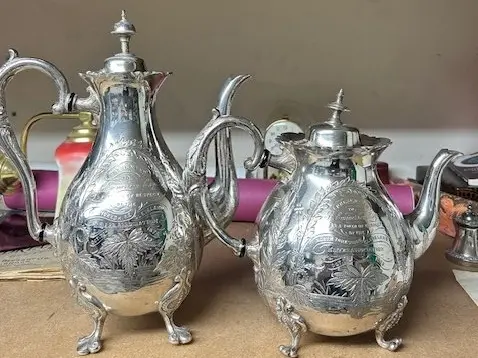
Retail manager John ‘Boggy’ McDowell QSM says the ornate silver-plated jugs were part of a donation the Gorge Rd shop received in March.
An inscription on them, which connects them back to Yorkshire’s industrial past, piqued the interest of the history-lovers.
It reads: "Presented to S Emmerson Esq as a token of respect by the North Yorkshire and Cleveland Mining Association October 7th 1873."
McDowell pays a huge amount of credit to one of his vollies, Mel Till — "she should be working for the CIB or FBI or something" — whose detective work traced the jugs’ origins back to Stephen Emmerson, dubbed ‘The Miners’ Friend’, who inherited Hollybush Farm after his father, also named Stephen, died in 1833.
The younger Emmerson ran the farm with his sister, Hannah, who also never married, until his death in 1887.
According to Skelton-in-Cleveland in History, on May 1, 1872, the Miners’ Association formed and held their first demonstration, attracting up to 7000 miners, on Hollybush land — as a thank-you, Emmerson was presented with a portrait of himself.
It was the beginning of trade unionism — something mine owners and landed gentry viewed dimly — so Emmerson was regarded as a "friend" for allowing his fields to be used for gatherings.
Such was their gratitude, on October 7, 1873, about 1400 miners gathered to witness the presentation to him of the two inscribed silver-plated jugs.
After he died, the farm and the "service of silver plate" were left to Hannah, then to his great-nephew, Stephen William Emmerson.
Stephen William died in 1904, leaving the farm to his son — another Stephen — who eventually took it over when he turned 21, in 1913.
He relinquished the farm in 1920 after he married Edith (nee Todd) and the couple emigrated to New Zealand.
It is believed they settled in Auckland where they had a son — Stephen Charles Emmerson — in 1922.
The elder Stephen died in Auckland in 1970, while Stephen Charles died in Helensville in 1978.
There remains a mystery as to how the jugs turned up in a Queenstown donation pile, but rather than being sold, they are now being returned to their place of origin.
McDowell says they were shipped off this week to Skinningrove’s Land of Iron, the Cleveland Ironstone Mining Museum, which holds the largest collection of objects and archives relating to ironstone mining in the country.
"It’s just a fascinating story," he says.
"We agreed we should send them back ... that’s where they belong; they mean a lot to the people of Yorkshire."