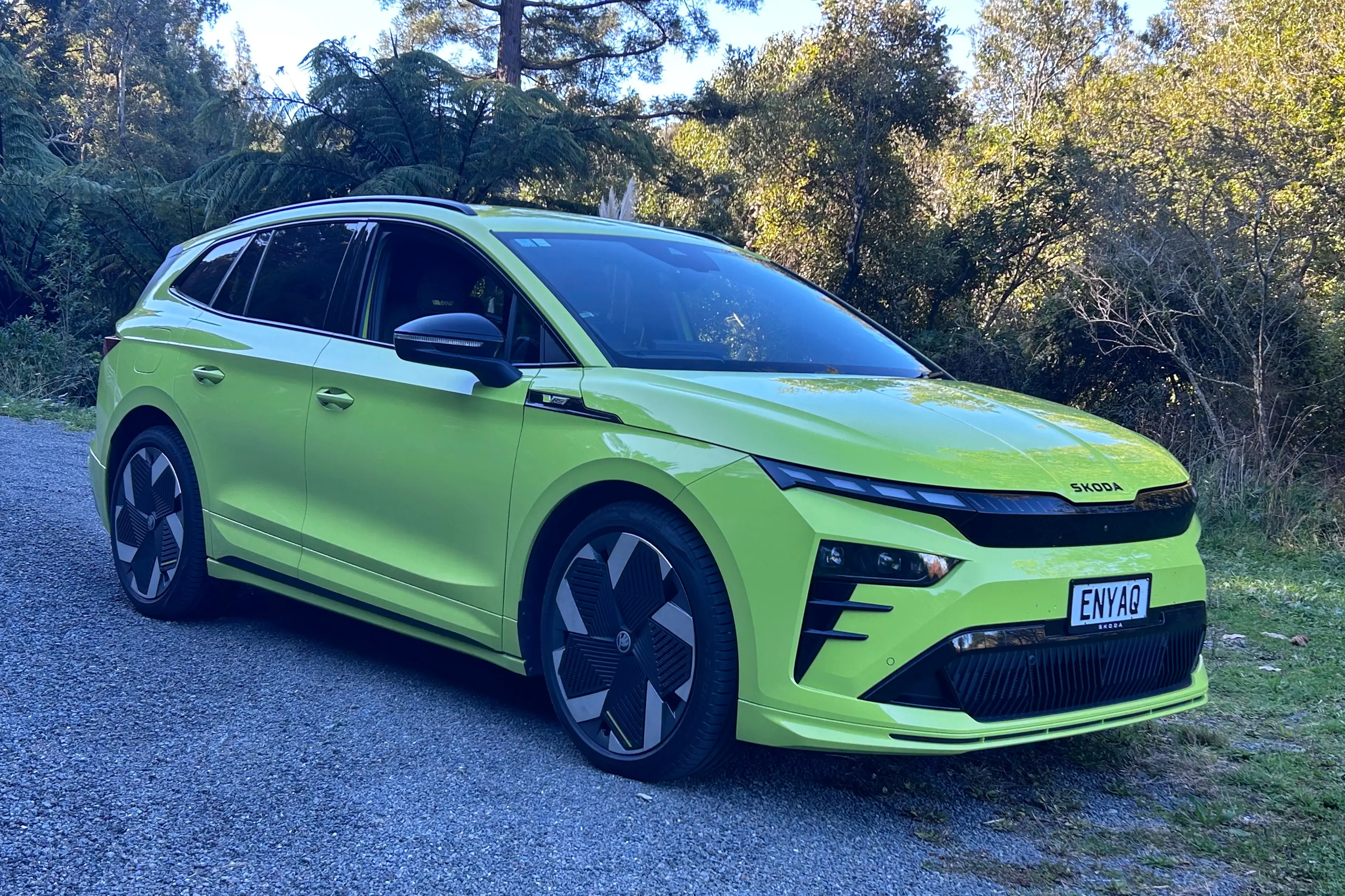
ROAD TEST: Skoda Enyaq RS 85 Would it be fair to assume the biggest measuring stick for the most extreme version of Skoda’s Enyaq electric car is: how well does it stand as an alternative to a petrol station wagon from the same brand? That potential is raised by Skoda NZ’s RS arsenal also including the petrol-powered Octavia RS wagon. Out to emulate the driving acumen of the world-famous Golf GTI hatch from which its platform and mechanicals are snatched, but with far more family-with-dog friendliness, the hot RS has become something of a legend, for good reason. On price, the Octavia RS is at an advantage, too, with pricing from $71,500 versus the Enyaq flagship’s $105,000 sticker. Still, if it simply came down to having a performance Skoda that delivers the right prime numbers, then the new Enyaq RS has the upper hand. Electric wins on power and torque output. It is somewhat quicker in the 0-100kmh sprint too; its 5.4-second time for that rest-to-legal-limit dash compares with 6.5 seconds for the Octavia equivalent. And though all Enyaqs being pegged to 180kmh overall means the Octavia has a higher top speed, the battery-reliant proposal still nonetheless meets with genuine credibility in Skoda’s claim of it being its most muscular road-tuned product yet. Week-long local residency also enforces the impression that what’s fully named the Enyaq vRS 85, but here the “v” is silent and the numerical ignored, has the right kind of push-on panache and practical pragmatism you expect from a skid-set Skoda. Shaping as an SUV doesn’t keep it from almost mirroring the station wagon’s packaging potential. More or less. Because of that, it validly continues the RS mission statement of being able to neatly blend the sporty side of its character with everyday sensibilities, all while also satisfying as a zero-emission car. Even so, as much as you’re thankful for the fat performance rubber, the all-wheel drive, the sportier, dynamically polished suspension tune and the more hunkered ride height, the Enyaq RS lends a different kind of competence and vibe from the Octavia RS. [Missing Credit]Skoda Enyaq RS 85: sporty with everyday sensibilities. Photo: Richard Bosselman Even when either of the two performance sound profiles, “sport” or “futuristic”, are engaged, it is a much quieter car; if you hear barking, it’s from the Octavia. Does that mean the electric has less charisma? I suspect it’ll take time to reconcile that one. One thing, though: it looks right for the role in which it is cast. The Enyaq is nicely brought back up to speed on the styling side with its mid-life facelift. Skoda’s Tech-Deck face first seen on the Elroq transfers well to its bigger sibling. The original styling of a mock radiator grille plus separate headlights was starting to date. Replacing it with a full-width illuminated light band up top, accompanied by secondary lamp units beneath, is much more of the now. The emblem change from the company’s old roundel featuring the winged arrow motif to the wordmark that spreads “Skoda” across the leading edge of the bonnet and boot lid is a small but powerful alteration. Beyond that, to ensure there’s no confusing it with the everyday $93,000 Enyaq Sportline, along with its bigger battery and more powerful dual-motor all-wheel-drive set-up, the $105,000 RS sits on 21-inch ‘Vision’ alloy wheels, is 15mm lower to the deck at the front and 10mm lower at the rear. Much exterior detailing — the wheels, the window trims, the sides of the rear spoiler, the door mirrors and the bumper inserts — is rendered in black. The overall body height does lend the car something of an MPV-like look, which isn’t really what you want in a hot hatch, but it’s still a good-looking car made all the more eye-catching in “mamba green”, the boldest of several RS-bespoke body colour options. The Enyaq’s cabin has been largely unchanged by this year’s major facelift, but that’s no issue. It’s a solid and welcoming place with high-quality fixtures and fittings and an intuitive integration of technology. High-backed bucket seats are part of the RS ethos, but this hardly impinges on space; there’s still plenty of that front and rear for legs and heads. Equally, those front chairs are hugely comfortable. Generally, spending at this level buys leather, but Skoda prefers soft-touch fabrics for its sports models and so, while the seat edges are in leather, the main elements are in Suedia microfibre. I’m all for it. The look is a refreshing change and the feel is brilliant; by making the seat more form-fitting, comfort improves. Lime-green stitching and piping for various parts of the cabin is also an RS thing. It’s better than it sounds, honestly, but you wonder how long before it starts to look grubby. [Missing Credit]Stitching and detailing in the cabin could start to look grubby with use. Photo: Richard Bosselman Practicality is what helps sell the Enyaq, and the RS is not exempt from that mission. There’s a big boot: space starts at 470 litres, expanding to 1,580 litres with the rear seats folded — and loads of storage space within the cabin. The zone up front is dominated by a large dual-level centre console that runs between the front seats, the top part with a tray for your mobile phone, including a wireless charger, which neatly solves the problem of it moving around when cornering, and a couple of cupholders. These being perfectly sized for Skoda’s (actually VW Group’s) own accessory vessels but just a touch too small for any third-party types reminds this is a brand that looks after its own. The door pockets are at least large enough for personal drink bottles. The main touchscreen is crisply presented and reasonably easy to use, as these things go. A row of physical shortcut buttons underneath the central air vents is welcomed. Further digital real estate comes in the form of an augmented-reality head-up display on the windscreen, and then a small, but perfectly legible, five-inch instrument cluster. The displays have RS-specific graphics, of course. [Missing Credit]The main touchscreen is crisply presented. Photo: Richard Bosselman All in all, the Enyaq RS has the same sporty touches anyone used to an Octavia RS will be greeted with. The difference is the battery under the floor means you sit taller in an Enyaq. That alone makes a difference when it comes to sizing up the biggest question from the petrol-wed corner: Can battery power be the equal of combustion power when it comes to providing driving thrills? Well, it’s fast. Almost all electrics are, of course, but here there is some serious shove, particularly from step-off. Thankfully, this isn’t delivered in the somewhat sickening sudden lurch of acceleration found in some other EVs. Still, the big wedge of torque can make it feel quite venomous at times. Though it’s silent by performance-car metrics, it is not a wholly quiet car. There’s a synthetic engine sound generator. But it’s relatively unobtrusive; you hardly notice it much of the time. In some markets, this variant comes with DCC adaptive dampers, which have also been a common ingredient of past VW Group performance models, the Octavia RS included. But it’s never been on the Enyaq, not even on the previous flagship Coupe, whose fastback shape is absent this time around. The potential of sport, comfort and normal modes, plus the “gem” setting, if you bother to take the time to tailor it, that is individual mode, is such that it seems a shame DCC isn’t even offered as a cost extra. That said, you can imagine why Skoda NZ has reticence, as it is an expensive car. As much as it’s hard to say if the RS would be better overall with the tricky dampers, it can be reported that, with the standard but still sporty suspension tune meted out here, it is quite different from that of the Enyaq Sportline 85. While there’s a suggestion that the jauntier ride comes down to more than it having stiffer springs, it running lower-profile 255/40 rubber, and upgrading here from 20-inch rims to 21s, also contributes. I’d say the tyre choice is mostly why you can feel road surface texture changes through the seat and the steering wheel. But the performance Pirelli Scorpion rubber also benefits handling sharpness and, in an overall dynamic sense, it seems very competent, not least given the whopping 2.3-tonne kerb weight. That bulk is quite effectively masked for the most part, even when pushing along on winding roads, where it lends badge credibility by sitting flat, hunkering down through compressions and being unfazed by crests. Whether it’s as ultimately communicative as those petrol RS models is something that will demand time to reconcile. I’d suggest, for now, that if you didn’t know those, but did know other electrics, you’ll think it above par. As said, you put your foot down in the RS and it goes: quickly, smoothly and rapidly for the horizon. Certainly, the off-the-line zip and on-the-move muscularity, the decent body control and a general assured sense of capability make this a lovely EV to drive and one of the better products in Volkswagen Group’s electric range. As with the Enyaq Sportline and the slightly more physically compact Elroq, the RS has just undergone some running-change updates that weren’t on the test car, but will feature on incoming cars. The B-mode for one-pedal driving will bring it to a full stop, rather than almost so. It gets dynamic road-sign display, a simplified rear-view camera display and front cross-traffic assist. Plus, it adds a small 21-litre frunk under the bonnet. There’s also preparation for bidirectional charging, which would be useful when finally enabled. Vehicle-to-load functionality for running small electric devices seems to be a selling point now. Vehicle-to-home is the big one, but that obviously asks for more than car industry involvement and, though at least one trial has been undertaken, no one knows if or when the required legislative change is coming. Anyway, what all VW Group products also lack in this market, but not in Europe, is the ability to take over-the-air updates, and without that the Enyaq cannot facilitate onboard navigation functionality to locate charging stations and automatically precondition the battery. That’s the kind of tech that sells; just ask any Tesla owner. RS is the only dual-motor Enyaq here and it has a bigger battery, with charging at up to 185kW. The WLTP range of 521km is inevitably optimistic. Real-world range seems pegged closer to 450km, subject to the usual caveats of terrain, passenger and cargo load, and weather conditions. [Missing Credit]The Enyaq continues Skoda’s Tech-Deck frontal styling. Photo: Richard Bosselman Winter conditions do no vehicle any favours efficiency-wise, but in respect of this time of year, take note that a heat pump now comes as standard. Skoda suggests the benefit in colder weather is that the battery can be kept at an optimised temperature to preserve range. Why buy? Mostly for bragging rights. It’s the most powerful and fastest-accelerating Skoda road car ever. The straight-line pace, improved dynamics and sharper styling enhancements lend appeal; it does look handsome at the kerbside. The technology ingredient needs improvement, but it nonetheless has a high specification and is comfortable and well finished. The biggest challenge is, of course, the price. Skoda’s gradual transformation from being a budget brand to semi-premium is abundantly clear here, but the sticker now is a $6k increase on what in itself seemed a hefty ask when announced at launch back in February. What undermines the pitch more is Volkswagen NZ advertising its ID.4 and ID.5 cars in RS-equivalent GTX format for $76,990. Skoda Enyaq RS 85 — At a Glance Overall rating: **** Design and styling: **** Interior: **** Ride and handling: **** Performance: **** Safety: ***** Environmental: ***** SPECIFICATIONS Price: $105,000 Powertrain: Dual electric motors, maximum power 250kW, maximum torque 679Nm Transmission: Single speed automatic, all-wheel-drive Safety rating: Five star Ancap Wheels and tyres: Alloy wheels, 255/40 R21 Battery: Lithium-ion phosphate, 84kWh (79kWh net), WLTP range 521km Emissions: Nil Dimensions: Length, 4658mm; width (including mirrors), 2147mm; height, 1635mm Kerb weight: 2229kg