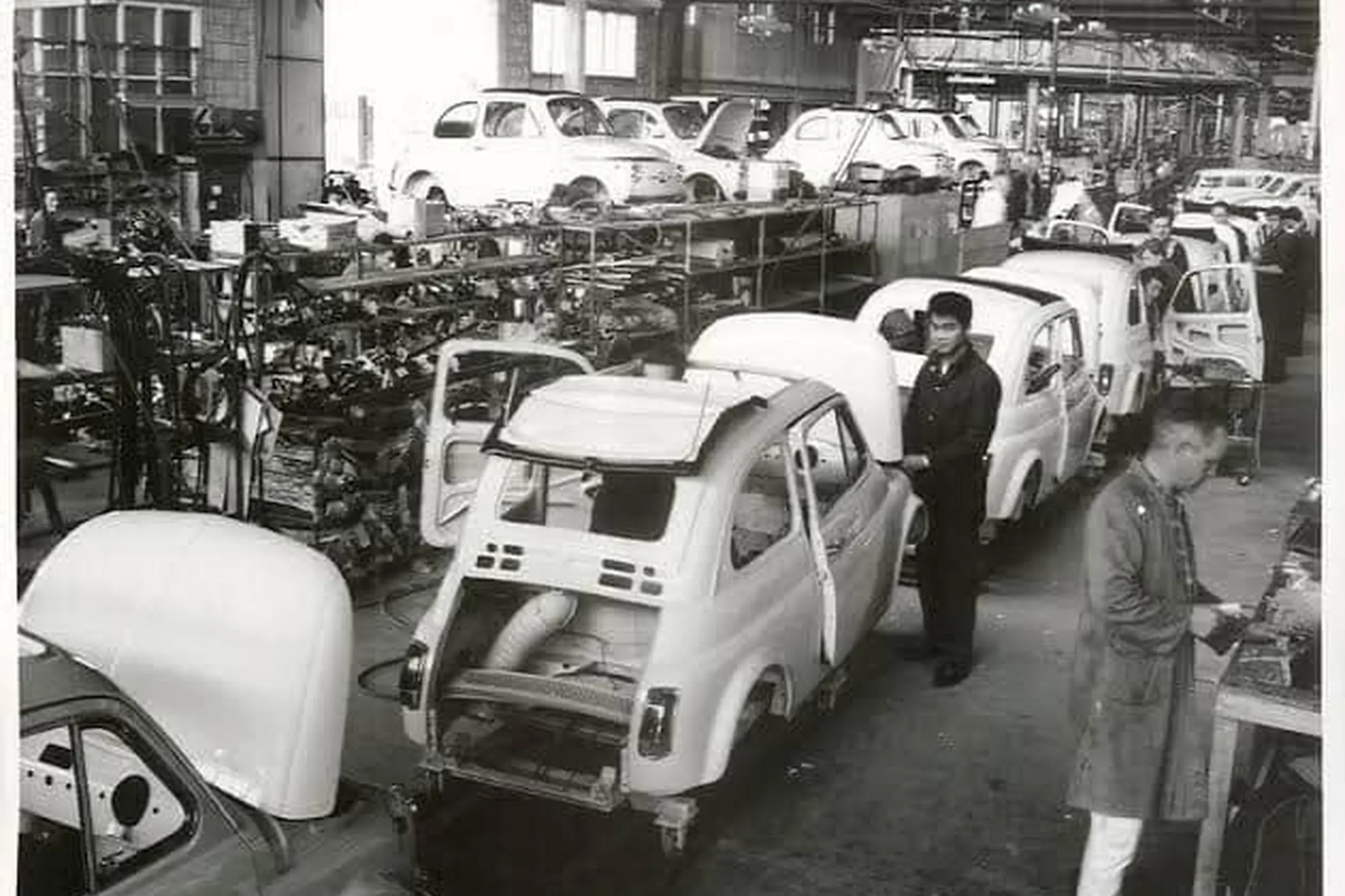
Italian marque Fiat has quietly announced it is suspending passenger car sales in New Zealand, ending a Kiwi market presence that stretches back to the early years of the last century. The decision follows an identical one for Australia, after very low sales from the strictly limited model range that has been available here in recent years. This news got me thinking, with more than a tinge of sadness, about my own experience of Fiat cars, the end of an era that saw Fiat prominent here in the second half of the twentieth century, and an earlier history in New Zealand that has a strong link to Dunedin. The Dunedin connection, as some readers will surely know, includes the ‘Olveston Fiat’, a (these days) very rare Fiat Tipo (type) 510 that was purchased by the Theomin Family, Olveston’s original owners, in the early 1920s. Having been sold by the family in the 1930s, the Tipo 510 was subsequently discovered in very poor shape in the 1990s. It was then immaculately restored to running order, and can be viewed in the garage at Olveston to this day, and occasionally spied out and about on Dunedin roads. But Fiat’s heyday in this country was in the 1960s and 1970s. Indeed, from 1965 to 1971 several thousand Fiat 500 (Bambina) models were assembled in Auckland. With pricing that started from just under 700 pounds (equivalent to about $15,000 today), they were popular nationwide. Other Fiat models, notably the locally built 125T, enjoyed great success in national saloon car racing for a time, while the Fiat 124 Coupe was a well-regarded sports car. My personal association with Fiat cars has never extended to owning one, but I have driven quite a number. These have ranged in age from Olveston’s Tipo 510 through to a thoroughly modern Mazda MX-5-derived Abarth 124 Spider owned by a friend of mine. A high point of my association with the marque was chasing a Fiat Uno down a mountain pass in Italy in the late 1980s. The Uno was being driven pretty vigorously and, sitting behind the wheel of a Honda Accord, I had to work very hard to stay on its tail. I was more than a little surprised to find — when passing the Fiat at the bottom of the pass — that it was being driven by a nun, with three fellow sisters as passengers. At the other extreme, within a year of that light-hearted moment, I happened to be behind the wheel of a Fiat Tipo in the worst moment of my motoring life, which was a fairly nasty head-on collision on a one-way arterial road in London. Suffice to say that I was driving the right way down the road, while the vehicle that hit me was not; the poor Fiat — my boss’s car — was written off, but thankfully I walked away with nothing beyond a sore neck and some minor seat-belt bruising to nurse for a few days. Fiat, which will continue to sell light commercial vans here, is signing out with its final stock of the modern iteration of the famous 500 Bambina, comprising the electric 500e, and the now aptly named Abarth 695 Final Edition. The current in-country stock of these models will not be replenished, but owners will continue to receive warranties, parts and servicing through the local dealer network. Fiat’s decision, which follows the exit for fellow Euro marque Opel early this year, is likely reflective of the impact new entrant brands — predominately from China — are having on established brands. Indeed, my fellow Drivesouth contributor Richard Bosselman has been crunching the numbers and reckons there are now close to 80 different car brands available here. That’s similar to Australia, with a new car market five-times ours in size, and a third more than the UK, which has new car market 15 times larger than here. LAT ImagesMitch Evans, of New Zealand, drives the Jaguar TCS Racing Jaguar I-TYPE 7 on track at Miami International Autodrome in January this year. Photo: Supplied Formula 1 Turning to matters of motorsport, Formula One’s mid-season break is now under way following last weekend’s Hungarian Grand Prix. As drivers take some time out ahead of the championship’s resumption at the 21-23 August Dutch Grand Prix, Liam Lawson is among those who should be reflecting with some satisfaction on the year to date. After a somewhat disappointing qualifying effort — managing 11th on the grid — the Kiwi raced well, making a great start and eventually coming home eighth. Crucially, he finished one place ahead of his team-mate Arvin Lindblad, and both he and Lindblad finished in front of Alpine drivers Pierre Gasly and Franco Colapinto. As a result, Lawson has passed Gasly to sit ninth in the drivers’ championship, while Racing Bulls has overhauled Alpine to grab fifth in the constructors’ title fight. By the time F1 resumes, a new Formula E champion will have been crowned, and there is a decent chance it could be Kiwi Jaguar driver Mitch Evans. After some torrid racing in Shanghai last weekend, the all-electric category has a new series leader in Briton Jake Dennis (Andretti Racing). But Evans is just two points back, with Germany’s Pascal Wehrlein (Porsche) a further three points adrift. The championship will be decided over the final two races, to be held 15-16 August at the London street circuit in the city’s Docklands area. David Thomson Editor Drivesouth