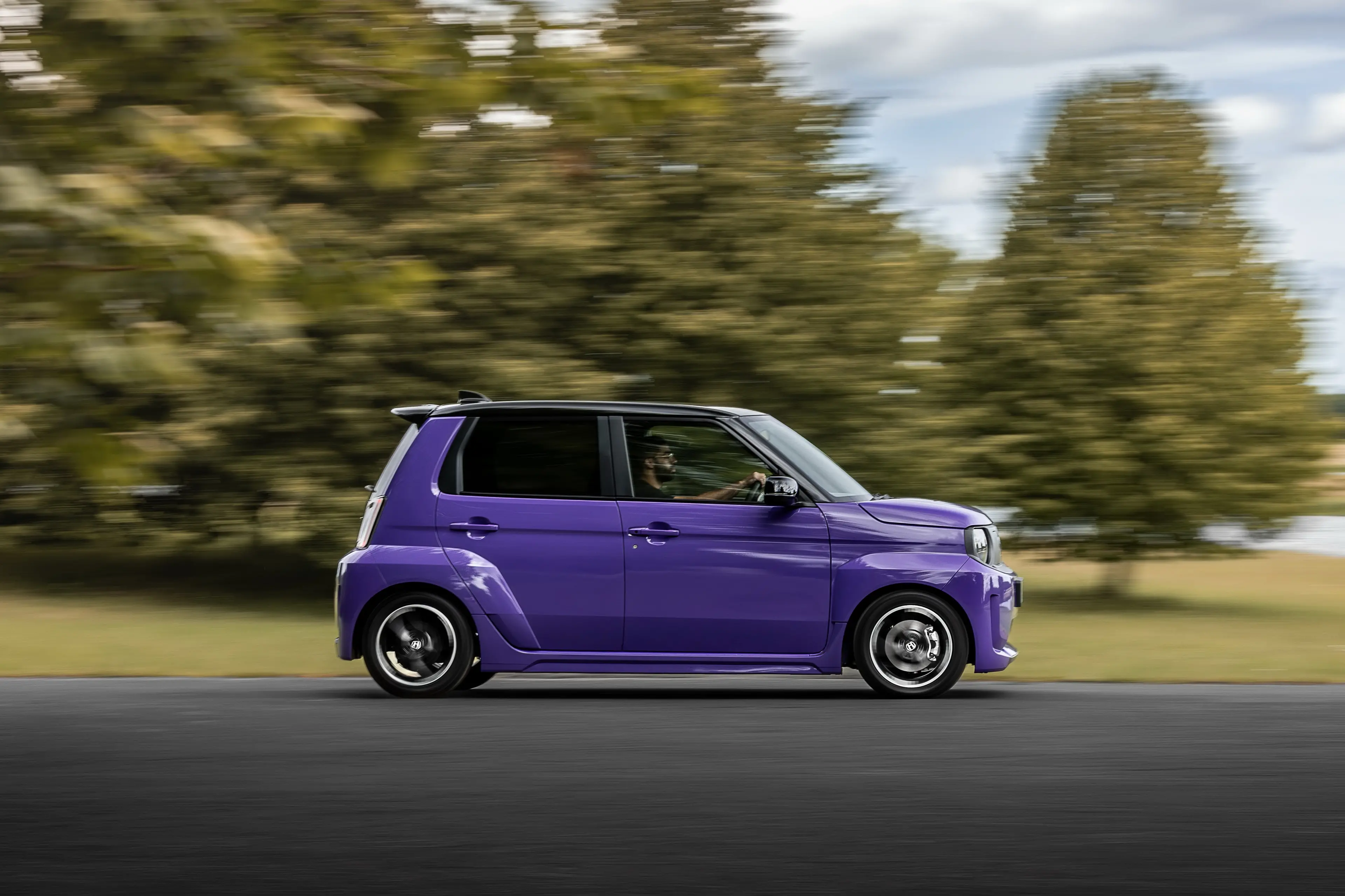
LET’S agree Honda’s progress toward electrification has been rather haphazard. Just consider the New Zealand-specific scenario. In mid-2025, a Honda we never expected to see, the e:N1, came at the right price. But it turned out to be a once-only consignment opportunity and once supply exhausted some 10 months later, that was that. Prior to that, another that looked perfect, the Honda-e, never made the cut. Too expensive. In any case, those were supposed to be entrees. What was key to brand ambition were three cars from the fully international, especially radical 0/Zero range. These were going to change everything. But right on point of production in March this year, Honda pulled the pin, completely axing the programme. That decision triggered immediate losses for Honda that amounted to 1.45 trillion yen (NZ$15 billion) in written off costs and saw the company post its first operating loss since going public in 1957. So where are we now? Answer: starting afresh by starting small. [Missing Credit]Honda Super One for Drivesouth 7-8-26. Photo: Richard Bosselman In welcoming the Super-ONE, the export edition of a battery-pure spinoff from a petrol car designed to meet Japan’s kei (light car) regulations, Honda New Zealand boss Carolyn McMahon made one thing clear: this one’s a keeper. Intent is to keep the nameplate for its entire production life. So is this Honda finally settling into an electric future; starting small but ultimately thinking big? McMahon cannot speak to future product, doesn’t discount more battery-dedicated models are in the pipeline and says, yes, electric has a firm future. “Our destination hasn't changed in the long-term . . . we've just recalibrated when and how we're going to get there.” At the moment most Hondas are hybrid and that’s not set to change for ages. “We’re staying very, very true (to hybrid). We’ll have 95% of our fleet in hybrid by next year. “As we have more customers interested in electric vehicles and wherever we can get them from, we'll look at them. “As the EV penetration grows, we'll look to continue to play in the space, but it's not going to be our core product.” It’s hard to see how Super-ONE won’t raise interest, perhaps to point of diverting some attention from Jazz hatchback and the ZR-V small crossover. It’s a personality-packed cute contender. Albeit one with a very clearly defined role. At 3.6m long and just 2.4m wide, the smallest Honda ever sold here and at just 1093kg — the lightest — it is fully committed to a city driving role. That doesn’t make it immune to 100kmh effort, but hang on tight, watch your mirrors and keep an eye on the battery consumption. The factory-cited 253km combined range from its 30kWh (29.6kWh usable) DC-rechargeable lithium-ion battery bases on NEDC calculation, should not be trusted. The more relevant WLTP scale says 207km. While home-charging will likely be the favoured choice for most owners, the Super-ONE can be hooked up to DC commercial chargers. There’s a maximum DC charge speed of 50kW, which mean the battery can be refreshed from 10% to 80% on full charge in 30 minutes. You can plainly see the car’s spirit in its wee bulldog look and can feel it in the driving too. Whizzing around Auckland’s Wynyard Quarter and taking a quick flit over the Harbour Bridge cemented that if any car launched this year is set to make you giggle, it’s this one. But pick your battles. Honda intends some long-distance driving as part of the launch promotion. I applaud the sense of adventure, but it wouldn’t be for me. Sticking to mainly round-town use will bring out the fun . . . and highlight an impressive functionality. Honda’s all car packaging expertise is well known. This car’s ability to seat four adults and/or stow decent loads, including a bicycle, shows that talent in spades. While the rear seats don’t slide back or forward, they do include the proprietary flip-flop-fold Magic Seat mechanism to provide additional flexibility for carrying larger items. That’s what the ‘long mode’ and ‘tall mode’ settings are all about. You can make a lofty pass-through space or put down both rear seats to create a tiny van. With the seats up, boot space is predictably rather limited. [Missing Credit]Honda Super One for Drivesouth 7-8-26. Photo: Richard Bosselman Though some aspects of visibility were a touch limited, my 1.8m frame was comfy at the wheel. It has an upright, but quite comfortable driving position in feel-good sports-style front seats and without shifting the driver’s chair, I could just fit behind, though headroom there was tight. Going electric doesn’t infringe whatsoever on cabin space; the battery fits neatly where a fuel tank was designed to go, in a space under the front seats and ancillary electronics go under the short bonnet. This all might sound familiar to those who used to buy Suzuki and Daihatsu cars built to “kei car” conformity. Remember those? It’s been a while, but it’s cool to see electric allow resurgence of a specific category of ultra-compact, lightweight city vehicles developed primarily for the Japanese domestic market — the name’s an abbreviation of kei-jidōsha, literally translating to “light vehicle”. Alto, Wagon R, Mira . . . these were big draws among the micro hatches eagerly adopted by cost-conscious New Zealanders back in the late 1980s and first decade of the 2000s. Could Super-ONE rekindle that fire? Though less severely than with the previous tilt with this technology uplift, the Mitsubishi i-MiEV of 2013, electric application still costs enough that a key element of the old sales pitch absents. I’d remind that, tight to point of departure in 2010, Alto held firm as our least-expensive new car. With a base-model tag of $41,900, the Super-ONE doesn’t come close to reinstating that proposition. Brand strategy in fact sees is sitting above some larger electric hatches with vasty stronger performances and range, room and as much kit, in not more. You can guess where they are from. Can it stand the China challenge? Honda NZ believes so. Still, it has just 50 coming between now and end of March, 2027 and though availability will improve, it intends to keep a close eye on buying patterns. Innovative cars always deserve a fighting chance, here there’s obvious attraction to anyone looking for something a bit different and aside from its tangible kerbside zing, Super-ONE is impeccably engineered, designed and finished. Honda has been in the kei game for a long time, and the project one N360 that came out in 1967 is a genre giant. That car is credited as being the Super-ONE’s great grandfather though, really, in respect to styling, it takes far more from another small hatch, the Honda City from the 1980s, specifically the impish City Turbo II. Anyway, the N360 evolved into the Life and finally, in 2012, into the N-One, reprising some of the N360’s styling cues. The current, second generation of N-One, the car from which the Super-ONE derives, is in two home turf formats. The sales winner has a 658cc three-cylinder petrol engine; the more recent electric alternate is still making its case. For export, though, the petrol was never considered. And to make N-One more attractive to our tastes, Super-ONE was born. Drivetrain aside, signatures are a wider track, chunky arches, uprated brakes, bespoke alloys, a proper little spoiler and protruding bumpers. To tech-heads, of course, it’s the powertrain that’s of higher interest. In the standard drive modes — Eco, Normal, City and Sport — it’s making 162Nm torque and 47kW or power, the limit to meet kei car standards. But for export and as another salute to City Turbo II, there’s an extra-zing option. Hit the purple button on the steering wheel marked “Boost” and it unleashes 70kW. Even though you should think frisky rather than frenetic, the difference with Boost is palpable. The 0-100kmh time of 10s isn’t exactly hot hatch threatening, but it’s 2s quicker than in standard and that extra meatiness is useful for smart overtaking and nifty merging into open road traffic. Remember how those old three-cylinder engines asked to be red line revved to keep them on tightwire-thin power bands? Honda sees that as part of the kei charm, so with Boost you get a sight and sound show. Simulated engine noises, a faux gearbox and also some interior lighting effects aim to reprise the old-school madness. Super silliness? Well yeah, but the way the sound mimics a high-performance four-cylinder turbo engine, complete with at-limiter chatter, is close to authentic. Getting a full handle on the car’s handling and ride wasn’t possible on the drive day. With 15-inch wheels, tight dimensions and the simplicity of a torsion beam rear axle and rear drum brakes, it’s patently and unavoidably of a certain genre. Independent overseas’ information suggest the version we see here is a smarter driving car than the home-market donor. The widened track adds to assertiveness and there’s a faster-steering rack with bespoke tuning and equal-rigidity (albeit not equal-length) driveshafts to reduce torque steer. The Yokohama Advan Fleva tyres seem grippy and don’t squeal easily. How much that matters is likely to be moot. For some, it sporting a turning circle of just 10.2m and having a front charging port makes more sense. Even if kept in the lower-performance modes, which allow for one-pedal driving, the Super-ONE cannot get away with being a low-key kei car. That’s because it comes in vibrant colours — the hero hue being the very brave purple — and the interior fit out is as jazzy as the exterior enhancements, with black microsuede and blue fabric to lift the mood and divert immediate attention from class considerations of hard plastics and fake leather. [Missing Credit]Honda Super One for Drivesouth 7-8-26. Photo: Richard Bosselman The dashboard has a three-tier design with useful storage space on the middle tier and a cupholder to the right of the steering wheel. There’s a reasonable glovebox and more storage on the floor between the seats. Main controls get chunky physical switchgear and while the digital side is fairly basic. The small driver display has simple graphics and offers a number of layouts. As a curiosity, it is the first EV I’ve meet with a specific battery temperature gauge. The main infotainment screen is the same as in all other modern Hondas. It does not offer many functions, not even in-built navigation, so for that you need phone mirroring or the Google accessory than ultimately becomes a subscription thing. Smartphone connectivity is wireless but it lacks a wireless recharging pad, so perhaps you’ll need to cable in regardless. [Missing Credit]Honda Super One for Drivesouth 7-8-26. Photo: Richard Bosselman Keyless entry and push button start, a Bose eight speaker audio system, a heated steering wheel are included and it’s a surprise to see adaptive cruise control, automatic high beam support and traffic jam assist. The Supe-ONE’s eco-vibe means intriguing use of recycled materials: the bumpers are made from those retrieved from old Hondas then ground up into second-use plastics; the grille has a white fleck because old tail light lenses are the source material. The extra-cost ($2090) Kuro package is worth thinking about. The word means “black”. With the roof, wing mirrors and that brash rear spoiler in this hue, the Super-ONE looks all the cuter. Crash-worthiness? Some past kei cars didn’t don’t do too badly. Alto had a four-star from out national auditor, Australasia New Car Assessment Programme (ANCAP). Recently Japan’s government mandated more improvements, which Super-ONE gets. Still, you might have to take Honda’s word about it being up to task as it has no plans to offer the Super-ONE for ANCAP assessment, on grounds it is such a low volume car the cost cannot be warranted. Specifications Price: $41,900 Powertrain: Permanent magnetic synchronous electric motor, maximum power 47kW (70kW in Boost mode), maximum torque 310Nm. Transmission: Single speed, front-wheel-drive. Safety rating: Not assessed. Battery type, range: 30kWh (29.6kWh usable) Lithium-ion battery, estimated combined economy (WLTP Combined test) 14.2 kWh /100km. Emissions: Zero emissions. Wheels and tyres: Alloy wheels, 185/55 R15. Dimensions: Length, 3582mm; width, 1573mm; height, 1616mm. Kerb weight: 1093kg