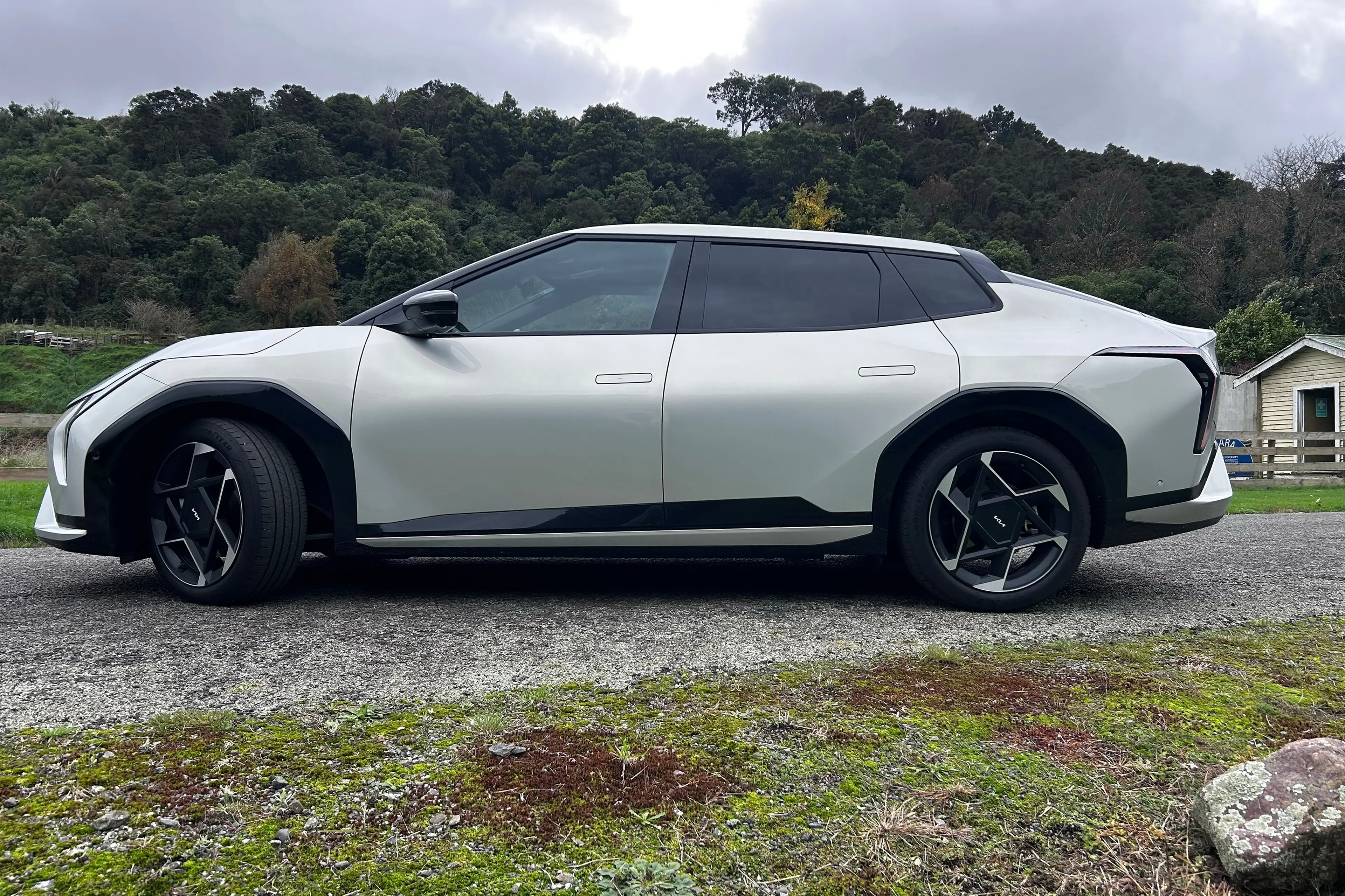
Road Test: Kia EV4 GT-Line ELECTRICS come in all styles and sizes; some have become orthodox, some outlandish, and a few tend to be considered outright outrageous. Is it fair to say nothing else shakes its booty quite like the Kia EV4? The maker calls it a sedan. Regardless, some will call it a hatch. Students of automotive history might argue it’s a modern take on those super-streamlined Tatra cars of the 1930s. A defiant breakaway from the general theme of this Hyundai Group brand lands as a Light LR and the $12,000-dearer top-tier GT-Line derivative tested here, aiming at a buyer who might otherwise be swayed by a Tesla Model 3, BYD Seal and the incoming Mazda 6e. It delivers with a single electric motor driving the front wheels, generating 150kW and 283Nm, feeding from an 81kWh (gross) lithium-ion NCM battery. GT-Line means sharp looks and a relaxed demeanour. Not outright aggressively fast but easily swift enough; fundamentally well-balanced, with a good combination of comfort, refinement and precision. All Hyundai Group cars have a common E-GMP architecture, in two intensities. EV4 is like the EV5 and EV3, with reliance on a 400-volt system, whereas EV6 and EV9 have, at the highest level, 800V. Come replenishment time, on the right sort of charger, the 800V cars will be done and dusted in less time than the 400V models, though in managing 128kW of DC uplift the 400V set up is not so bad in its own right. In respect to how quickly it expends electricity, the news is also good. The GT-Line claims a WLTP-certified 612km; the LR Light can go a bit further still and, though this assessment didn’t specifically gauge efficiency, we know Hyundai Group cars do well in the real world: expect around 505km of range in mixed highway/urban running, and upwards of 400km on the highway haul. The interior styling and instrument layout are teleported from Kia’s other 400-volt cars, which means a suitably techy, screen-dominated dashboard with plenty of physical controls, including a gear selector on the steering-column stalk and a chunky steering wheel. All this means it should stand a good chance of being one of the electric cars that makes swapping from petrol or diesel power spectacularly easy. But, of course, it won’t. The EV4 fastback here is the far more radical variant of an alternate hatch that only goes to Europe. You’re basically served a three-box body onto which an extended separate boot stretches out … and out … and out … If you are of the belief that EVs should be statement cars that push the envelope, then how could this car disappoint? There’s more than just a faintly sci-fi edge to its highly distinctive, highly distended ‘aero’ style. Those flat-faced three-spoke design alloy wheels are a suitable finishing touch for something so extrovert, likewise the slim upright LED headlights. The flanks are clean and neat, and kept aerodynamically efficient by flush-fit pop-out door handles. To me, it just doesn’t quite gel. It’s too fussy from the C-pillar back and the sacrifice for this artfulness goes a touch too far. Though reasonably capacious at 490 litres, the car’s overall shape demands a boot opening that is high and narrow enough that slotting in big luggage items might require some lateral thinking. There are handy release pulls to drop one or both of the 60:40-split folding rear seats, and with those down cargo capacity expands to 1,435 litres, but it’s a pity there’s no load-through facility for long, narrow items. The boot has stowage space beneath for charging cables, but no spare wheel set, of course. Instead, there is some tyre sealant and an electric pump. With a motor under the bonnet, there is no frunk. The low roofline also affects the cabin’s vertical space for those of above-average height. What also influences this aspect is that it has the same slightly raised seating, front and rear, as the taller-roofed EV3, plus a sunroof. It was barely tolerable for my 1.8m frame no matter where I sat. To achieve a reasonable driving position required angling the seat back a bit further than I generally like, which would have impinged on anyone of like height sitting behind, who would also find their head brushing the roof lining and their eyes at the level of the window tops. That the part-mesh front-seat headrests were shaped to allow light in and passengers to see out is a sign, perhaps, that Kia realised what sort of space it had created. The front part of the cabin is as you’ll find in every Kia EV. The dominating feature is a wide screen that houses both the infotainment touchscreen and the driver’s dial set. To provide a clear view of the latter, the fully adjustable steering wheel is fairly large. As in the EV3, it has the same issue in that what you don’t easily see is the 5.0-inch heating, ventilation and air-conditioning touchscreen sandwiched between the two 12.3-inch LED screens. Yes, there are physical ‘piano key’ buttons for temperature and fan speed on both sides of the dashboard, but it’s still an anomaly for a brand that generally does so much better with its ergonomics. On each arm of the wheel are controls for the audio functions and adaptive cruise. Easily overlooked is a driving mode button on the centre spoke, which allows you to cycle through the various modes. A set of paddle shifters is for shifting through the four levels of available battery regen. It also has an effective one-pedal mode, but the variable braking of the auto mode is brusque. The screen system includes inbuilt navigation, wired and wireless Apple CarPlay/Android Auto, AM/FM and DAB radio, and a Harman/Kardon audio system. There are front and rear USB points. Dual-zone climate control includes rear vents located in the centre console. All EV4s come with vehicle-to-load (V2L) power and facilitate over-the-air updates. Powered front seating, with both chairs heated and ventilated, artificial leather seat trim, two-tone interior trim, a head-up display, a heated steering wheel, ambient lighting, a wireless phone charger and a power-operated boot are also part of the GT-Line buy-in. It’s fairly practical and fairly upmarket, but not overtly so in either case. The front chairs look special, with a nice two-tone finish, distinctive 1970s-style ribbing and neat wing-shaped headrests, but equally of note is how Kia’s eco-mindedness comes into play, with extensive use of recycled and bio-based plastics. This deserves credit, but it’s a shame most of that delivers as hard finishes. The bins would benefit from soft inserts There are good storage options, with a large open space in lieu of a centre console, which features a wireless phone charger, plus two cupholders, the arms of which rotate out of the way if you need more flat storage. While the cabin furnishes fairly well, there’s a missed opportunity in the boot lacking pockets or nets to help store small items, let alone bag hooks. Intelligent LED headlights that strive — and mostly succeed — to block glare for oncoming traffic, an electro-chromatic rear-view mirror, a surround-view camera, and a blind-spot monitoring and reverse parking collision-avoidance package are in as well. Autonomous emergency braking, adaptive cruise control with intelligent speed-limit assist, rear cross-traffic braking, lane-keep assist, blind-spot detection, driver monitoring, reverse camera, front and rear parking sensors and seven airbags, including a centre-front unit, are all standard fare. Being a Hyundai Group car, you’re stuck with having to either put up with, or disable, the very zealous bing-bong overspeed and driver-monitoring systems. You can hasten the disabling process by setting up a shortcut, but that’s only for the duration of that specific drive. As soon as you stop and turn off, the car is ready to start up its annoyances all over again. I’m all for keeping drivers safe, but there are better ways than this. The springs, shocks and electric-assist steering maps were all tuned by Kia in Australia for what are defined as local conditions. Not every suspension-tuning undertaking ‘over there’ is a good fit for our roads, and Kia — in its pitch to be seen as the sportier, younger person’s brand — seems to have a habit of making its electric-car suspensions a little less compliant than you get in equivalent Hyundais (not that there is one in this case). But the EV4 genuinely breaks away from that habit. It’s a car with confident body control, is good over bumps and proves to be a pretty easy-going car. The ride comfort on 19-inch alloys shod with relatively low-profile rubber is absolutely fine. Steering that offers a modest 10.9m turning circle is light in urban manoeuvring, but firms up nicely at open-road pace. Like almost all pure electrics, the EV4 feels noticeably quick off the mark, Yet, while the 7.8-second 0-100km/h time is wholly respectable, it’s no sports car in disguise — not that this bothers me. More important than the outright speed is the delivery of the performance, which is measured and smooth. If the steering wheel were a fraction smaller in diameter, the EV4 might feel slightly sportier, but overall there’s plenty of good going on here. Kia placing the charging port on the front-right wheel-arch means it needs to be nosed into charging bays, which not everyone might like given the view out the rear glass is fairly poor, but it has an excellent reversing camera and a wide array of sensors. Going by the tenor of overseas tests, the alternate hatch is a far more convenient car. Aside from the sake of obvious flamboyance, why the fastback was preferred for here might seem odd. The back story is that there was no choice. We have it because Kia builds it in South Korea, whereas the hatch is solely produced in Slovakia. It’s easier and cheaper to take the car from Seoul than from central Europe. Styling so distinctive it stops a whisker short of OTT will keep the EV4 from being universally appealing. Kia can rightly argue that, for those who crave inoffensiveness, there are other choices either behind its own badge or within the broader Hyundai Group family that offer less-challenging designs. I’m also reminded of a well-known designer of controversial products who reputedly said, “If I asked people what they wanted, they still wouldn’t be happy with it.” At a glance Overall rating: **** Design and styling: *** Interior: **** Ride and handling: ***** Performance: ***** Safety: **** Environmental: ***** Specifications Price: $75,990 Powertrain: dual electric motors, maximum power 150kW, maximum torque 283Nm. Transmission: single speed, all-wheel-drive. Battery type and economy: 81.4kWh (78kWh useable) lithium-ion, estimated combined economy (WLTP combined test) 14.9 kWh /100km. Emissions: zero emissions. Safety rating: untested by Ancap, five star Euro Ncap. Wheels and tyres: alloy wheels, 215/50 R19 tyres. Dimensions: length 4730mm, width 1860mm, height 1480mm. Kerb weight: 1912kg.