
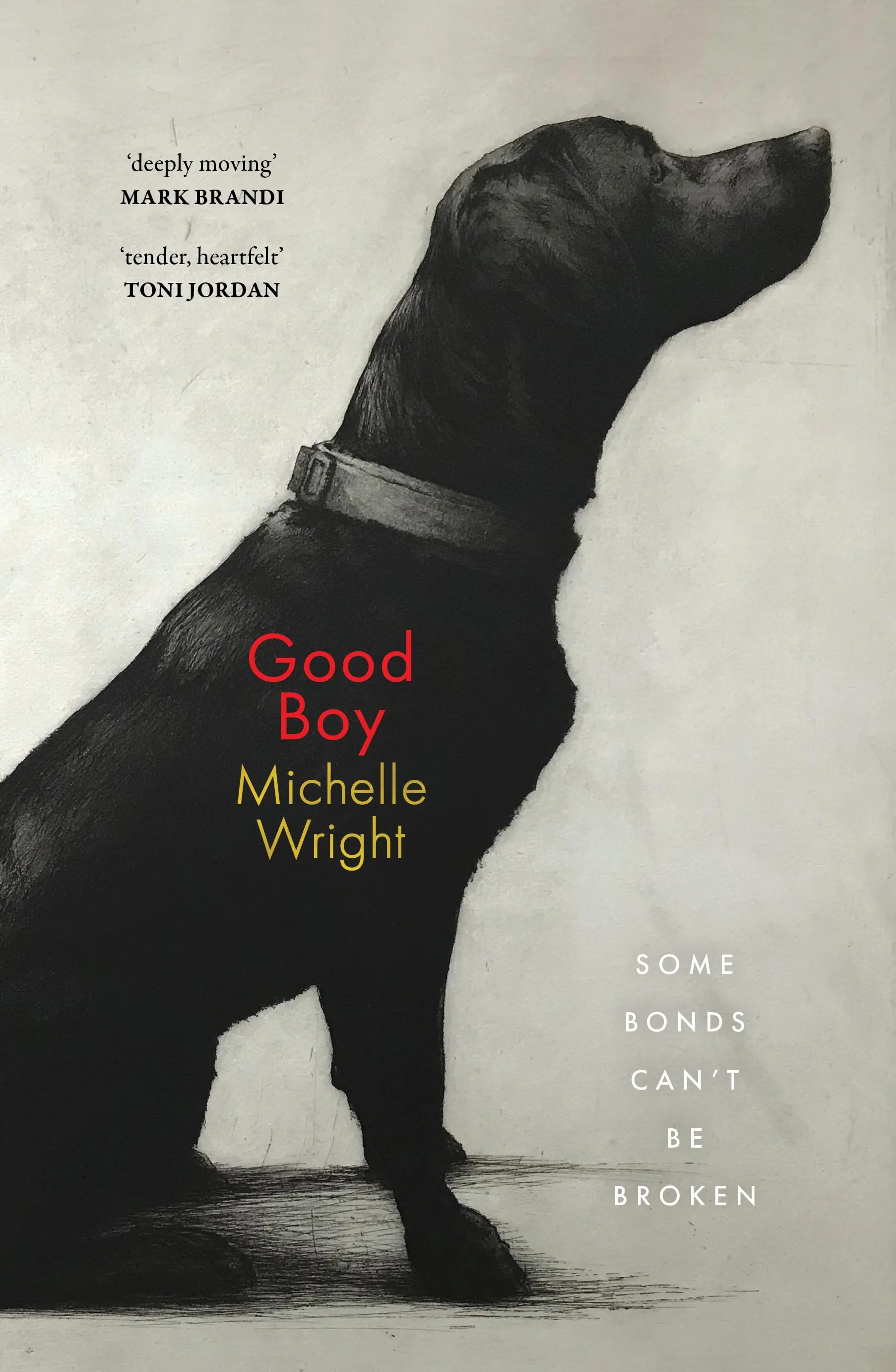
PHOTO
Good Boy
Michelle Wright
Allen & Unwin
Reviewed by Jessie Neilson
Cooke, or “Cookie”, sits in the prison grounds threading his apple seeds to make jewellery and minding his own business.
He practises the philosophy of head down, no eye contact, staying clean as he is up for parole in six months’ time.
It is January 1998 and Cookie is in for murder.
He has done the hard yards at high security Hopetoun, its own kind of hell, and lives now in relative comfort and lax security at Middleborough.
His living situation is rather like flatting, and he and his fellow inmates try not to instigate dramas.
Not unlike a communal farm, at Middleborough, in the middle of nowhere in Australia, he is almost free to come and go.
Almost.
Meanwhile, Nigel is a shelter dog who has recently been found dumped on the side of the road.
With anxiety issues, stubby appearance and penchant for self-mutilation, he is just the kind of rejected dog to be put on death row.
It is the final chance for Nigel, renamed “Good Boy”, and a few other scrappy dogs to redeem themselves via the “Pawsitive Outcomes” dog rehabilitation programme.
Cooke, reluctantly, puts his hand up for the bonding sessions.
What happens next is more than he expected: from not having a single visitor during his years of imprisonment, and preferring not to work with people, he finds this canine companionship non-negotiable.
They begin to rely on each other, tuning into each other’s emotions.
Cooke is a man of few words but an astute observer of behaviour, and Good Boy becomes his anchor.
However, the dog’s behavioural and anxiety issues mean he is likely facing a death sentence.
This is what Cooke cannot bear, and his desperate preventative actions propel this narrative forward.
Meandering back and forth through Cookie’s childhood to his present, the third person perspective gives us deep insight into his brokenness which he is unable to voice himself.
His adolescence contains the unsurprising spiritual and physical neglect, the trauma and the stunted growth, represented in the figure of his father, who has the perfect face of a conman.
Yet amongst the hopelessness, other figures emerge who promise compassion.
They are filled in with great detail and become alert and active characters who try to wrangle success for Cookie.
He, too, has appreciation of the wonder of the world, though he conceals it from others.
He enjoys the slowness of nature, the flat dun mushroom caps that cluster in the gloom.
Australian novelist and short story writer Michelle Wright’s Good Boy begins at a slow pace but soon becomes much more compelling.
Step-by-step she delves into Cookie the person and his vulnerabilities.
The characters and situations both in his messy past and in his dog-saving present mission are well-rounded and convincing.
It is the storyline that unfolds next, as he takes his dog on the road, which is most poignant.
Cookie and Good Boy pass through many landscapes and he feels as if a character in a film.
He imagines his own story behind the wheel, but in this case the windscreen reveals nothing — it is entirely void and blank.
This is a tender story where, even if the character is not crooked, the pathways are, and what should be a simple road through adulthood is anything but.
Jessie Neilson is a University of Otago library assistant