
PHOTO
Last Sunday night, I stayed over in Middlemarch. This is not, on the face of it, news. Plenty of people stay in Middlemarch on a Sunday night, mostly because they live there or quite fancy breakfast at the Kissing Gate Cafe. But I stayed for a comet, and for something the comet was about to do that it does only once every few years.
The comet is 10P/Tempel 2, discovered in 1873 by Wilhelm Tempel, a German lithographer who taught himself astronomy. It has circled the Sun about every five and a-half years since, leaving behind a trail of dust. Over the decades, that dust has spread into a long ribbon around the comet’s orbit, rather like a gravel truck leaving a line of chips down the centre of the Sutton Rd.
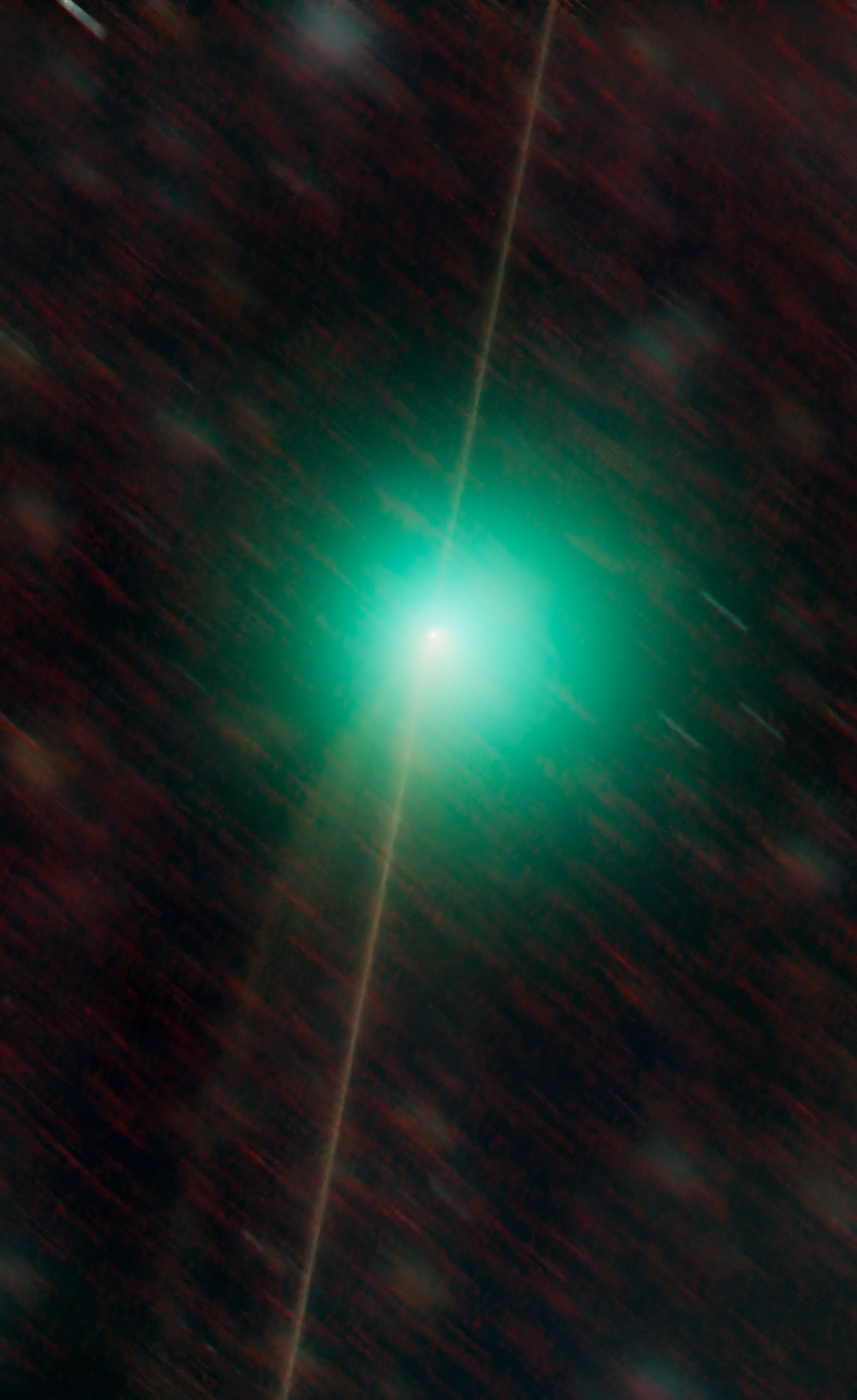
This week, Earth crossed the plane of that orbit. For just a few nights, our changing viewpoint compressed the broad ribbon of dust into what appeared to be a single bright spike piercing the comet’s glowing coma. Then the geometry changed, and the spike disappeared again. Miss it, and you wait for the next favourable crossing. Comets do not send reminders.
So on Sunday I sat in my little observatory while frost settled across the paddocks and the roof stood open to the stars. The camera drank in exposure after exposure. The comet itself is too faint for the naked eye, but on the computer screen it slowly bloomed into view: a soft green coma, coloured by glowing carbon gas, surrounding a tiny cream-coloured nucleus. And there, running clean through it, was the spike.
A hundred and fifty years of shed dust, lined up just so, for just a few nights.
One of those nights belonged to me.
Tempel 2 remains visible through binoculars in the evening sky over the next couple of weeks, provided you have dark skies and patience.
This is why I love astronomy. Not the rare, spectacular events, memorable though they are.
Most of astronomy isn’t fireworks.
It’s waiting for the geometry to become perfect.