
PHOTO

Esther James walked into Dunedin on 31 May. The city was desperately trying to purge the memory of the street violence that had taken place earlier in the year. In January, while James was making her way through Northland, Dunedin had experienced a demonstration by several hundred people over food distribution. It turned into a riot in which a grocery store window was broken; bricks, stones and concrete were thrown at police, injuring one policeman; fighting broke out; and a van was overturned and set on fire after it knocked down a female protester. In April, while James was in Wellington, there was further disorder in Dunedin, with more demonstrations, stone-throwing, window-breaking and arrests.
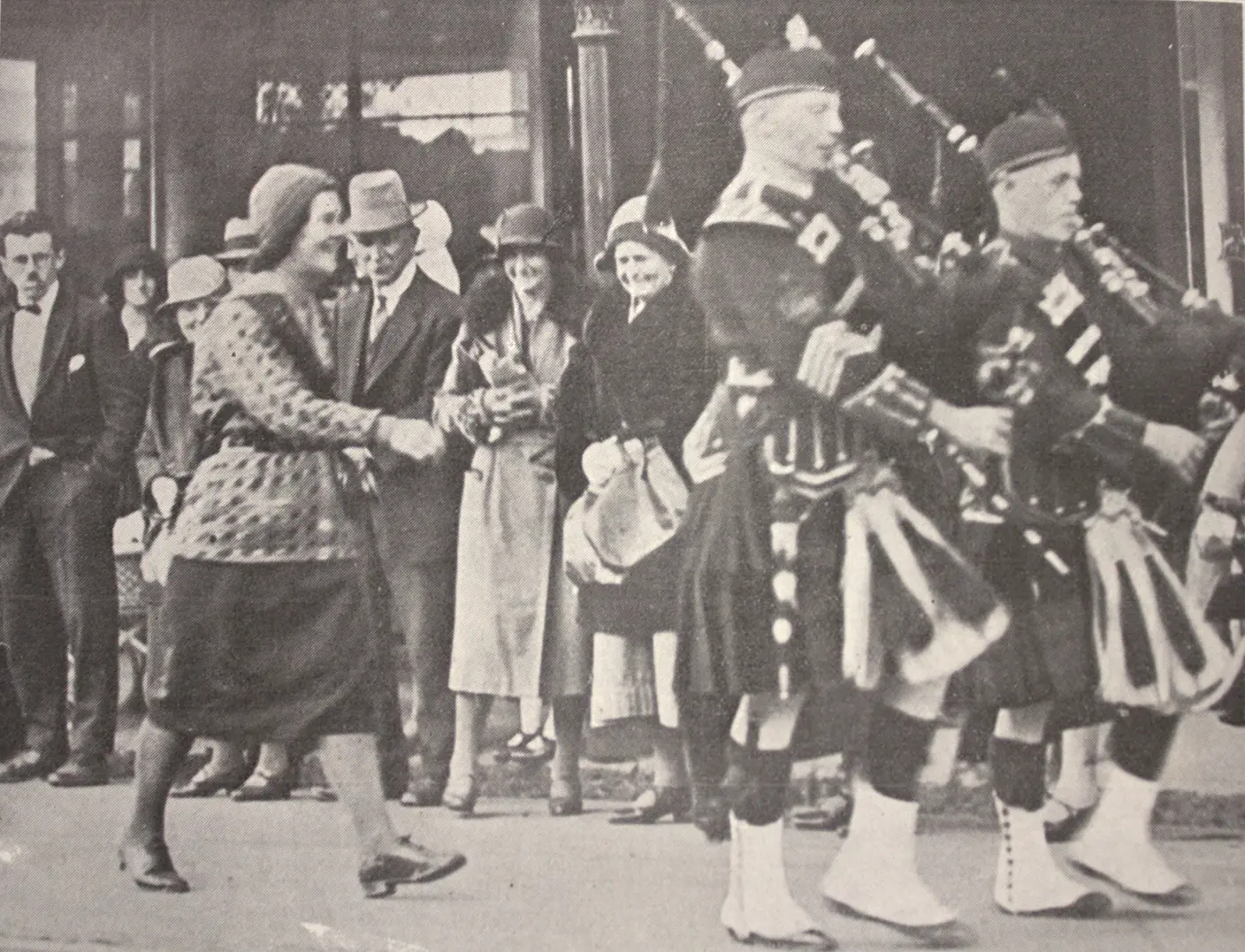
James fortuitously arrived in the city during Come to Dunedin Week festivities billed as a "war on gloom" and held in conjunction with the annual Winter Show. This followed a "Made in New Zealand" week during which appropriate displays had been arranged in 437 shop windows in the city. James agreed to extend her stay in the city to four days, and to take part in as many festival activities as she could. The visiting celebrity became one of the week’s star attractions.
The Dunedin Manufacturers’ Association arranged for a suitable reception for James on her arrival in the city at three o’clock on the Tuesday afternoon. Two pipers and a group of Girl Guides formed a guard of honour and escorted her along George St from Knox Church to the town hall as she waved to the crowd that then followed her along the street. She stood on the town hall steps and addressed the hundreds of people there to greet her. The mayor, Robert Black, and his wife, Helen, welcomed James and the mayor conferred on her the freedom of the city. Doing nothing to dispel the stereotype of a city founded mainly by canny Scots, he pinned a leather medal on her chest and told her: "This entitles you to walk as far as you please on our pavements, breathe as much as you want of our good fresh air and drink as much as you want of our pure water — and all for nothing". After she made a few brief remarks on her walk, the official party went inside the town hall for afternoon tea.
On the Tuesday evening, Robert Black paraded James around various festival activities. It comprised a frantic few hours. She gave short talks during intermissions at picture theatres and during interludes at concerts in the town hall and the concert chamber and made an appearance at an amusement park that had been set up in the town hall basement. She also spoke at a Farmers’ Union and Women’s Division social in the Otago Women’s Club rooms that included a mock trial in which a number of well-known residents and visitors, including James, "were charged with ridiculous offences and suitably punished": in James’ case, for walking through New Zealand without showing sufficient reason.

On the Wednesday, James spoke to a large audience in the Otago Early Settlers’ Association Hall and, in the evening, spoke on the radio station, 4YA, and attended an Empire Ball organised by the Victoria League in the Tudor Hall in the Savoy Building, to which she wore a shell pink Celanese gown. On the Thursday, James attended a Women’s Division reception and was introduced at the unveiling of a footpath plaque in Water St marking the spot where the first organised European settlers landed in 1848.
James also took part in an afternoon procession and street collection and attended an evening poster ball, a popular entertainment at the time, at which ball-goers wore costumes that represented poster advertisements of well-known goods, or the goods themselves. Clad in two pure white fleeces, James led the procession of people who marched around the town hall floor and made their appearance on the stage, where they bowed, curtsied or pirouetted and then glided into the wings. The Evening Star reported that the ball "was a jolly affair, the young people . . . forgetting their superficial worries over the depression and throwing themselves with spirit in prosecuting the slogan of the ‘Come to Dunedin Week’ sponsors to drive dull care away". It added that James’s fleece attire was "an appropriate costume — and cheap too".
After the Friday morning to herself, James spoke at a children’s entertainment in the town hall in the afternoon, attended by about 800 children and their parents. According to the Evening Star: "Miss James explained to the children the objects of her walking tour through the dominion, and during her brief description of her travels proved herself to be a particularly keen advertiser and publicity agent for New Zealand-made goods". In the evening, James again turned up at various picture theatres and at a concert in the town hall jointly given by the Choral Society and the Orchestra Society. She also attended a capping party put on by Otago University medical students. According to James, after the party they all adjourned to a nearly hotel, where James took off her shoes and stockings and sat legs straight out while the budding young doctors took turns kneeling down and closely examining her lower leg walking muscles.
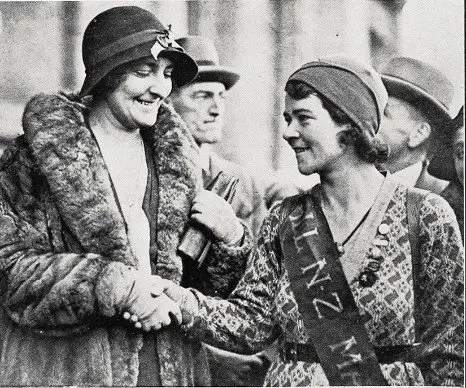
A crowd of several hundred assembled outside the town hall to farewell James on the Saturday morning, with a rousing three cheers, on her southward journey from Dunedin.
The book
• New Zealand Maid: Esther James And Her Campaigning New Zealand And Australian Walks During The Great Depression, by Ian Dougherty, is out now.