
PHOTO
May 29, 1453 was a momentous day. On that day the forces of Mehmet the Conqueror, after a siege of 53 days, breached the walls of Constantinople and brought the Eastern Roman Empire to an end.
This great city that straddles Asia and Europe had been the imperial capital for 1129 years, since it was founded by Constantine the Great.
Standing majestically on the promontory commanding views of the Golden Horn, the cathedral of Hagia Sophia was consecrated in 560 AD.

Anatolia, modern Turkey, was a critical location in the early years of Christianity. Before the construction of the first churches, worship took place in sacred rooms within domestic houses and archaeologists have uncovered a handful of these.
Anatolia was also an early centre for the deification of Roman emperors and their worship as living gods. This human characteristic continues in some countries to this day, and it was a driving force in the story of Jesus Christ.
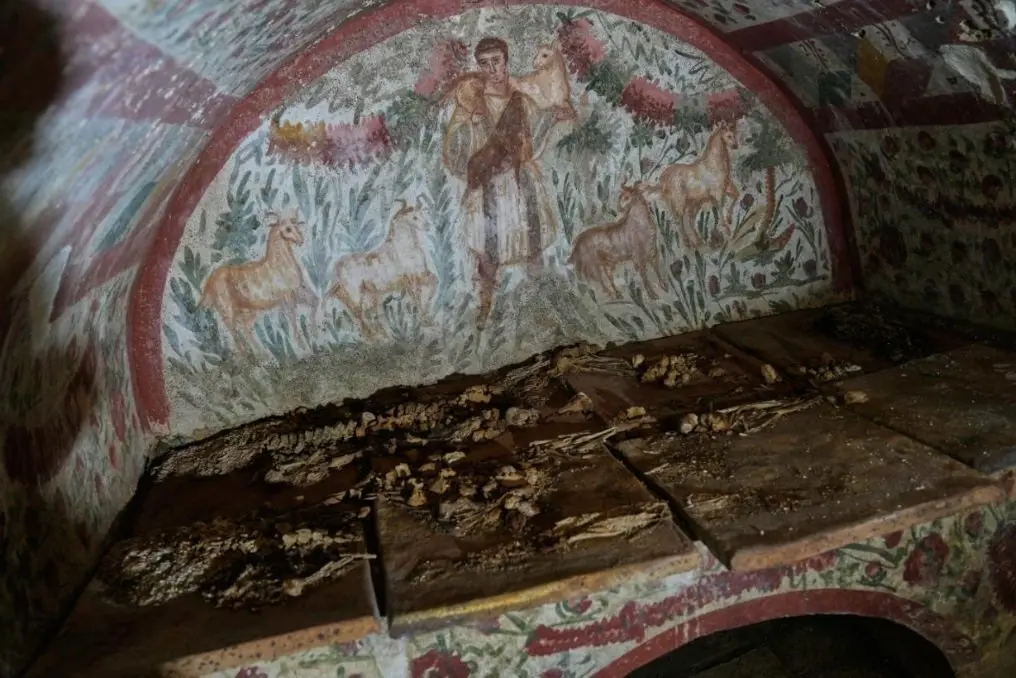
Archaeology has so much to contribute to our understanding of this phenomenon and it is again in Anatolia that, last year, a fascinating tomb was opened at Iznik, in western Turkey. It comprised an underground chamber containing the bones of five people. Sealed since the third century AD, the wall paintings have survived with the colours as vibrant as if the artists worked there yesterday.
One of these scenes depicts a splendid banquet, another a garden and a third, the owners of the tomb, grandee Romans with their slaves and attendants. However, the scene that has attracted most attention is the wall painting at the far end of the tomb, because it is one of the earliest known images of Jesus Christ.
He stands in an Elysian scene of trees and flowers with a goat over his shoulders and flock of four more surrounding him. We are used to seeing him bearded, with shoulder-length hair and a decidedly western face. Not so for the Romans of Iznik 1750 years ago. To them, he had short hair, no beard and wore a toga.
Western Turkey is a treasure house of archaeological sites. The amphitheatre at Pergamum could have held 25,000 people to view the sacrifice of Christians and, at Ephesus, a shop has been uncovered where vendors sold tiny flasks to pilgrims that contained sacred oil or holy water.