
PHOTO
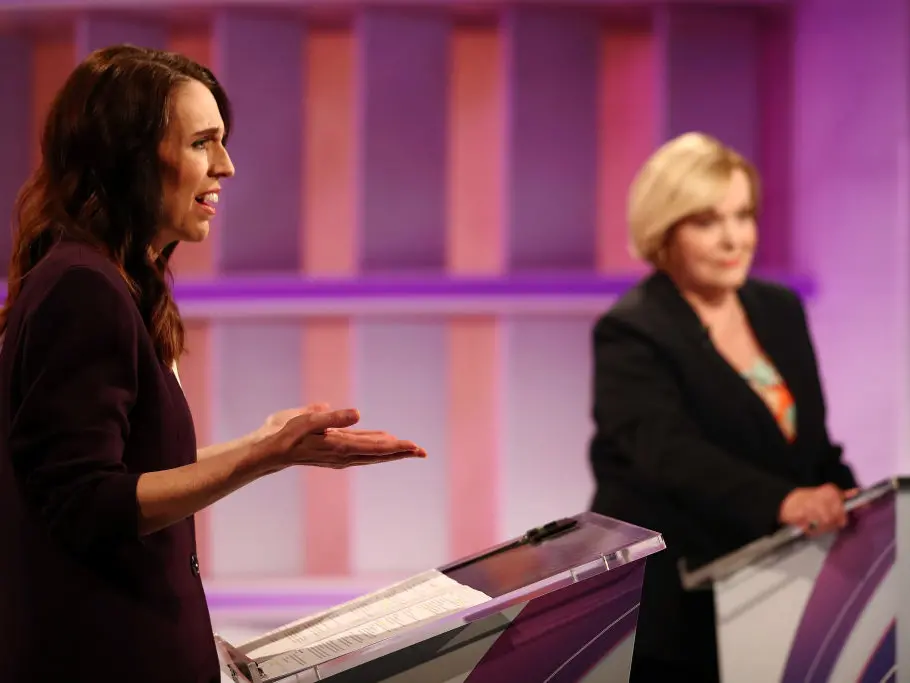
It was billed as the night the election campaign would heat up, but the first debate between Labour leader Jacinda Ardern and National leader Judith Collins struggled to simmer, let alone reach boiling point.
Both leaders were on their best behaviour, although Ms Collins’ eyebrows got a good workout, frequently arched as she shook her head at Ms Ardern’s answers.
The two walked into TVNZ’s Auckland studio having heard the results of a 1News Colmar Brunton poll which had Labour down 5% to 48%, but still with a high enough percentage to govern alone if New Zealand voted that way on October 17.
Ms Collins, meanwhile, had to sound optimistic about National’s 31% - down 1% - and the seeming loss of her party’s bedrock support to Act New Zealand, which polled 7%, its highest rating in 17 years.
Ms Ardern said MMP elections had never resulted in a single-party government, and she did not expect that to change.
Ms Collins said her campaign had been stalled by the second Auckland lockdown, but felt she had regained momentum since National’s official campaign launch on Sunday.
"I think we can show we have a much more positive vision for New Zealand, particularly around building the economy and having a proper border agency in place."
Ms Collins, who clearly had the most to gain as well as the most to lose in her first debate as National leader, easily held her own against the Labour leader, and as the debate wore on became more confident in interjecting and challenging the record of her Government.
Playing heavily on her humble rural upbringing and experience as a small business owner, Ms Collins had the best one-liners of the night, including a snipe at Ms Ardern at her failure to implement a capital gains tax and a zinging challenge to her on border control.
"With people coming from areas where there is no Covid-19 at all, we would give them the same treatment that Ms Ardern is giving to the Australian rugby team. We would treat them like they were equals."
She took on Ms Ardern in her pet area of interest, child poverty.
"This is nonsense. Last election Ms Ardern stood here and said she came into politics wanting to end child poverty, and what has happened?
"Children living in material hardship, those numbers have gone up by 4100 and that was before Covid."
Ms Ardern defended her record, saying that when the Government was elected seven out of nine measures of child poverty were getting worse, and three years later seven were now improving.
"Judith is talking about just one of those [statistics]."
Ms Ardern was solid throughout, although she did not hit the rhetorical flourishes of which she is capable.
She was strong in defending her party’s tax policy, and criticised National’s planned tax cuts, saying, "I do not need a tax cut."
Her Government’s approach to Covid-19 had meant New Zealand was back to some sense of normality, and she would maintain a "stamp it out" approach to the disease, she said.
She cited the new Dunedin Hospital as an example of Labour’s "double duty" approach to infrastructure projects.
"Right now we are demolishing the buildings on the site of the new Dunedin Hospital, that will create thousands of jobs, and we have also invested in shovel-ready projects for people to train at the tech, training that we need to build that hospital.
"We get a double whammy of both building a new facility and training our young people."
The debate was an even contest, which traversed issues such as employment, climate change, poverty, taxation and agriculture.
Ms Collins perhaps edged the debate narrowly, but neither leader would have left the podium dismayed about their performance.