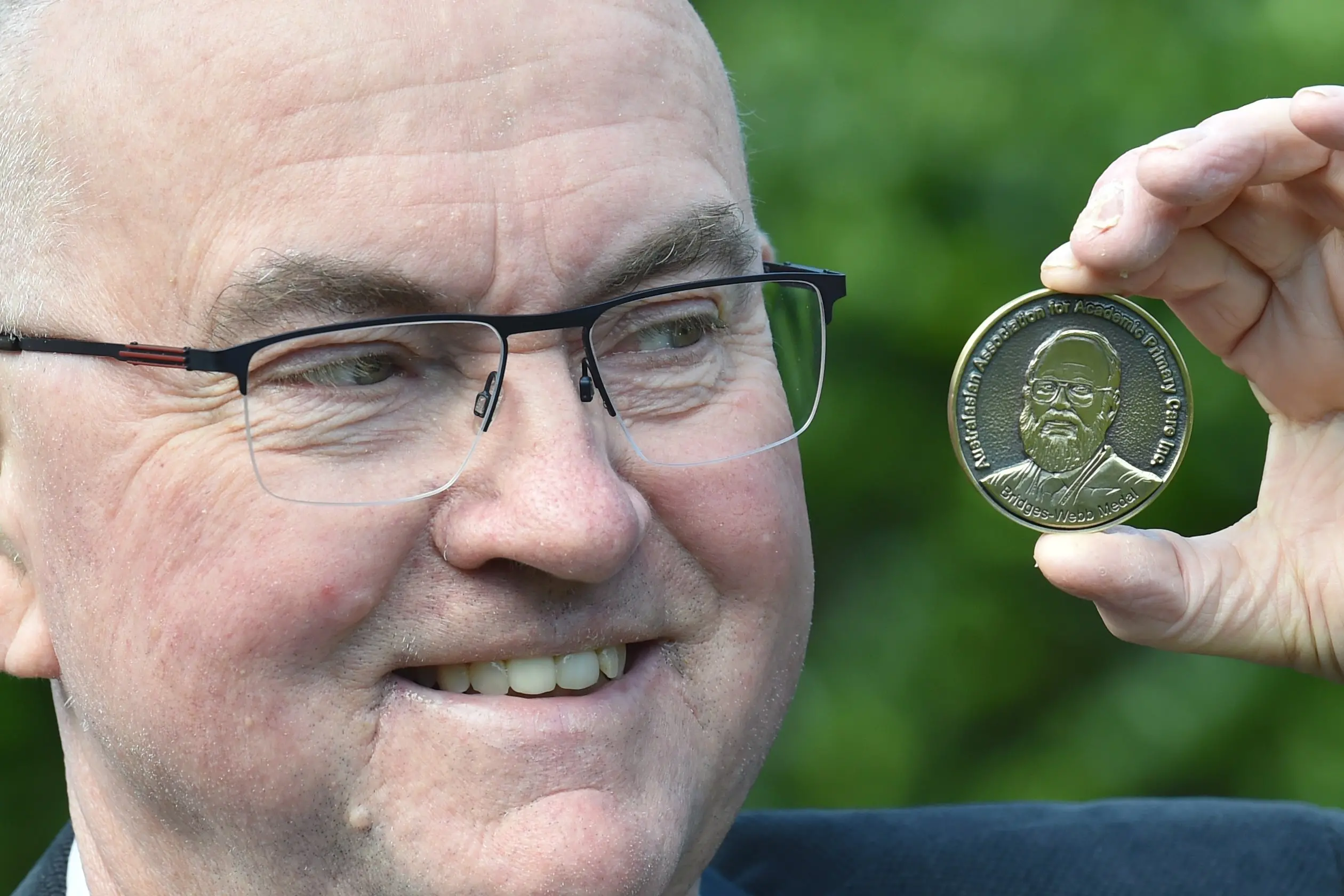
Contributions to improving New Zealand’s health system have earned international recognition for an Otago researcher. University of Otago Elaine Gurr chair of general practice and part-time Dunedin general practitioner Prof Tim Stokes has been awarded the Australasian Association for Academic Primary Care’s (AAAPC) prestigious Charles Bridges-Webb Medal. The medal is presented to academics of international standing, for making an outstanding contribution to leadership in primary care research in Australia or New Zealand. ©Allied MediaThe Australasian Association for Academic Primary Care’s (AAAPC) prestigious Charles Bridges-Webb Medal. Photo: Peter McIntosh Prof Stokes is the first Otago staff member to receive the medal, and joins a list of senior, highly cited academics. “It’s really nice to have the medal awarded in recognition of the work I’ve done to foster collaborations, both within New Zealand and also across the Tasman, in terms of our academic discipline.” Formerly from Birmingham, Prof Stokes helped develop research in general practice and primary healthcare in the United Kingdom. He has continued that research since his arrival at Otago in 2014, and collaborated with colleagues across New Zealand and Australia to focus on New Zealand’s health system. “The research that I’ve done since coming to New Zealand has really focused on doing what’s called health delivery research — research on the health systems, both in primary healthcare and also across linkages between general practice, primary healthcare and secondary care in terms of healthcare delivery. “That’s basically looking at research that looks at how we can better improve health services.” He said one of his first research projects in New Zealand was to look at ways to improve treatment of people with chronic obstructive pulmonary disease in the southern regions. “And that work was used by the Southern District Health Board — as it was then — to help inform its delivery of services in the area. “That sort of thread of doing collaborative work with general practice and the DHB has continued through a range of collaborative areas across the health sector in the southern region. “In addition to that, the second thing that I’ve been doing was very much moving into some national evaluation research in a similar area, again with colleagues at the University of Otago.” He had also researched ways of supporting general practitioners, hospital residents, and doctors who wanted to do academic research at master’s or PhD level. He said a recent project looked at understanding how regional groupings of district health boards could work better together to deliver more complex care across New Zealand. “I think that research was important.” Another recent project looked at ways to improve the quality of care for people living rurally. At present, Prof Stokes is finalising research papers on the evaluation of New Zealand’s Pae Ora health reforms, which replaced district health boards with Health New Zealand Te Whatu Ora. He said it had been very “rewarding” and “humbling” to be part of “positive changes” in New Zealand’s health system. “I just feel that I’ve been able to use the skills and talents that I have, for good. “I don’t just do research because I like doing research. I want to do research in order to help improve the quality of care that we provide to our patients. “So I guess I feel honoured to be able to have the opportunity in New Zealand, to have actually been able to help support that.” john.lewis@odt.co.nz