
PHOTO
The government has unveiled a new style of school report it says will give families clearer information about their children.
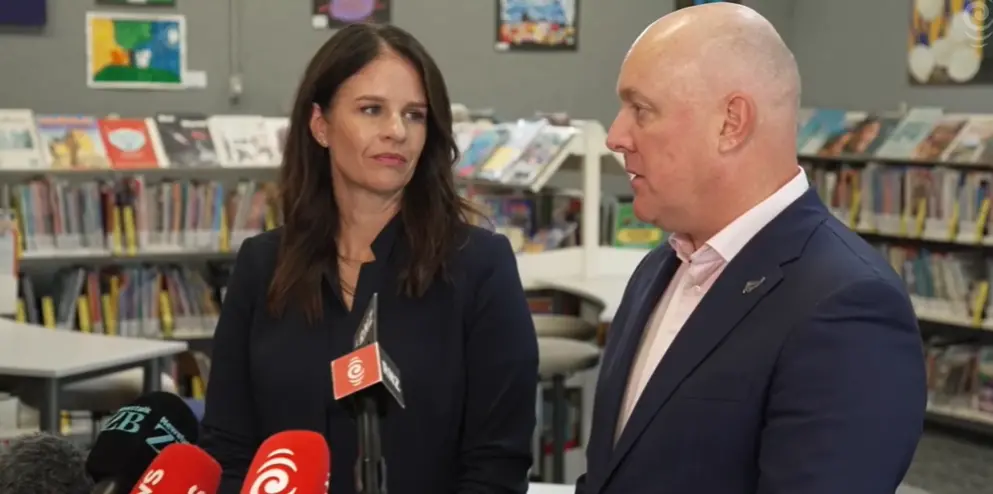
Prime Minister Christopher Luxon and Education Minister Erica Stanford made the announcement at Cockle Bay School in Auckland this afternoon.
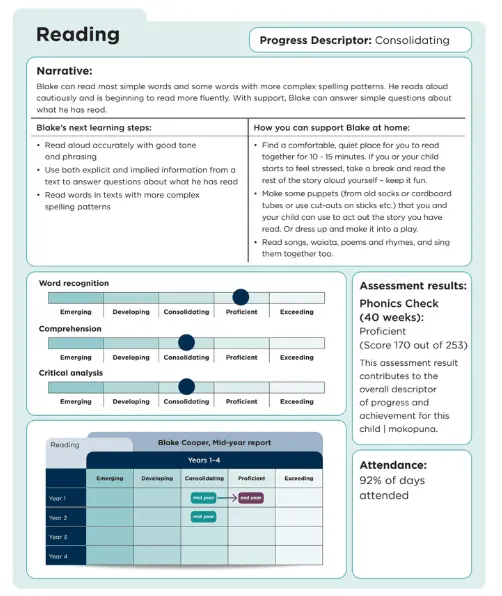
They say the reports will ensure all primary and intermediate schools describe children's achievement in reading, writing and maths twice a year in the same way.
The new reports would rank children's achievement on a five-point scale - emerging, developing, consolidating, proficient and exceeding - across several aspects of each of the three subjects.
They would also provide an overall percentage score for each subject and descriptions of what children could do in each.
Schools were also expected to include student attendance in the reports.
The government said schools would report on other subjects and on student behaviour as they already did.
Education Minister Erica Stanford said the change delivered on an election campaign promise.
"If you look at what we have now in many reports that I've seen, they're not very detailed and it might just say 'maths, tick' - that's it. We are providing by strand - algebra, geometry, number… children's progress over time, and there is a key to explain what each of the descriptors mean.
"So it should be easy to understand... it is more detailed, more comprehensive, it gives them a far greater picture of their children's success."
Stanford said multiple agencies, including the Education Review Office, had called for nationally consistent reporting of student achievement and progress.
Schools would use a new test, the SMART tool, to measure children's achievement in Years 3-8 either online or in print, and schools could use AI to analyse children's results, she said.
A common method for describing achievement ensured children's reports would remain consistent even if they changed schools.
Parents should note that children would start each year at a "novice" level of achievement, because they were learning new information and would progress as the year went on, she said.
The Ministry of Education had told schools their reports were expected to include the new progress descriptors, a narrative about why the progress descriptor was selected, and how parents and whānau could support their child's next learning steps at home
They were also expected to include assessment results, attendance information and a visual representation of progress over time.
It comes as schools are opening up again for 2026 and must use new maths and English curriculums for students in Years 0-10 this year. Draft curriculums for other subject areas are out for consultation until mid-April.
By the end of 2025, 9% of students in Year 13 and 15% of Year 12s had not achieved the literacy and numeracy co-requisite, figures provided to RNZ by NZQA show.
The achievement rates were the lowest in the past five years.
They equated to about 5000 Year 13s and 10,000 Year 12s who would not receive any NCEA certificates because they had not yet met the requirement.
