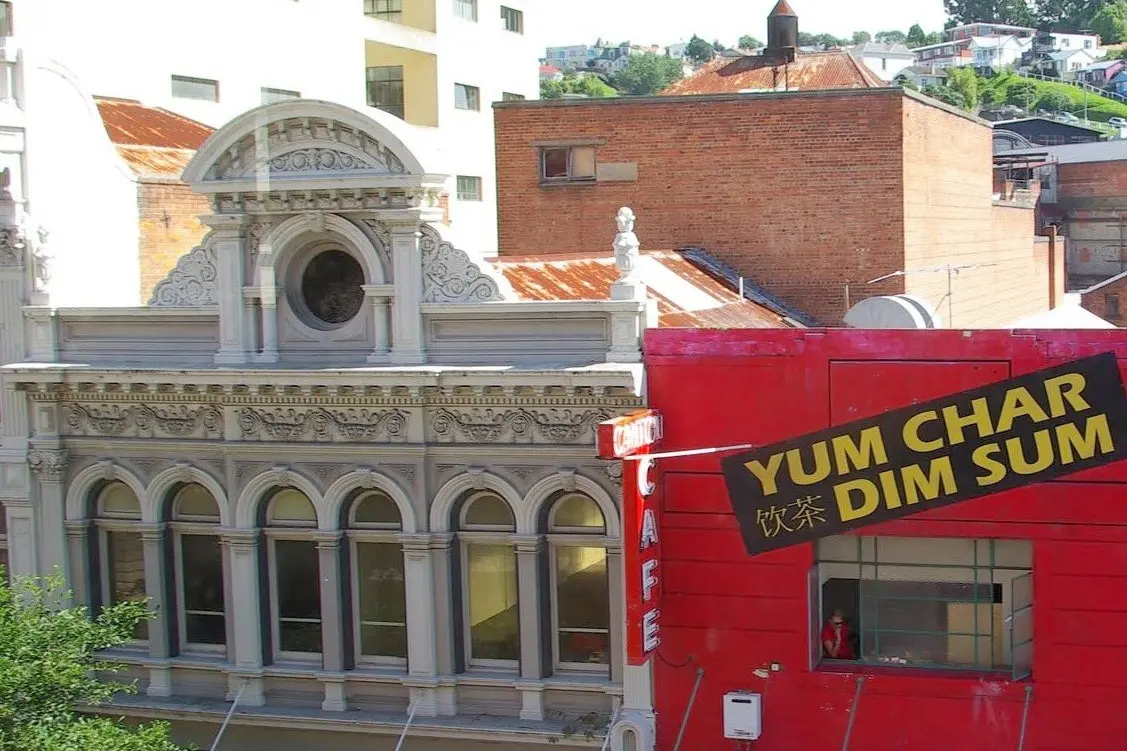
Another victory for the old buildings which make Dunedin New Zealand’s best preserved Victorian/Edwardian city. Distinction Hotels plan a flash hotel in the very unVictorian box which is Philip Laing House (which replaced the handsome Government Life building in 1970) and, best of all, they’ll refurbish the long-neglected buildings next door in Princes St. When Radio New Zealand had studios in Princes St a few years ago I passed those forlorn buildings every day and wondered what stories lay behind them. The most intriguing, the second to the right in the old photo, is the Exchange Court built in 1880 by John Hislop (who wrote Pure Gold and Rough Diamonds a superb account of his days as a travelling jeweller and watchmaker in Central Otago). For 30 years a swag of small businesses occupied the court until in 1915 it was converted into a picture theatre called Everybody’s, able to seat 1200 patrons with the grand entrance being at the shop vacated by chemist J Hayne (later a notorious abortionist who was imprisoned in the 1920s). When the ``talkies’’ arrived Sir Benjamin Fuller of the Fuller Hayward theatre empire visited Dunedin in May 1930 to announce that Everybody’s would be upgraded and sound equipment would be installed with the new theatre to be called the Roxy (after the famous giant cinema in New York). Fuller proclaimed, ``New York would not see better than the Dunedin public will witness. New Zealand does not have the palatial and enormous houses, but, for the talkies, the swing is towards smaller houses where the voices can be reproduced with their natural tone and volume.’’ Memories were made for thousands of Dunedinites during the early boom years of the talking pictures. When the Roxy opened in June the Otago Daily Times reported, ``the whole theatre has been renovated and furnished with considerable taste, forming a charming setting for the presentation of talkies. The first programme was shown to a capacity house, and everyone was obviously delighted with both theatre and pictures.’’ The Roxy littered its advertising with phrases emphasising the quality of its sound system ‒ ``sound as it should sound’’ and ``as clear as a bell’’ ‒ and being known as a ``one price’’ theatre with all seats just one shilling (about $8) ‒ a contrast to today’s prices of around $22. The Roxy became known for double feature sessions and energetically promoted Saturday afternoon sessions for children which always included a cliff-hanger serial to entice the kids back next week. Promotions aimed at children were common, one of the first being a chance to win a ``six month free ticket’’. All you had to do was pick up an entry form at the Roxy sweet shop and write your criticism of the current film The Black Watch. The film was set in India and had the Black Watch regiment fighting some rebellious locals while an officer falls in love with a mysterious Indian woman who dies in his arms. Maybe not kiddie fare but it is noted for including an uncredited John Wayne among the extras. [Missing Credit]The Rattray St/Princes St corner in 1898 with the old Government Life building and at far right the Exchange Court building which became the Roxy Theatre. Photo: Hocken Collections Week after week the Roxy churned through its mainly ``second run’’ movies, each one described with superlatives which probably soon lost their impact, while Fuller’s other theatres The Strand, the Princess and King Edward might more often show new releases. In December 1930 the Fuller theatres applied for permission to show films on Christmas Day but the city council refused. As unemployment increased in the early days of the Depression the Roxy manager John Hamer, who was married to a stepdaughter of John Fuller, brother of Sir Ben, issued 100 free tickets to a night at the films to be distributed by the Citizen’s Unemployment Committee which reported, ``much appreciation of Mr Hamer’s action has been expressed by many of the men.’’ In 1931 the Roxy was in the hands of Wightman McCombe who had been managing Oamaru’s Majestic Theatre, but his reign was short as the theatre closed suddenly in June 1931 halfway through the run of The Hot Heiress, ``a sparkling comedy featuring Ben Lyon, Thelma Todd, and One Munson.’’ What to do about the children’s serial The Lighting Express, which had several episodes to go, was solved by inviting the youngsters to the Strand Theatre where the remaining episodes would be screened after the normal Saturday afternoon film. The mystery of the sudden closure was solved when it was announced within a few weeks that Woolworths had bought the site to open their first Dunedin branch. Other buildings in that part of Princes St have their tales to tell, the Beau Monde milk bar among them, but for me the Roxy, with the plaster mouldings of the ventilator towers still intact, is a good enough reason to celebrate the absence of wrecking balls and the rise of a much-needed luxury hotel. Dunedin writer and broadcaster Jim Sullivan writes the Nothing Too Serious column for the ODT.