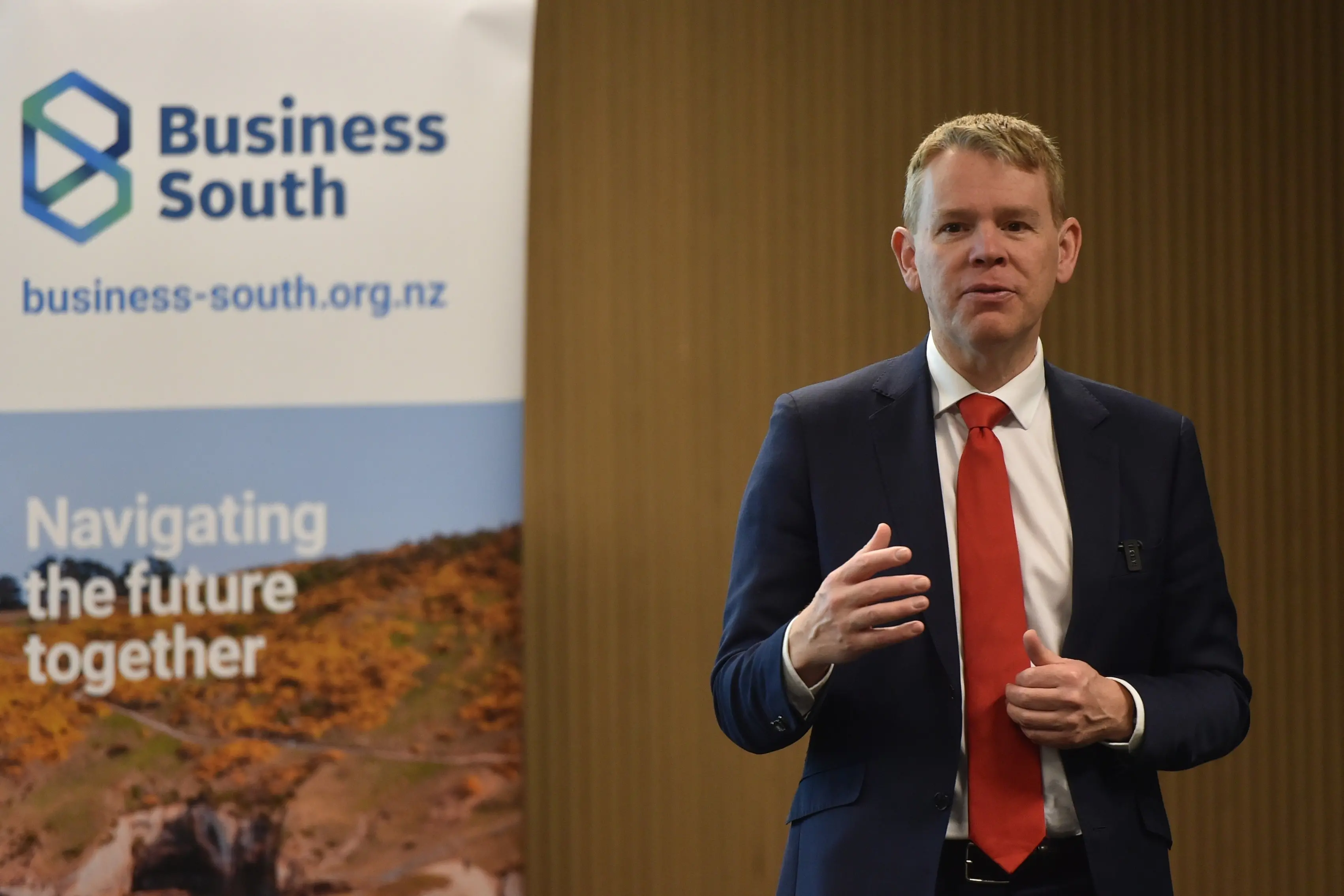
The election campaign trail is a marathon, not a sprint, and it often begins by taking small steps first. Labour leader Chris Hipkins was in Dunedin bright and early yesterday for a breakfast meeting with Business South. The turnout was hardly stellar — 28 people were picking over the ham and bacon savouries, fruit or muesli on offer — but Hipkins will well know that business leaders don’t always turn out in their droves for a left wing political leader unless that person also happens to be the prime minister. Which, of course, he once was and very much wishes to be so again. Hence he is in the midst of a very long series of provincial meetings such as this, fielding questions on everything from health equity to arts funding to local government reform. The rhythm of meetings such as these are usually consistent. Assuming that there is no major policy announcement being made — and yesterday there was not — the party leader will make some version of their standard stump speech. An experienced politician like Hipkins can do 10-20 minutes, without notes, on their policy platform, as he did with little fuss yesterday. The trick is to make it sound like they are saying it for the first time rather than the 200th time. Again, this comes easily for a veteran such as Hipkins, who sounded suitably engaged and enthusiastic about his arguments. Hipkins set out the four issues Labour would campaign on — the cost of living, job creation, access to health care and housing affordability — and dealt with each in turn. So far so good, but the best part of such meetings — and the bit which all political party communications staff dread — is the Q+A section. With no control over the content the subjects, and the answers, can take the politician in question well off script. Think Christopher Luxon three weeks ago when addressing a similar business gathering in Rotorua, and making remarks he later felt compelled to apologise for. There were no such stumbles from Hipkins yesterday, but he did offer one very revealing answer right at the end when asked about what lessons he had learnt from his year as prime minister. The first, and this might be a salient point for MPs on the other side of the House who harbour higher aspirations to consider, was that being the Prime Minister was not the same as being a senior Minister — as Hipkins had been for several years already. Being PM — or at least being good at it — requires a breadth of vision and a depth of knowledge which surprised even Hipkins, who had worked in politics, and been a politician, for many years before ascending to the top of the greasy pole. Put simply, it’s not an easy job and not everyone can do it. His second lesson was that becoming PM should not be viewed as a licence to repeal everything that happened beforehand that you did not like. Kiwis liked continuity he argued, hence Helen Clark had not torn up everything that Jim Bolger had done, John Key did not tear up everything Helen Clark had done, and nor did Jacinda Ardern pull apart what John Key and Bill English had done. His corollary to that was that he felt that Christopher Luxon, on the other hand, had tried to tear up Ardern and his own legacy, mainly at the behest of National’s support parties. The lesson he wanted noted was that a Hipkins government — should there be one following the November 7 election — would follow the former rather than the latter example. For more on this, head to www.odt.co.nz and have a watch of an interview I did with Hipkins on Thursday, in which I asked what legislation Labour would repeal, or prioritise, if elected. Some of Hipkins answers from earlier in the session reflected that determination not to dismiss every government policy out of hand. For example, he suggested that there ought to be greater cross-party consultation over major multi-year infrastructure projects, and also said that Labour would not automatically halt every proposed local government amalgamation deal proposed under the government’s Head Start programme — if the councils in question wanted to merge and it made sense for them to do so Labour would not stand in their way Hipkins said. Hipkins third takeaway from his time at the top was the need to better communication to the wider public and for politicians to pay closer attention to what the public were telling them. Politicians listen to people talking about politics every day, and can often underestimate just how little interest many people actually take in what is happening in their lives. They are more interested in what bread and milk cost and whether they can afford the rent or mortgage — Hipkins message was that politicians ignore those concerns at their peril. Now some might scoff at 28 people being in the room to hear Hipkins say that, but some of those gathered were important and influential people whose views are well worth noting. This is not the biggest stage Hipkins will stride on to during this election campaign, but the smalls steps in Dunedin on a cold Friday morning may well lead to bigger strides elsewhere later in the campaign. Otago Daily Times political editor Mike Houlahan writes the Southern Say column for the ODT.