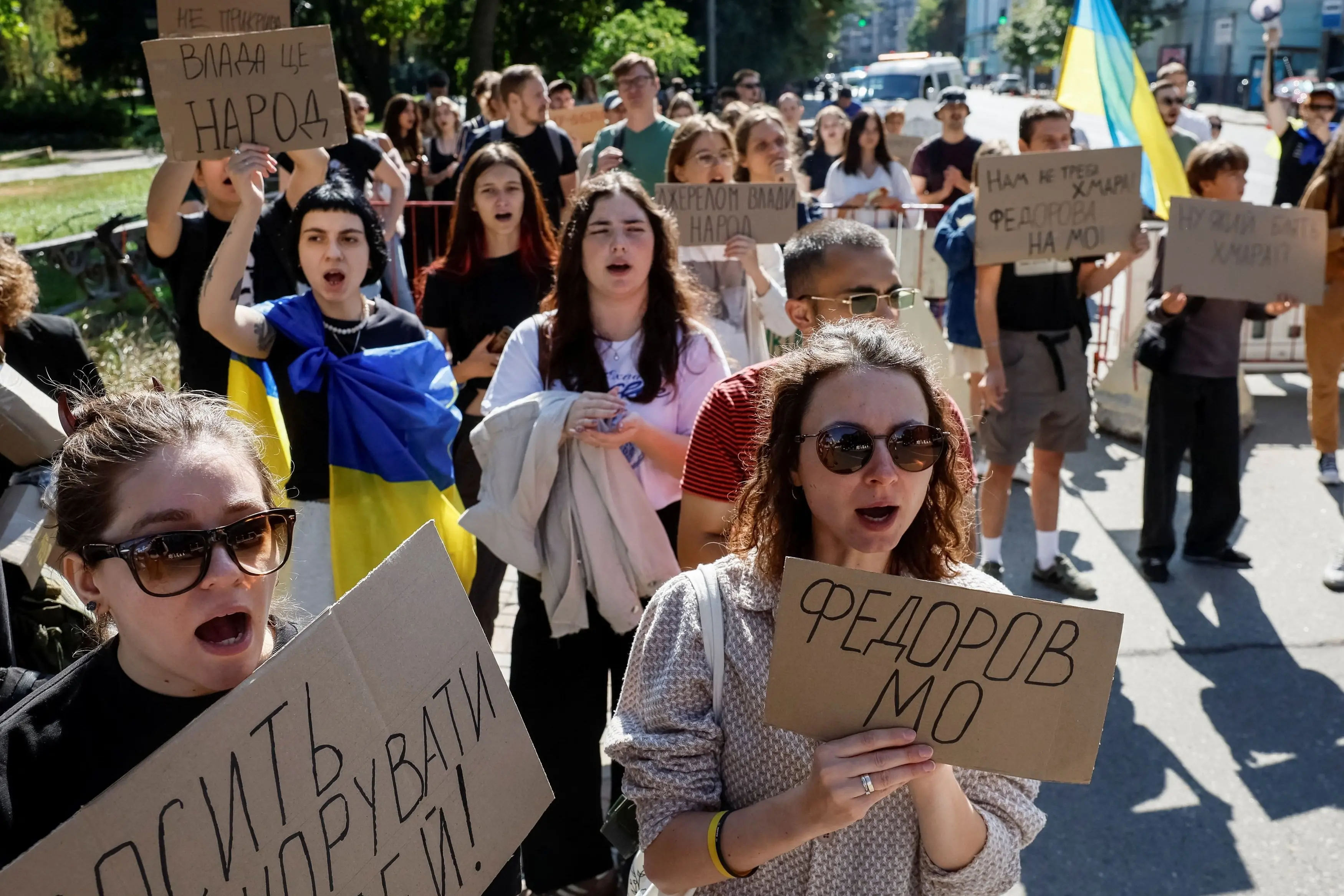
“Democracy cannot be held hostage by Russia,” said Mihaylo Fedorov, until recently Ukraine’s defence minister. “We must find a legal, safe and realistic mechanism which will allow Ukraine to renew its full democratic process even in the conditions of a long war.” Seven years after the last election, some Ukrainians are demanding a new one. The protesters who have been outside President Volodymyr Zelenskyy’s office on Ivan Franko Square since Fedorov was fired last month were still there the day after his nine-minute video went out on August 18. However, they were not more numerous than the day before. It has been seven years since the election that brought Zelenskyy to power in a landslide powered by widespread revulsion at the rampant corruption in the government. His popularity soared after the Russian invasion (90%), and four-and-a-half years into the war it’s still at 65%. That’s why Fedorov’s bid to mobilise the people against him has failed. There’s a lot of dissent and dissatisfaction out there, no doubt, because the corruption problem is real. No year passes in Ukraine without arrests and trials of high-profile thieves right inside the government. Zelenskyy’s chief of staff, Andriy Yermak, resigned last year in the midst of a corruption scandal that also implicated the president’s former business partner Timur Mindich (who fled abroad). This year’s premier outrage featured people connected to the state-owned nuclear power company who misappropriated $3 million to pay bail for a former energy minister accused of money laundering. They have been arrested, as have been two senior state bank officials, while the deputy head of Zelenskyy’s office has been fired. Shocking, shameful stuff, but it’s Standard Operating Procedure in post-Soviet political cultures where officials and politicians act as if they have the right to plunder the state. At least in Ukraine some of them are being arrested or dismissed, and Zelenskyy himself seems clean. How does Ukraine compare with other post-Soviet states on the international Corruption Perception Index? Transparency International ranks it at 104 out of 182 countries, in the same group as Brazil and Argentina — and steadily improving. Only 23% of public service users paid a bribe in the previous 12 months. Russia, by contrast, ranks 157, near the bottom of the list, in the same group as Chad and Zimbabwe. 34% of Russian individuals paid bribes in the past year to public officials (health, education, police, etc.), and 71% of Russian companies bidding for state contracts get demands for bribes. Ukraine is not good on the corruption front but it’s getting better, and there’s no strong case for throwing the rascals out. But even if most people in the government are not rascals, seven years without an election is a long time. Surely democracy demands an election now — or at least the Russians and Donald Trump think so. They claim he has no legitimacy otherwise. By the same logic, Winston Churchill should have called an election in 1940, when the United Kingdom was fighting the Germans all alone in the Battle of Britain, before either the Soviet Union or the United States had come into the war. The last election had been in 1935, so five years later Churchill had to hold an election or become illegitimate. Nonsense. Parliament just passed laws each year postponing the election by one year until peace was in sight in July 1945 (one year after D-Day) — and Churchill lost. The United States did hold an election in 1944, but the situation was different: no bombs, no refugees, no enemy country within reach. (Roosevelt won, then died within three months and Truman took over). Circumstances alter cases. Countries a long way from the front line, not being bombed, with up-to-date voter registries can certainly hold elections in wartime: New Zealand did, South Africa did, Australia held two elections, Canada had two plus a plebiscite. But it’s very hard to do it when bombs are dropping on the voters. There could be a case for holding an election despite the nightly air raids on Ukrainian cities, the seven million citizens who have fled abroad or are living in occupied territories, and the very large number of soldiers in the trenches — but not many people in Ukraine are demanding it. Polls say that 70% would prefer to wait for peace, even though seven years is a long time. So Mihaylo Fedorov is wrong to demand an election now, although he has been badly treated by Zelenskyy. He would be doubly wrong to meet Donald Trump during his forthcoming visit to the United States, because the US president, after consulting with Vladimir Putin in Moscow, would be only too happy to set him up as an alternative to Zelenskyy. Independent London journalist Gwynne Dyer writes the World View column for the ODT.