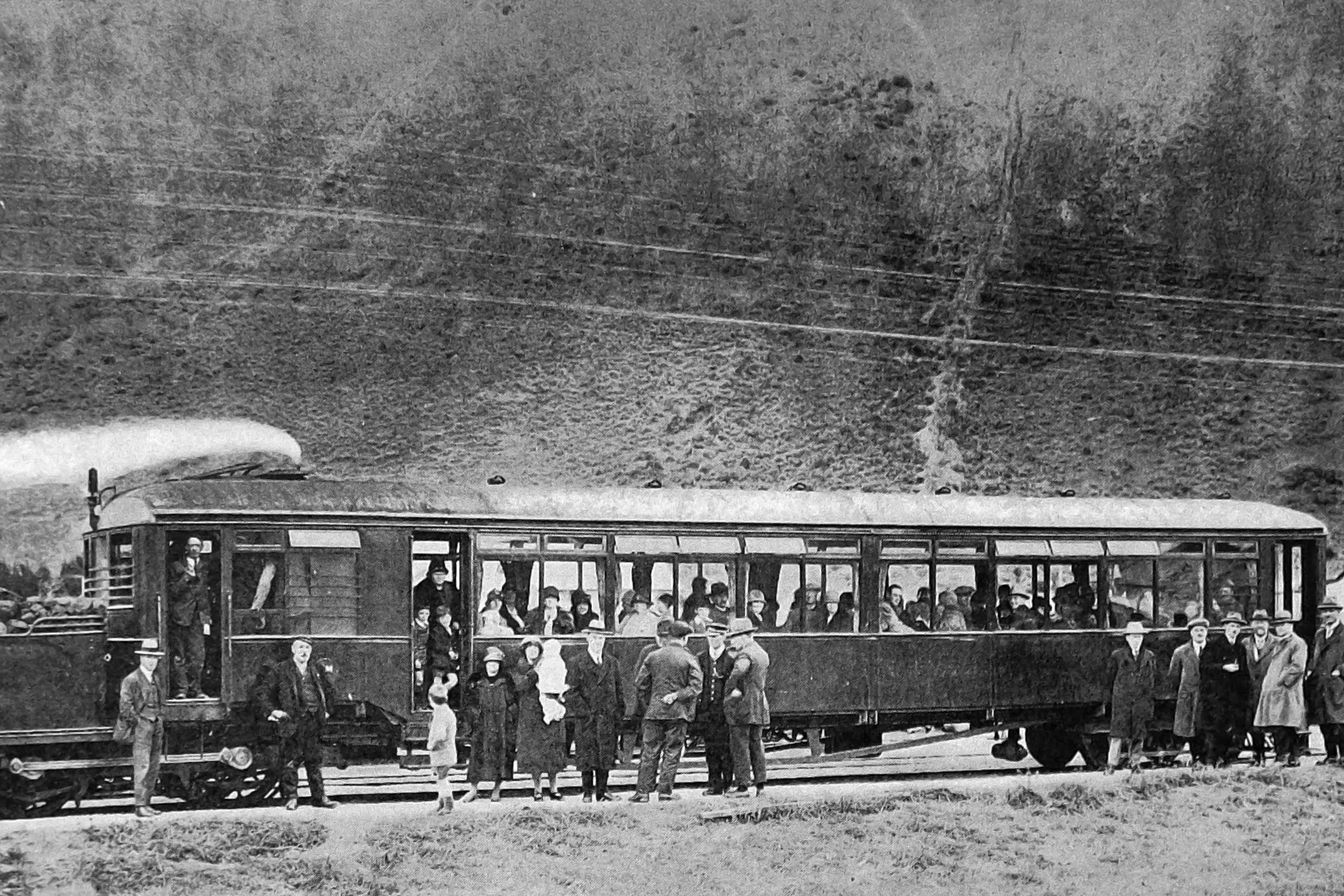
The new Clayton steam railway carriage which is to be used on the Oamaru-Kurow line was given a trial run to Kurow yesterday, having come from Christchurch on the previous day. The carriage, which has a seating capacity of 54, was manufactured by the Clayton Titanic Engineering Co, of Lincoln, England. It is drawn by a Standard under-type engine. It is electrically equipped with dynamos and battery. There is dual control on the carriage with steam brakes on eight wheels. There is also a hand brake at each end of the carriage. The engine has a travelling capacity of 100 miles without replenishing either coal or water. The carriage is constructed largely of steel. It is beautifully lighted and assumes the character of an observation car. The seats are reversible and are covered with buffalo hide. The ventilation is good and comes from toplights and ventilators. The carriage has a total length of 55 feet, and is of standard width. Its total weight, including the engine, is 23 tons. A seat is provided in the car for the guard, and provision is made for ambulance appliances. A feature of the steam carriage is that it consumes only 12 pounds of coal to the mile, instead of the usual 30lb. The journey between Oamaru and Kurow, which is usually accomplished in 2½ hours, was completed in one hour 45 minutes. This included 14 stops averaging one minute each. At some points of the journey a speed of 42 miles an hour was obtained. On arrival at Kurow there was a large assemblage of the townspeople, who viewed the latest medium of transport with considerable interest. The carriage and officials were photographed, and a large number of townspeople was taken for a short ride. This is the first carriage of its kind in use, and the Railways Department is using the Kurow line as a test. If the carriage succeeds in diverting the traffic from the road back to the railway, it is probable that it will be used on several of the other branch lines of the Dominion. The advantage of the new service is that the train — or carriage, to be more accurate — will stop at all crossings to pick up passengers. It will also will save at least an hour on the journey. The officials who operate the carriage consist of a guard, a fireman and a driver. The driver operates from either end of the vehicle. Mirrors in the garage The last place one would expect to find a mirror is in the auto repair shop. Yet a collection of small mirrors will be found to be very useful tools. For instance, when examining the differential, into which a light cannot be inserted, a small mirror will be found useful to reflect the light from a lamp into the deeper recesses. Again, when working in back of the instrument board a mirror may be placed on the floor of the car, reflecting the light upward. One great advantage of this is that the light need not be held close to the face, which not only makes for discomfort but frequently defeats its own purpose by supplying sufficient light to temporarily blind the worker. It is a good plan to attach handles to the mirrors so that they may be inserted into narrow places. Shell’s predecessor gets land The lease of five Harbour Board sections on the reclaimed land at the foot of Frederick street, of an area of approximately three acres, has been purchased by the British Imperial Oil Co (New Zealand) Ltd, at the upset rental of £500 per annum. This marks another stage in the progress of the port of Dunedin. The company proposes to commence building operations in September, and will erect four large storage tanks for petroleum spirits, store buildings, and rail depot to railway siding. Buried pipe lines will convey the spirits from oil tank steamers to the storage tanks. — ODT, 2.8.1926