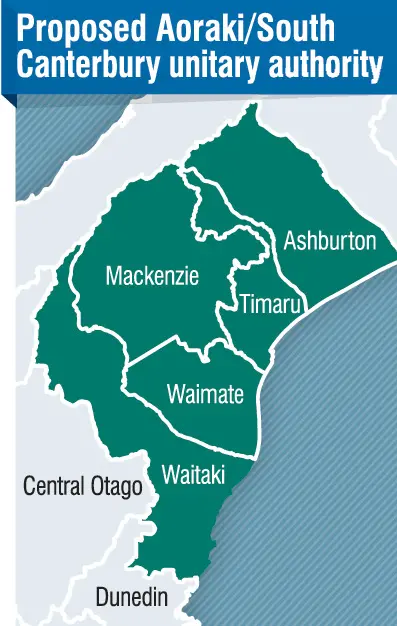
Mayors who have put forward a joint proposal for a new Canterbury/North Otago unitary authority say their combined districts are a “genuine powerhouse for the country”. The “ambitious” plans for a five-district authority were submitted under the government’s Head Start pathway on Sunday. In a joint statement on Monday, the mayors of Waitaki, Timaru, Mackenzie and Waimate districts said their proposal would create a “single, stronger unitary authority” across one of New Zealand’s “most economically significant regions”. Ashburton District Council has also been included, despite the council voting not to sign up, for “greater scale, a broader rating base and stronger regional capability”. The proposed new authority was described as “a genuine powerhouse for the country”, home to the Waitaki Valley hydro schemes, some of New Zealand’s “most productive agricultural land and food processing industries” and “internationally renowned” tourism destinations. Waitaki District Mayor Mel Tavendale called it a “once-in-a-generation opportunity to build something better together”. “We’ve listened carefully to our communities throughout, and I’m pleased we can put forward something genuinely locally led. “Our communities are linked by our rivers, our economy and our way of life, and this proposal reflects that reality.” Timaru District Mayor Nigel Bowen said the proposal was a “genuine team effort”. “This region powers New Zealand in the most literal sense, and this proposal is about making sure our local government is as capable and ambitious as the place it serves.” Mackenzie mayor Scott Aronsen said there had been “open, honest conversations” around the table and “that’s exactly what a decision of this scale deserves”. “For our smaller and rural communities, this is about securing better services, stronger representation and real resilience for the future.” Waimate mayor Craig Rowley said the proposal “keeps our district’s voice at the heart of any future arrangement”. “It’s practical, it’s ambitious, and it makes sure smaller communities like ours are heard every step of the way.”