
PHOTO
Regional leaders and government officials have pledged to work together on affordable housing solutions, transport projects and better access to healthcare in Queenstown Lakes and Central Otago as part of a regional deal.
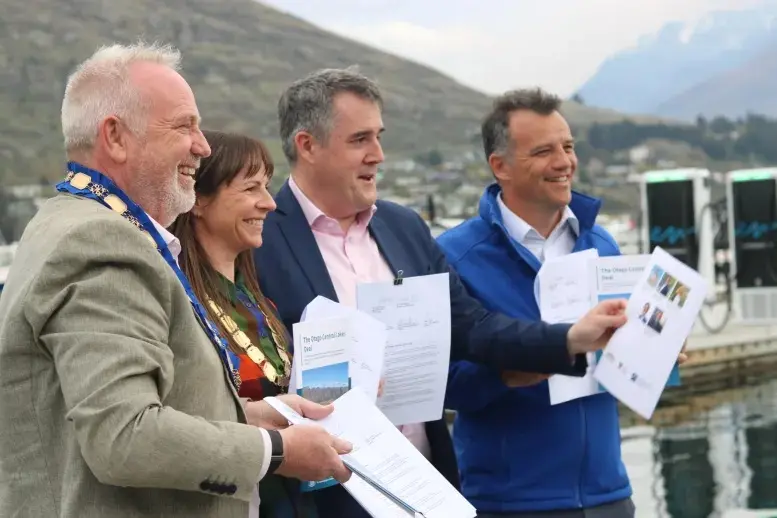
The Otago Central Lakes Deal - a 10-year plan to deliver infrastructure and manage rapid growth - was formally signed in Queenstown on Tuesday afternoon.
Queenstown Lakes District Council, Central Otago District Council and Otago Regional Council teamed up in early 2025 to develop a joint proposal.
The deal was initially set to be unveiled in August, but the announcement was scuppered by the National Party's crisis talks.
Speaking at the signing, Infrastructure Minister Chris Bishop said he was excited to formalise the deal, and excited about the future of the region.
"It's about the start of a renewed relationship between central government and the councils to try and unlock growth here, but also fix some of the problems that have been built up for too long," he said.
In late August, negotiations were put on hold after the National Party ruled out the idea of a bed tax.
The three councils said they were seeking more clarity, given the deal had included a commitment to explore an accommodation levy in 2027.
Bishop said the deal ultimately included "a commitment to work together around getting that funding flow."
Queenstown Mayor John Glover said discussions over exactly how tourism-related infrastructure should be funded would continue in coming months.
"What we recognise is that we're going into an election, all the parties have different views on how tourism should be supported. So it's probably unreasonable to come up with a form of words this side of the election," he said.
"But when we had a conversation with the ministers we said that what we're looking for is a commitment from the Crown to acknowledge that there is funding impacts on local councils - and a commitment to look at the different ways of bridging that gap."
Transport infrastructure was a core pillar of the plan, Bishop said.
He said the deal would also be accompanied by a new Queenstown Strategic Network Plan - which would explore projects like a replacement Edith Cavell Bridge at Arthurs Point in Queenstown as an early priority, and an additional crossing over the Kawarau River in the long term.
"It's a plan that deliberately looks out over the next 30 years and some of the projects and some of the proposals in the plan are identified in the deal as well. It's not a plan for funding. That's a separate issue. But it is a plan about what we need to do as we build out the network here," he said.
The plain reality was that the region's transport networks had not kept up with growth, he said.
"I think we've under-invested here in the region and we need to step up. And I've been reflecting on that today, just over the course of the conversations, and seeing some of the transport challenges - and frankly getting stuck in traffic on the way here."
The regional deal - while stopping short of specific project announcements - also includes a pledge to look at local councils getting a portion of mining royalties, and a commitment to look at the case for inclusionary housing zoning.
It also built on a previously announced $180 million funding commitment for healthcare, with a commitment to expanded local health services including mental health, maternity, cancer care and radiology, as well as ongoing work to determine whether a new hospital was needed for the Otago Central Lakes region.
As the agreement was being signed on behalf of the Crown, it would remain in place no matter the outcome of the upcoming general election, Bishop said.
"The point is to create an enduring partnership around key priorities," he said.