
PHOTO
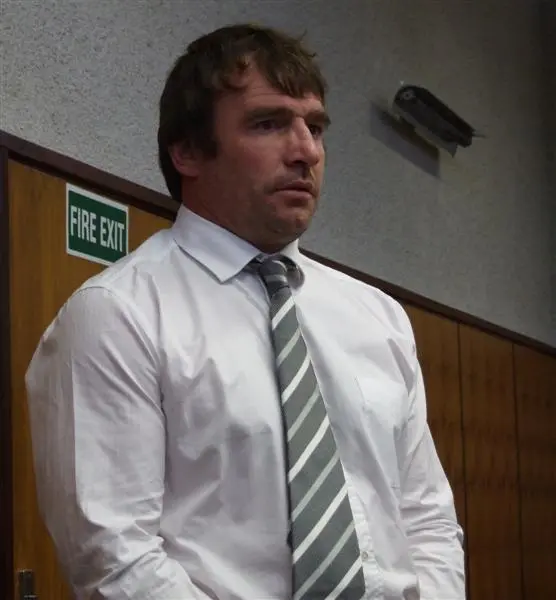
Former All Black Andrew Hore, ''more than most'', should have acted responsibly when it came to managing firearms, a judge said as he convicted him yesterday on a firearms charge.
The bid by Andrew Keith Hore (37), of Patearoa, to be discharged without conviction for supplying a shotgun to an unlicensed person on the opening day of the duck-shooting season was opposed by police and rejected by Judge Dominic Flatley.
''You, more than most, should have acted responsibly here,'' Judge Flatley told Hore during sentencing in the Alexandra District Court.
He thought Hore had displayed a ''cavalier attitude'' towards the relevant rules of firearms management and fined him $400, court costs $130.
Counsel David Robinson submitted the consequences of a conviction would outweigh the gravity of the offence, but the judge said that was not the case.
The defendant admitted supplying a gun to Daniel Parker when they were duck-shooting on May 2 at Paerau.
The charges laid against Hore and three other people followed a police investigation into an incident in which Mr Parker received a serious injury when a gun discharged after it fell off an all-terrain vehicle.
Mr Parker was dealt with by the court last month on a charge of unlawfully possessing a gun after his firearms licence was revoked and two other men were earlier dealt with by the court for possessing a gun without a licence.
Mr Robinson said there had been an intense level of publicity and Hore had been ''frankly pilloried'' by the media.
Some media reports incorrectly said it was the gun supplied by Hore that caused the injury.
The defendant had ''no connection'' to the incident in which the man was injured, Mr Robinson said.
Hore supplied the gun to Mr Parker at 8am and the incident happened at 3pm.
The offence was ''at the lower end of the spectrum'' and Hore's work opportunities overseas could be affected by any conviction, as it might result in him being refused entry to Britain.
Hore had work available overseas during the Rugby World Cup and would suffer a ''substantial financial loss'' if a conviction meant he was denied access to some countries.
Hore's wife was British, their children had dual citizenship and it was planned to hold the children's christenings during the couple's trip to Britain.
In 2005, Hore was one of three Otago farmers convicted and fined for shooting and killing a protected fur seal on the Otago coast.
He also faced a firearms charge, which was withdrawn by police, and he was granted diversion on that charge after making a donation to a charity.
Judge Flatley said in this matter, the defendant had not checked whether Mr Parker had a firearms licence before giving him a gun.
There was also the potential for poorly managed firearms to have serious consequences, including fatalities, the judge said.
Hore, being a rural man, and having ''previously being involved in similar type of offending'' should have taken more care, especially as he knew the duck-shooters were ''likely to consume alcohol, and they did''.
The defendant would have to disclose this conviction before entering another country but it was not known whether he would be refused entry because of it, Judge Flatley said.
Prosecutor Sergeant Ian Collin said there was no ''mandatory'' disqualification of entry into the United Kingdom if there had been a conviction within the last 12 months.
It was at the discretion of an immigration officer.