
PHOTO
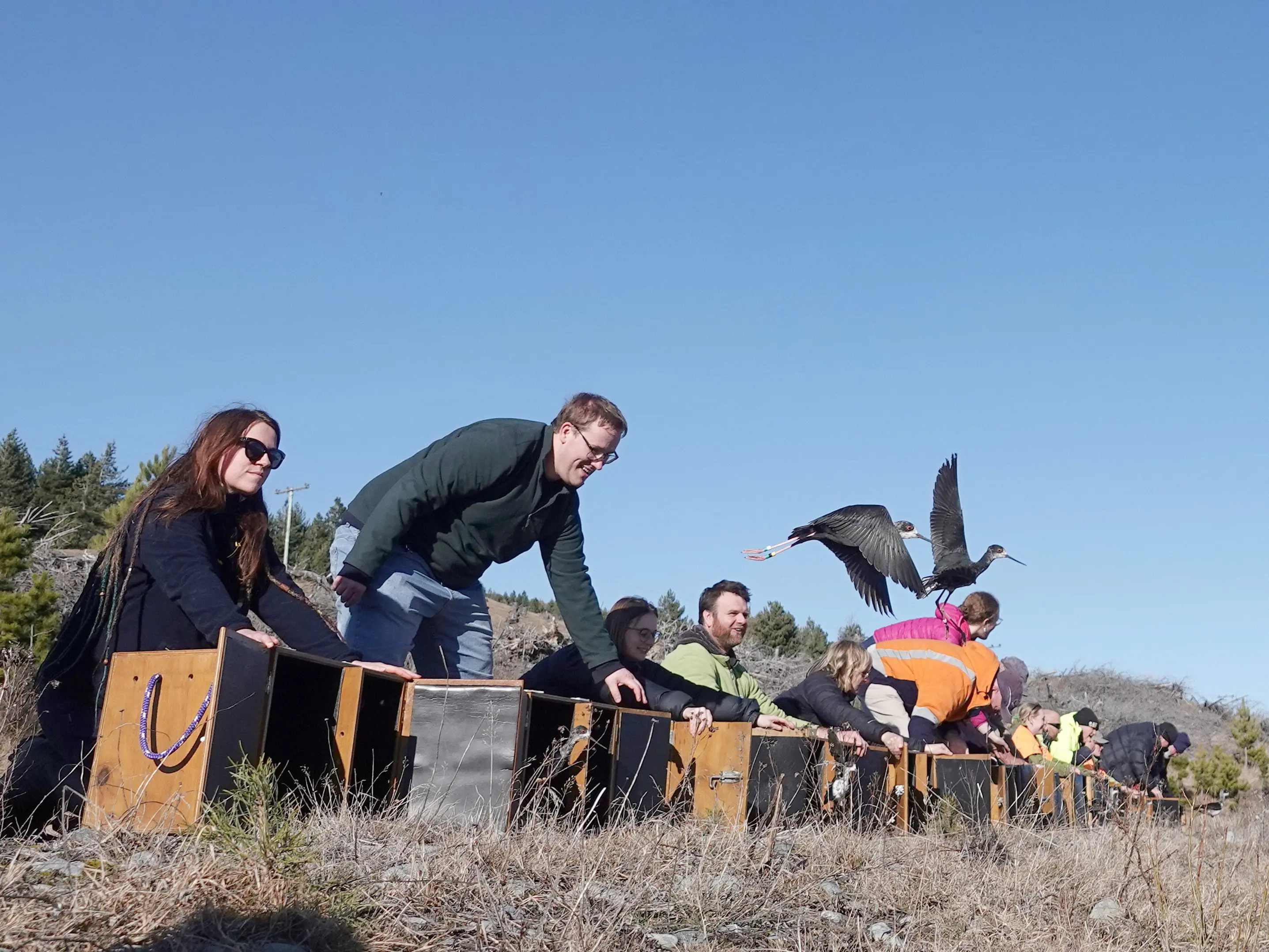
New Zealand’s wild kakī/black stilt population has been boosted with the release of 148 young birds in the Mackenzie Basin this month.
Kakī are one of New Zealand’s rarest native wading birds and a taonga species for Ngāi Tahu. Conservation efforts over the past 40 years have resulted in the bird — known for its distinctive black plumage and red legs — being rescued from a population low of just 23 and the brink of extinction.
The released kakī were raised in captivity by the Department of Conservation (Doc) at its Twizel kakī facility, and by the Isaac Conservation and Wildlife Trust in Christchurch. They join an estimated 141 adult birds in the wild, whose population fluctuates but is slowly increasing.
This month, 75 kakī were released at Lake Tekapo, and another 73 into the Tasman Valley, where extensive trapping helps protect the birds from introduced predators such as stoats and feral cats.
Doc senior biodiversity ranger Dean Nelson said the annual kakī release was a highlight for the local community, and the culmination of 10 months of intense work.
"Each young kakī released into the wild has been hatched from incubated eggs taken from wild or captive pairs, then fed and cared for in captive facilities over many months," Mr Nelson said.
"Kakī are critically endangered and found only in New Zealand. Our efforts to bolster and protect the wild population in the Mackenzie are crucial to their survival."
The newly released kakī will be given supplementary food for up to six weeks as they settle into their new environment.
Despite extensive predator control across their braided river habitat in the Tasman, Godley and Cass Valleys, kakī are vulnerable in the wild. On average, about 30% of released birds survive to adulthood.
Mr Nelson said planned research, funded from the international visitor conservation and tourism levy, would use solar-powered GPS transmitters on kakī to improve understanding of why so many young birds were lost, and better focus management activities.
Trials are already under way with captive kakī to find the best method of attaching the transmitters to the birds. This work was sponsored by Environment Canterbury and Guide Hill Station. — Allied Media