
PHOTO
The West Coast Regional Council has a record $65 million worth of flood protection projects on its books.
Among the most critical is a $25.8m project for the flood-prone town of Westport.
A series of stopbanks will eventually ringfence the town after it was swamped in a 1-in-100-year flood in July 2021. Hundreds of homes were evacuated and many permanently abandoned after the Buller and Orowaiti rivers submerged significant portions of the northern and eastern sides of the town.
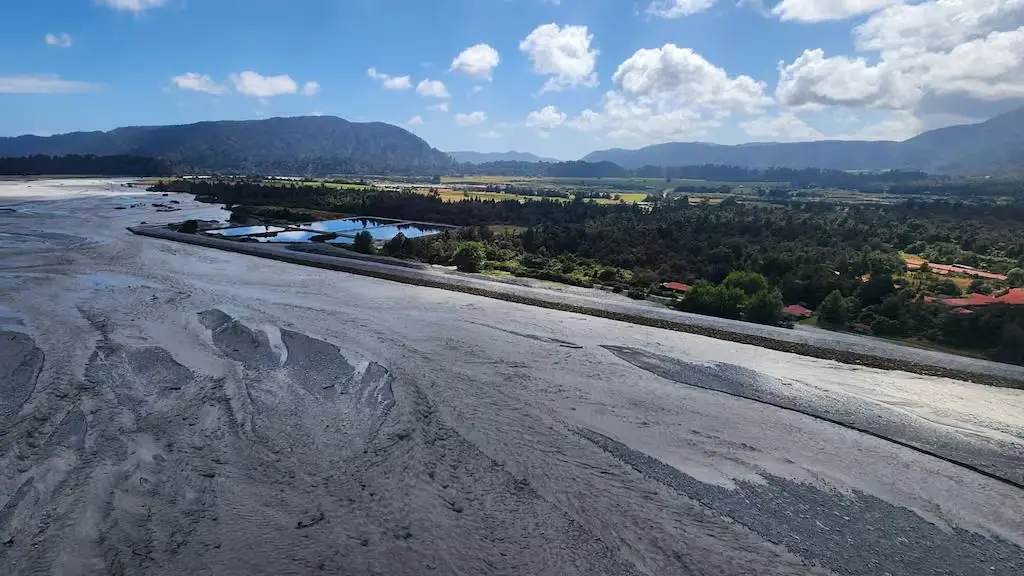
The council is also overseeing major flood protection improvement projects for Greymouth and Hokitika and is working on staged improvements at Franz Josef Glacier to give medium-term security for the tourist town until a decision is made on the future of flood protection on the adjoining Waiho (Waiau) River.
A series of reports presented to the regional council's operations committee recently give a picture of the extent of the work in Greymouth, Franz Josef, Hokitika, and Westport: $65m in total.
Much of the money has been co-funded by the government, with ratepayers in each of the local rating district schemes expected to pay a share through a 60:40 arrangement.

For the combined projects across the four West Coast centres - under way for at least the past three years - the council has so far spent $26.5m from its total budget of $65m, which is co-funded by the government and local ratepayers.
The Westport job includes a ring of major stopbanks, together with an upgraded flood warning system, and a long-term strategy to eventually shift the town to higher ground. Expenditure to date is $6.59m.
At Franz Josef the council is leading numerous stopbank upgrades on both sides of the Waiho (Waiau) River with two stages under way simultaneously: stage 1 is worth $12.3m and the budget for stage 2 is $7.9m. Expenditure for both stages combined is about $13.2m to date.
The council has two projects totalling $12.5m on the books for Hokitika.
A staged stopbank scheme on the Hokitika River began in 2023 while the proposed seawall extension has yet to be fully funded.
So far, the council has spent $4.7m on the stopbanks, and over $800,000 to date, mainly on scoping the seawall.
For Greymouth, an ongoing programme to raise the height of the floodwall - built in 1990 after two floods devastated the CBD in 1988 - is costing $6.6m scheme, with $1.9m spent to date.
WCRC chief executive Darryl Lew said the four projects were "profoundly significant" for the West Coast.
"The flood protection works are vital regional lifelines protecting major local economies, critical infrastructure, and key employers.
"They highlight council's ability to balance essential community protection with long-term climate adaptation and ratepayer affordability."
Regional council chairman Colin Smith said his council had not done a good job of communicating the council's value to communities.
"They (flood protection projects) are really strategic and significant, as you can see in a $60m funding."
He reiterated the importance of the regional council to the West Coast.
"The role the regional council plays is extremely important for our region, and you can see it in terms of the sort of funding and contribution the council makes to the region."
The government plans to abolish regional councils after the 2028 election and create larger unitary councils as part of major reforms.
LDR is local body journalism co-funded by RNZ and NZ on Air