PHOTO
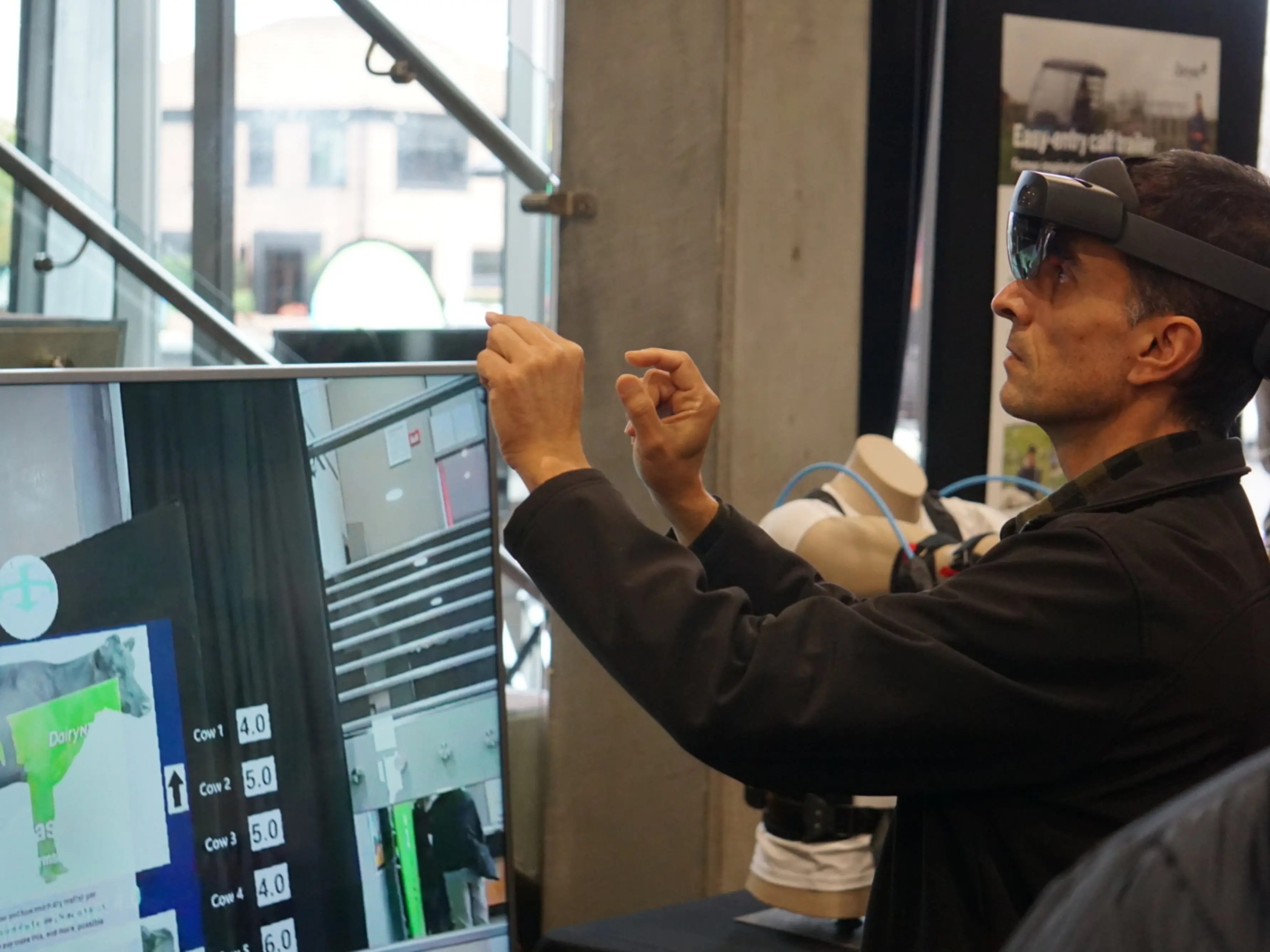
A futuristic scene of dairy farmers carrying out their farm work with augmented reality (AR) glasses isn’t as far-fetched as it might seem.
DairyNZ is working with Lincoln Agritech on a pilot project trialling augmented reality headsets with gesture-based technology on dairy farms.
The glasses were revealed at its Farmers Forum in Ashburton earlier this month.
Farmers were invited to try the headset using their hands to add information to an image of superimposed digital content in front of them against the real backdrop of the conference centre setting.
Senior scientist Dr Callum Eastwood said wearers who put on the goggles could see through the lens to the world in front of them with the technology projecting out information.
"In our case, while you are on a dairy farm you can be doing a particular job with a cow or out in a paddock or with some machinery and the augmented reality goggles can be bringing up information you need while doing that task."
He said the sky was the limit for the technology to provide information.
Trials had looked at its possibilities which were fast evolving as big players such as Facebook and Microsoft developed better hardware and end uses, he said.
"We looked at what the opportunity might be with a 10-year horizon. It’s not something that will be available tomorrow, but it’s getting the innovation started."
Researchers explored case studies including access to grazing information while a farmer was in a paddock and access to training material for body condition scoring of cows.
The third study was accessing information for a tractor such as its many grease points.
Dr Eastwood said the grazing trial used a QR code on a fence post so the person with the headset could bring up information about the paddock such as pasture covers, when it was last grazed, when fertiliser was last applied and a maintenance list.
He said users could input more information by typing notes in or using their voice which went back into the software.
"I think it went pretty well. We imagine in the future the headset would have GPS in it so you know where you are so you wouldn’t have to use the QR approach. ... The feedback we got from farmers trying it is they could see the potential, but you can easily access this information off your phone so it showed us the areas that it would have to get much smoother or you would have to add more value."
The next level would be the headset and camera being able to measure a paddock’s pasture when the wearer was looking at it, he said.
App architecture might be a step making AR more useful, while reducing the goggles to a less clunky sunglasses size would make the proposition more valuable to farmers.
Dr Eastwood said people operated visually in most of their daily lives and being able to use this skill via AR without reading a long manual had potential for farm machinery maintenance or training new workers.
DairyNZ scientists were also working on more ready-to-use projects, including an easy-entry calf trailer.
The trailer had been designed in a partnership with ACC and Kea Trailers to reduce injuries where farmers lifted and carried calves on dairy farms.
Dr Eastwood said the trailer concept used a spring-loaded saloon door so farmers could push calves through a one-way gate.
"That was inspired from ideas we’d seen from farmers and the aim is to overcome some of the difficulties you’d have when you’re out in a paddock, going to pick up a calf and bringing it back to the calf rearing facility. Often farmers will use an all-purpose trailer and opening the gate can be difficult, they get stuck and often farmers are holding a calf while trying to open the gate."
Refinements were made to the design after further tests on autumn-milking farms the past few months and the trailers will go with other ideas to the Innovation Awards at the national Fieldays near Hamilton.
They are close to going on the market.
Other ideas are an easy walk-through pedestrian gate for calf rearing to make it easier to go from one calf pen to another.