
PHOTO
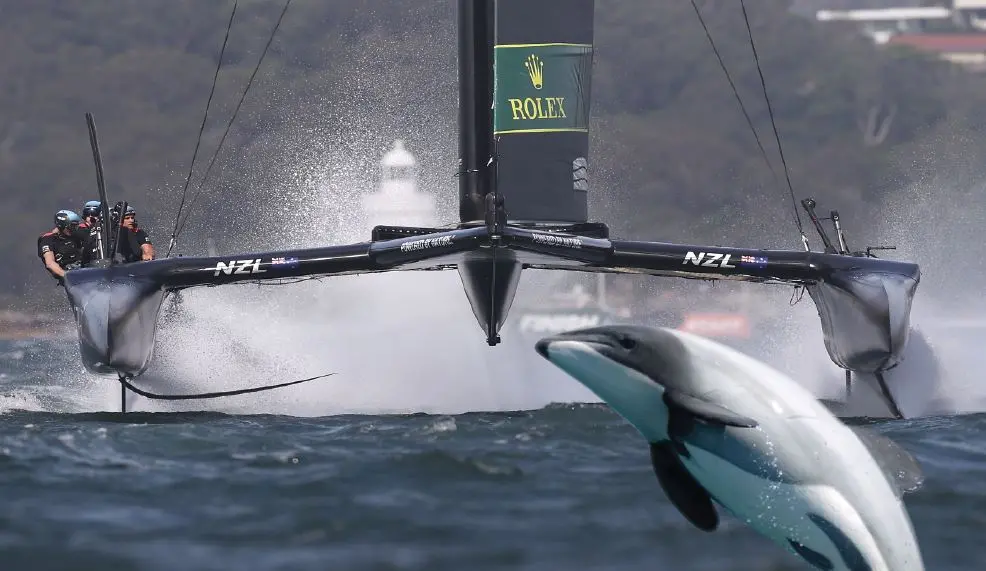
SailGP race organisers will now rely on sighting hector’s dolphins to keep them safe during next month’s racing on Whakaraupō Lyttelton Harbour.
A decision not to use a deterrent device means the mammals will now be free to swim where they like, and racing will be called off if they are seen or heard anywhere near the racecourse and high speed catamarans.
Organisers for the March 18-19 event are employing several detection strategies focusing on four zones in the harbour, stretching from the harbour mouth to the racecourse.
The SailGP Marine Mammal Management Plan states if dolphins are detected in zone four, the nearest zone to the racecourse, the boats will be ordered to stop.
Once racing has stopped, a SailGP spokesperson said the yachts “will simply wait until (the dolphins) leave”.
In zones one or two, dolphins will be reported and tracked. If they are in zone three, racing will be delayed.
SailGP is experienced with the issues and understands the risk, the spokesperson said.
A key detection strategy will include trained dolphin observers and volunteers, stationed along both sides of the harbour and in boats, looking out for dolphins.
Experts say they may locate some of the dolphins but not all of them due to difficulty seeing the mammals at any distance, particularly if the water is choppy.
A second detection measure will see a drone with artificial intelligence criss-cross the harbour.
However, the drone can’t be used when the boats are racing because of broadcast interference. It will scan and photograph the surface before and after the sailing sessions.
Real-time acoustic monitoring, using two AI programmed hydrophones attached to buoys in the harbour, will operate just east of the racing zone. They will monitor continuously for the echo-location of dolphins.

Underwater acoustic expert Dr Matt Pine was consulted on the MMMP and has now been employed to do the listening.
He said the devices can pick up dolphins pinging, or echo-locating, up to a few hundred metres away, depending on how noisy they are.
“We expect in murky waters like Lyttelton Harbour and in busy environments, they will be echo-locating most of the time,” Pine said.
However, dolphin expert Professor Liz Slooten, formerly with the Zoology Department at Otago University, disagreed.
“He (Pine) is wrong,” she said.
“When there is lots of noise it makes more sense for a dolphin to listen using its ears, because sound carries much further than echo-location. The dolphins may simply turn their echo-location off,” she said.
SailGP and ChristchurchNZ will also be relying on spectators and race officials to report dolphin sightings.
We are not relying on any single dolphin detection measure, said race organisers.
Said SailGP head of event and commercial director Karl Budge: “Based on the advice of (the Department of Conservation) and other experts, we maintain full confidence in the efficacy of the plan.”

If an incident were to occur, DOC has jurisdiction.
“We wouldn’t speculate on who might be held responsible if an incident was to occur,” said DOC Mahaanui operations manager Andy Thompson.
Expert considered resigning
A member of the team that came up with a plan to protect hector’s dolphins during SailGP has revealed they wrestled with their conscience and considered resigning from the group.
Many experts and stakeholders were consulted over the Marine Mammal Management Plan, including Te Hapū o Ngāti Wheke Rāpaki, the Department of Conservation, Environment Canterbury and university marine specialists.
One expert has now told The Star they seriously considered opting out, in part because they were required to sign a confidentiality agreement.
The expert said they had a real problem with being gagged, given the plan to hold the event in a dolphin sanctuary was so much in the public interest.
Once it was clear the SailGP event was going ahead, members of the group had to decide whether they were in or out, the expert said.
“Sometimes it is better to stay in so you have some influence, so I stayed in.”
Significant redactions were made to the plan before it was released by ChristchurchNZ in December last year.

An un-redacted version was leaked to The Star last week. It showed SailGP organisers intended to use a controversial acoustic deterrent device to keep dolphins off the racecourse.
Organisers believed the device would “help to protect dolphins from the risk of vessel strike, which is very likely to be fatal”.
However, the device was later dropped when it became clear no one knew how hector’s dolphins might react to it.
Said the expert: “I think the final version of the MMMP is probably not far from the best you can do, if you’ve already made a very bad decision to hold the race in a completely inappropriate place.”
Slooten said there are likely to be up to 30 dolphins in the harbour every day in March.
Many will have calves with them, so they will be slower and reluctant to dive deep.
“Two huge blades silently slicing through the water at 100 km/h; the dolphins will never have experienced anything like this,” she said.
“It’s a similar experience to a remote rainforest civilisation seeing a warplane flying over their village for the first time.”
The F50 catamarans will be practising at high speeds in the day or days preceding the event. The expert said this is where the real danger to dolphins lies, because the MMMP designates ‘free practice’ areas across most of the harbour.
SailGP organisers did not respond to a request by The Star asking what specific measures would be taken to protect dolphins during the practice sessions.
-By Tony Simon