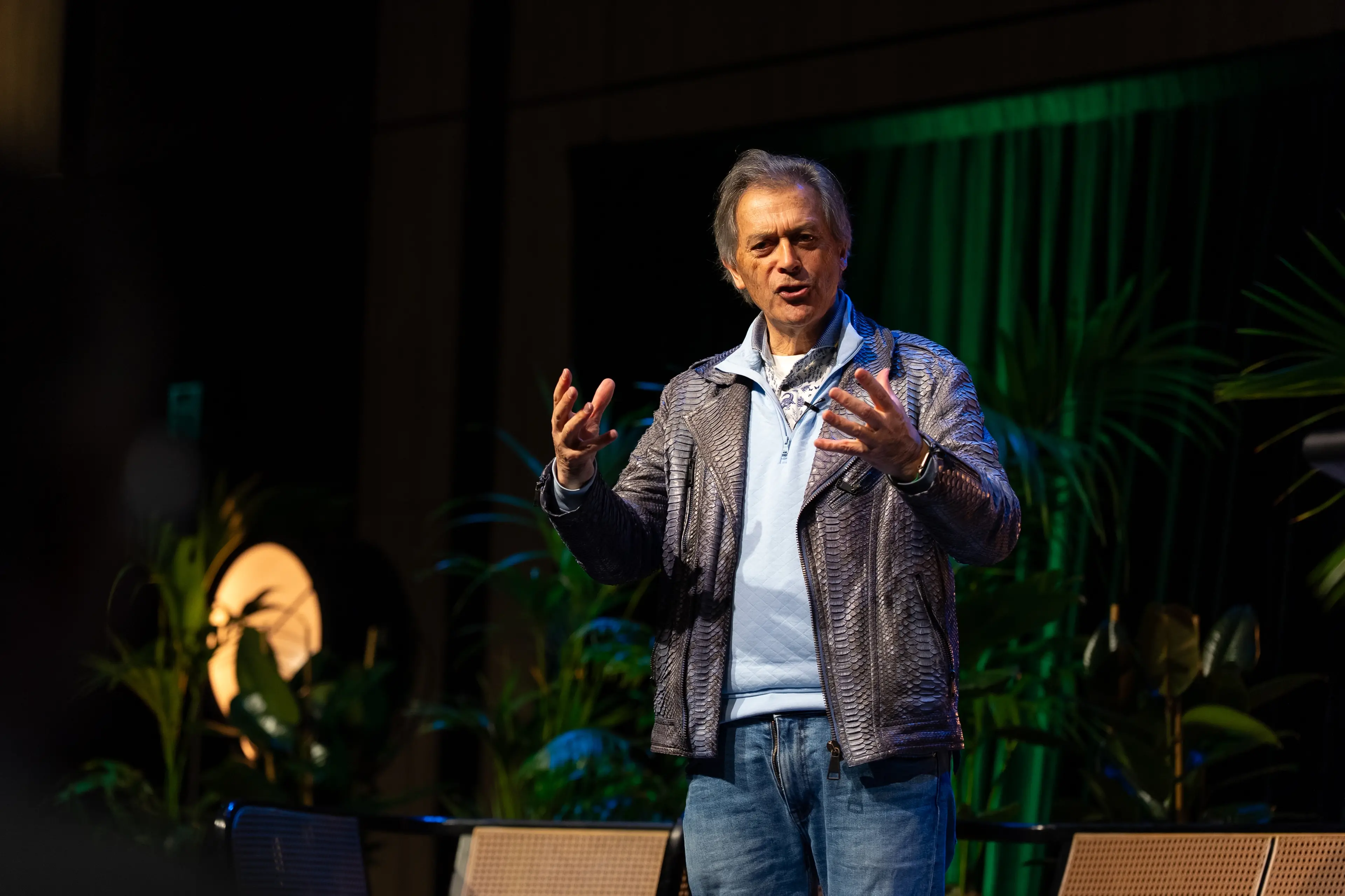
If Sir Ian Taylor had his way AI-inspired online learning would be an everyday part of classrooms for young school children. The Dunedin founder and managing director of Animation Research, and sports graphics pioneer, explains the technology is already here for this to be a reality. His four-year-old grandson, Franco, has written his own AI-generated book. The youngster’s imagination was allowed to run free. Under his directions, a robot with wheels — to go faster — comes from outer-space with the words and illustrations packaged by an AI agent, in English and Te Reo. That answers the “orange cone’’ naysayers, asking for studies to back the change, he said. "At four-and-a-half Franco chose a Māori word for a robot for a Māori translation of his book and what are we doing? We are taking our kids to school to learn structured numeracy and literacy. What if every kid at school could write their own book about things they have done as a class or really interest them and then take them home to read to their parents?’’ Developing an online education programme drawn up by an AI agent has become a passion project for him to inspire children to learn. "I looked at the new curriculum and I thought: this is wrong and this is a backward step so we built an AI agent we called Matauranga — Māori for indigenous knowledge — and into it we put the entire new curriculum and all the best pedagogies and asked him a very simple question: Does it get our kids to the future.’’ The answer was succinct “no”, but left the door ajar enough when the AI tool elaborated “not with equity and not yet”. So a Navigator’s Toolkit was built to value teachers’ time after seeing the pressure on them in the classroom. The focus was shifted from structured literacy and numeracy to inspiring curiosity. As for the AI concern about equity, Sir Ian has made the downloadable videos free for every school in NZ and the Pacific Islands. A financial literacy unit — among many units under Matauranga instructions - brings in art, music, social and history removed from the curriculum. A time machine takes children through the history of money without assuming they can read or be bothered reading. The same video which would have cost $500,000 and six months to make a year ago was written on a laptop on a kitchen table one Saturday afternoon. Other videos go back to the economic centre of NZ in 1280 or a virtual Globe Theatre to listen to William Shakespeare. A host takes the English playwright and poet back to NZ to hear Māori storytellers in Te Reo. Sir Ian said the online videos embraced local stories and made Shakespeare relevant. They were designed to encourage children to ask better questions and look ahead to what the future might look like, he said. "Now that machines can answer almost any question, shouldn’t our biggest question be — what should we be teaching at schools? Do we need to read? Probably yes, but do we need to read for the same reason? Probably not. There are a whole lot of questions not being asked.’’ Sir Ian took his education vision and company progression to 800 growers and industry people at the Horticulture NZ conference in Wellington this week. The tech entrepreneur started Taylormade Media in 1989 as a television production company. A year later he began Animation Research, turning it into a computer animation company recognised globally for its sports graphics. More lately, AI has transformed the way graphics look for sporting events ranging from the America’s Cup and the PGA tour to Formula One. Sir Ian said Apple co-founder Steve Jobs had once hoped he could see an interactive tool be developed in his lifetime to ask Aristotle questions on a computer. That day had arrived. "Artificial Intelligence, or I call in ancestral intelligence, is the biggest game changer that I have seen in my history.’’ Over his lifetime, he had seen the first light bulb in the family home, the arrival of television, computers and the world wide web, but none of them matched AI. Sir Ian said the one area Mr Jobs underestimated was the pace or breadth of the future Aristotle. The most advanced AI consumed eight trillion words in a single month of training. If a human did nothing but read 24 hours a day for their entire life they would consume eight billion words. The record for a human solving 43 quintillion options to unlock a Rubik's Cube is 2.76 seconds, yet a robot can do this now in 0.103 seconds. Sir Ian said it was clear AI would change every industry on the planet. The lightbulb moment for Animation Research can be traced to four Otago of University students returning in 1989 after becoming the first non-Americans to win the World Computer Programming Championships. After starting a television company in his hometown, taking over the TVNZ studios, it occurred to him computer graphics were going to be the future. Knowing nothing about it, he popped down to talk to Professor Geoff Wyvill, who showed him the computer graphics lab and the power of digital technology. An observation that digital data would be the currency of the future was taken to heart. For the 1992 America’s Cup they found organisers had two bits of data from the back of the boat, an X and Y coordinate. Computer programmers wrote the code in a computer costing $500,000 and the size of a small fridge in Silicon Valley to change the world of sports coverage. By the next America’s Cup the two coordinates were sold to a French telecommunication company for €12 million ($NZ23.5 million). OTAGO DAILY TIMESFrom the beginning Sir Ian Taylor always wanted to run his business in Dunedin. Photo: Gregor Richardson Those computer programmers are still with the company. A call out of the blue from United Airlines prompted another graphics direction in television advertising. To build the commercial they had to buy the biggest hard drive in the country capable of holding one gigabyte of data and costing $15,000 in 1992. More award-winning commercials followed that decade until they saw their work was being commoditised, soon performed by “guys in the garage’’. Graphics and animation work was diversified, ranging from an early online insurance assessment tool, air traffic control simulators, televised documentaries, whale-watch attractions, the Christchurch rebuild to a tour for numeracy and literacy teaching in prisons. SuppliedThe Animation Research team produce live golf coverage of the TPC Players Championship in Florida from their remote studio in Dunedin in 2022. Photo: Supplied When Covid-19 arrived sports tournaments were cancelled, income went to zero and teams around the world were recalled to be put on paid leave to Christmas. In lockdown, teams worked from home and six weeks later covered the first tournament for the US PGA tour in Texas more than 14,000km away. Once considered too risky by clients, providing graphics remotely from the studio has become the norm. Sir Ian’s son, Ben, is now chief executive of the company and a year ago put more eggs into the sports coverage basket. Today, the graphics teams covers Formula One, 3500 games of major league baseball and 800 days of golf a year. Sir Ian said the expanded vision was to take on new technology, including AI, to turn digital data into visuals people would pay for. Where once graphics appeared exclusively on television screens, they are available on cell phones, tablets and many other platforms. Sports fans can see any shot from any player on any hole, any time they want, with these graphics viewed around the world by millions of people. A PGA tournament with 140 cameras across the golf course results in 10,000 shots tracked a day automatically. Sir Ian said his son was watching this in a truck and called on an AI assistant to write the code, loading thousands of shots into an interface, taking in ball and club speeds and angles, carrying distance, spin rate and all the data. "We have used it ever since and there is the winner. We didn’t even ask about the wind, but it saw the wind data and the impact on every hole to allow us to tell a story.’’ The software began predicting where the ball would land for the first time and three months later a fourth Emmy was won for technical excellence. There was no planning for this, only the insight to see it coming and a desire to be first. Sir Ian confided to growers that in 37 years of business he has never written a business plan. Rather, the culture of the company comes from his Māori heritage and sitting around the table with his mother and aunties. Being open to the footsteps ahead of him and respecting the past has been combined with trusting the team and technology to take on new directions. As was the fad of the day by corporates, he once decided to have an in-house competition to come up with a mission statement. The secretary won with the offering: ‘Bugger the boxing, pour the concrete anyway’. Sir Ian said that was the perfect description of Animation Research’s direction of choice. Horticulture NZ paid for flights and accommodation to the conference.