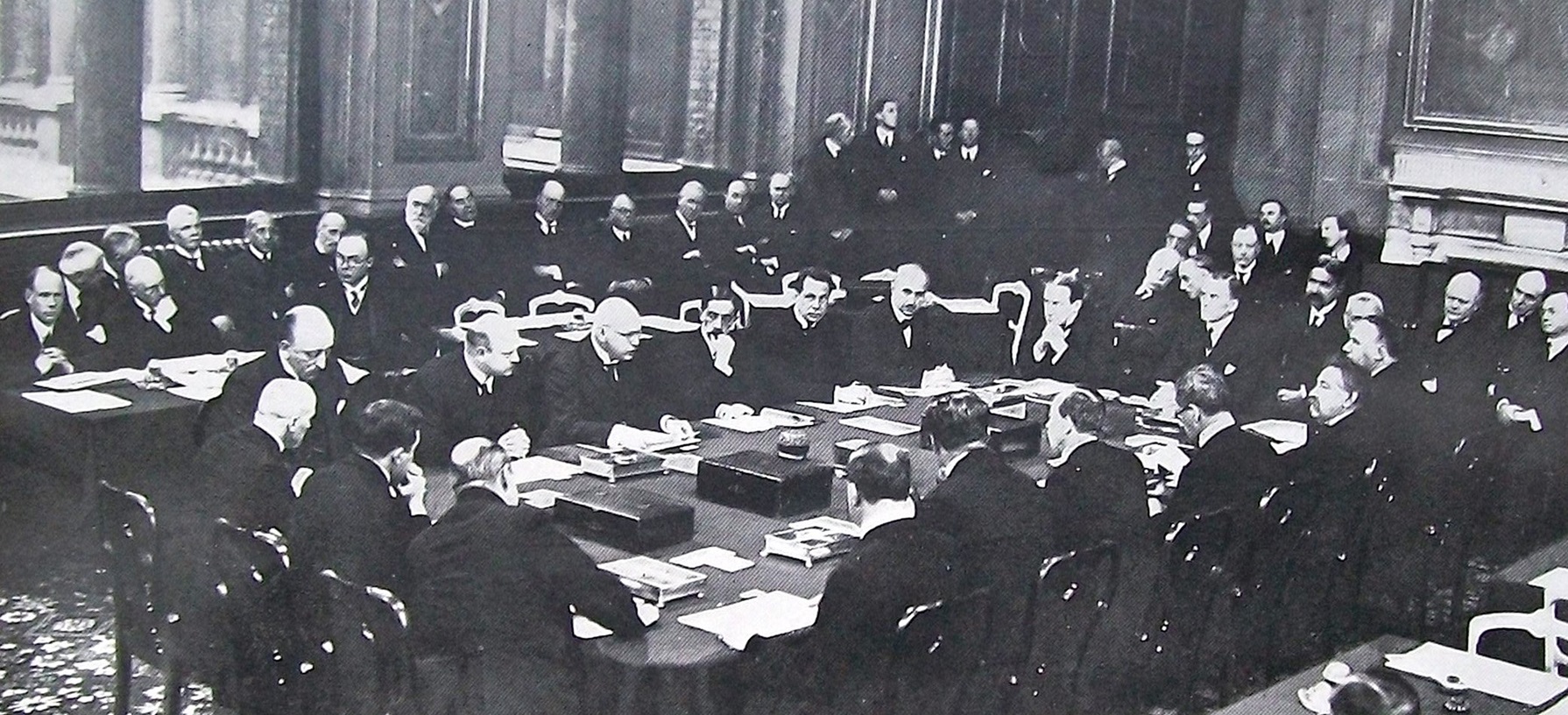
Plenipotentiaries from the countries of Europe sign the Locarno Treaty in the Gold Room at the Foreign Office, London on December 1, 1925 (clockwise from top right of table) British prime minister Stanley Baldwin, foreign secretary Sir Austen Chamberlain, Sir Cecil Hurst, Mr Lampson, French premier Aristide Briand, French secretary-general of the foreign office Philippe Berthelot, Czech foreign minister Dr Eduard Benes, Polish premier Count Aleksander Skrzynski, delegate Prezazieik, Belgian foreign minister Emile Vandervelde, delegate Rolin, German delegates Franz Kempner, Carl von Schubert, German foreign minister Gustav Stresemann, German prime minister Dr Hans Luther, Italian delegates Marquis Medici and Pilatti and Italian plenipotentiary Vittorio Scialoja. — Otago Witness, 19.1.1926
London, December 1: The Locarno Pact was signed to-day with almost whispered benedictions and felicitations. There is no denying the solemnity of the occasion. Indeed, there was a strange restraint on all present, as if they were overawed by the momentous achievement. Even the glamour of the famous gilded room in the Foreign Office, alternately illuminated by a sickly December sun or the blaze of six huge floodlights, under which the kinematographers worked, failed to thaw the strict official atmosphere. A large crowd, flanked by a battery of photographers, gathered in Downing street to witness the arrival of the delegates to sign "The Treaty of Mutual Guarantee," which is the official title of the Locarno Pact. There was a rush when the German delegates arrived, and some raising of hats, but no other demonstration. The diplomatic representatives of the signatory Powers, the British Ambassadors to Paris, Berlin, and Brussels, members of the Cabinet, and the High Commissioners for the dominions were accorded seats at the ceremony. There was only one speech in English. This was Mr Baldwin’s at the close of the ceremony. The rest were in French, with the exception of the Germans, who both spoke in their high-pitched mother tongue; but all spoke as if in conversation across the table. The only touch of vigour was supplied by Monsieur Briand, who, speaking direct to Dr Luther and Dr Stresemann, pictured the spectre of France’s sacrifices, and breathed the fervent hope that Locarno would render its repetition of them impossible, and Dr Stresemann’s equally lofty assent to the new spirit of world concord. Besides the Treaty of Locarno, signatures were also affixed to the arbitration treaties and conventions, which were initialled at Locarno. Punctually at 11 o’clock an official clapped his hands, and the lights were turned on and the cameras began to whirr. Sir Austen Chamberlain read in French a message from the King regretting that his sad loss prevented him from celebrating the occasion as he could have wished to do, but saying that it was his "dearest hope that the great work of appeasement and reconciliation will provide the foundation for sincere friendship among the several nations."
Coates hails treaty
Speaking at the dinner of the Canterbury Industrial Association, the Prime Minister said the signing of the Treaty of Mutual Guarantee should bring to all the greatest happiness, because they found the nations of Europe — those which had been so lately at war with each other — guaranteeing each other’s peace. It would tend to bring solidarity to the world, and it was particularly pleasing to notice that the leading hand in bringing this about was that of an Englishman, Sir Austen Chamberlain. He trusted that the Pact would bring peace to Europe, and that armaments could be reduced, thus paving the way to world peace. — ODT, 3.12.1925
Compiled by Peter Dowden