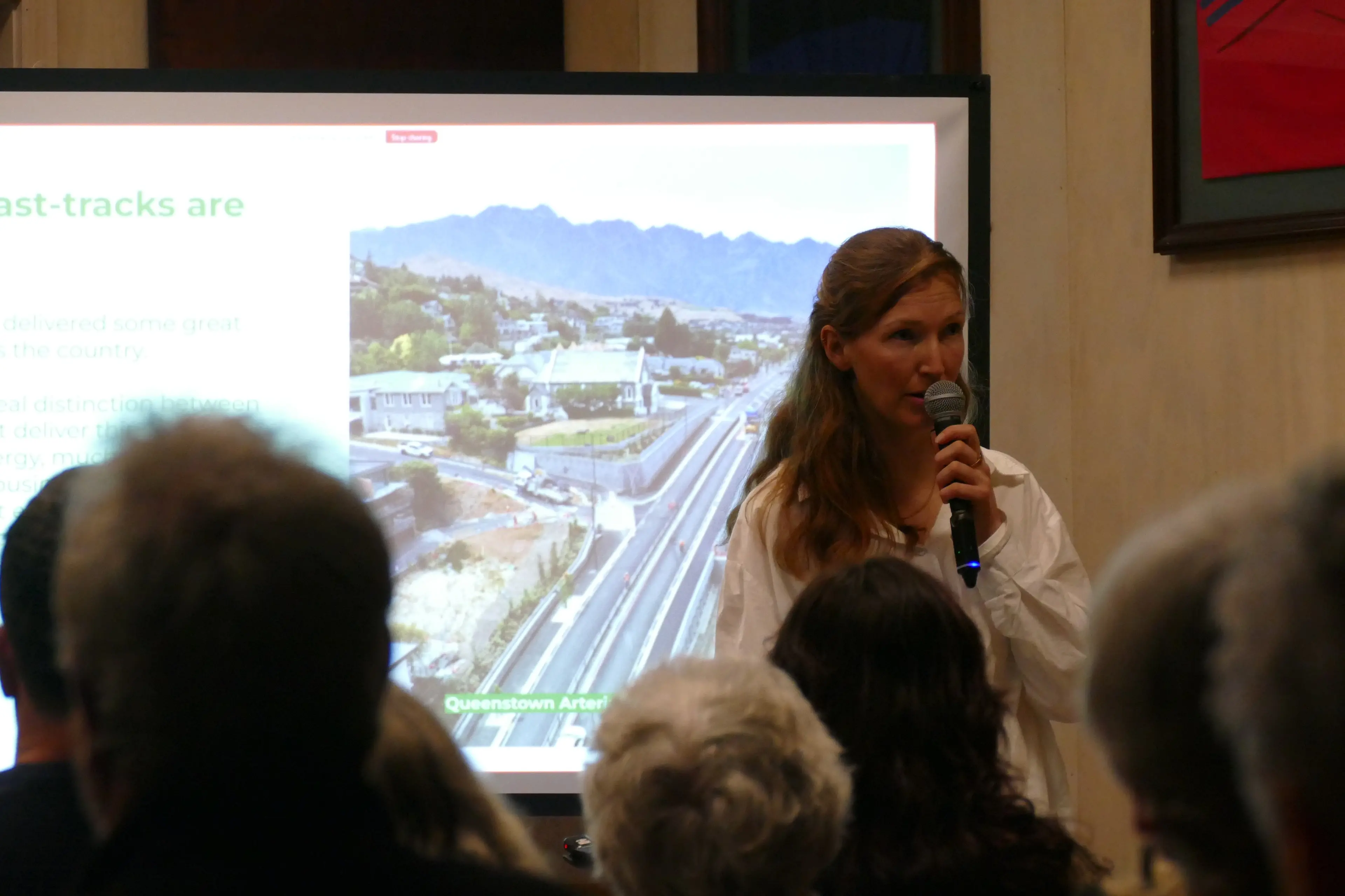
A controversial 1250-house development near Arrowtown will be a “folly of history”, a community group set up to address the fast-track proposal has said. The Ridgeburn project, mooted by prolific developer Kurt Gibbons, envisages a 1250-house development at Arrow Junction, with a 200-odd unit visitor accommodation complex, about 6km outside the community’s agreed plan for growth near Arrowtown. It has been promoted as a way of addressing the district’s housing crisis. But after fears about traffic jams and unrealised infrastructure were raised, it was officially withdrawn on July 22 when the applicant said it would engage with concerned parties and their experts “with a view to addressing outstanding issues, narrowing areas of disagreement, and, where possible, identifying common ground”. Still, it was standing room only in the Arrowtown Community Centre on Tuesday night as representatives from the volunteer Queenstown Strategic Growth Initiative (QSGI) addressed their concerns with the latest iteration of the project, and what it could mean for the future of the district. QSGI spokeswoman Hanna Pettit said Ridgeburn would be “a folly of history”. “Every decision made here … on traffic, infrastructure, the shape of this town, will outlast the people that approve it. “It will be a permanent change to the [Wakatipu] Basin, and the next generation will have to live with the consequences, whether it works or not. “So I think this is our chance to stop it while we can.” Ms Pettit said, based on calculations of a “standard household”, it would result in about 3200 people living at Ridgeburn — Arrowtown, by comparison, was home to only about 2800. She said the development was claiming to bring in 180 affordable homes, some of which were proposed to be just 35sq m. It appeared a portion of the affordable homes will be rented for a decade, after which they could be resold at prices indexed at the market growth, she said. Over the past decade, there had been a 174% increase in property value in the area, meaning if Ridgeburn was able to offer a house at $599,000, as stated, in 10 years’ time it would cost $1.14 million. Ms Pettit said the average lot size at Ridgeburn was 35% smaller than Hanley’s Farm and the only parking appeared to be a driveway. On traffic, modelling indicated an extra 825 vehicles would enter State Highway 6 during peak morning travel times, equating to about one vehicle every five seconds. “It’s a town in the middle of nowhere,” Pettit says. “It’s just irresponsibly proposed in the wrong place, and it’s really got no reason to be in Arrow Junction, other than the fact the land’s for sale.” While Ridgeburn was the most pressing issue for the volunteer group, which is assembling a team of independent experts to ensure they are ready to provide comment to the panel when required, Ms Pettit said it was just one of many proposed developments the community should be worried about. She said the Queenstown Lakes District Council had the highest number of live fast-track applications per ratepayer in the country — four times Auckland’s load. “But the challenges that we have with Queenstown is that our growth has limits. “We live in a basin, we have mountains, we cannot sprawl like … Auckland, and we can’t build roads to absorb that growth. “Once it’s gone, it’s gone.” She contended the resort town’s economy was a regional and national asset, and Ridgeburn was putting it at risk. “We rely on the [expert] panel to put the worth of our tourism industry ahead of something like Ridgeburn, but the problem is, if they don’t, then we can never get back what’s lost.” The volunteer group was also concerned if Ridgeburn got through, the precedent would be set and all other applications — at the moment, there were 11 in the Wakatipu — “have no reason not to be approved”. “So, we’re basically giving the keys to any developer who has access to rural land on the fringes of Queenstown, Wānaka, Cromwell, to bypass the local council planning and put developments [in] that are outside the spatial plans.” That would result in uncoordinated growth, scattered across “the most significant landscapes in New Zealand”, with inefficient infrastructure, no schools, degraded environment and “long-term damage to our tourism economy that underpins it all”, she said. Mr Gibbons has been approached for comment. tracey.roxburgh@odt.co.nz